

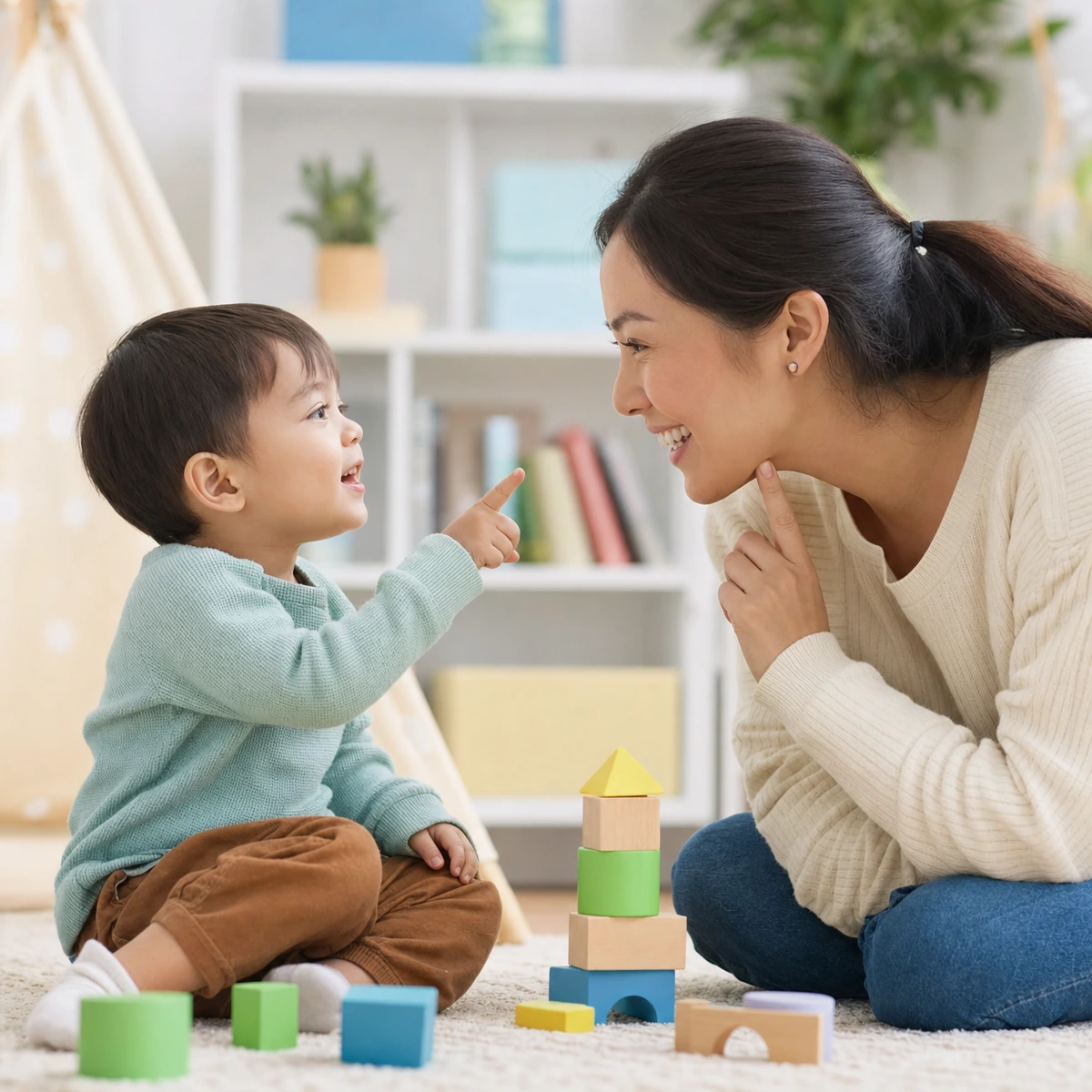
Children learn language rapidly during their first several years, and the second year is no exception. Two-year-olds begin using more words to communicate what they want and how they feel. They can also understand more of what people say to them, comprehend and even begin answering more questions, participate in seated play activities, and interact more with their peers.
Here are the milestones you can expect from your 2-year-old during this crucial stage of development.
Receptive language skills during the second year
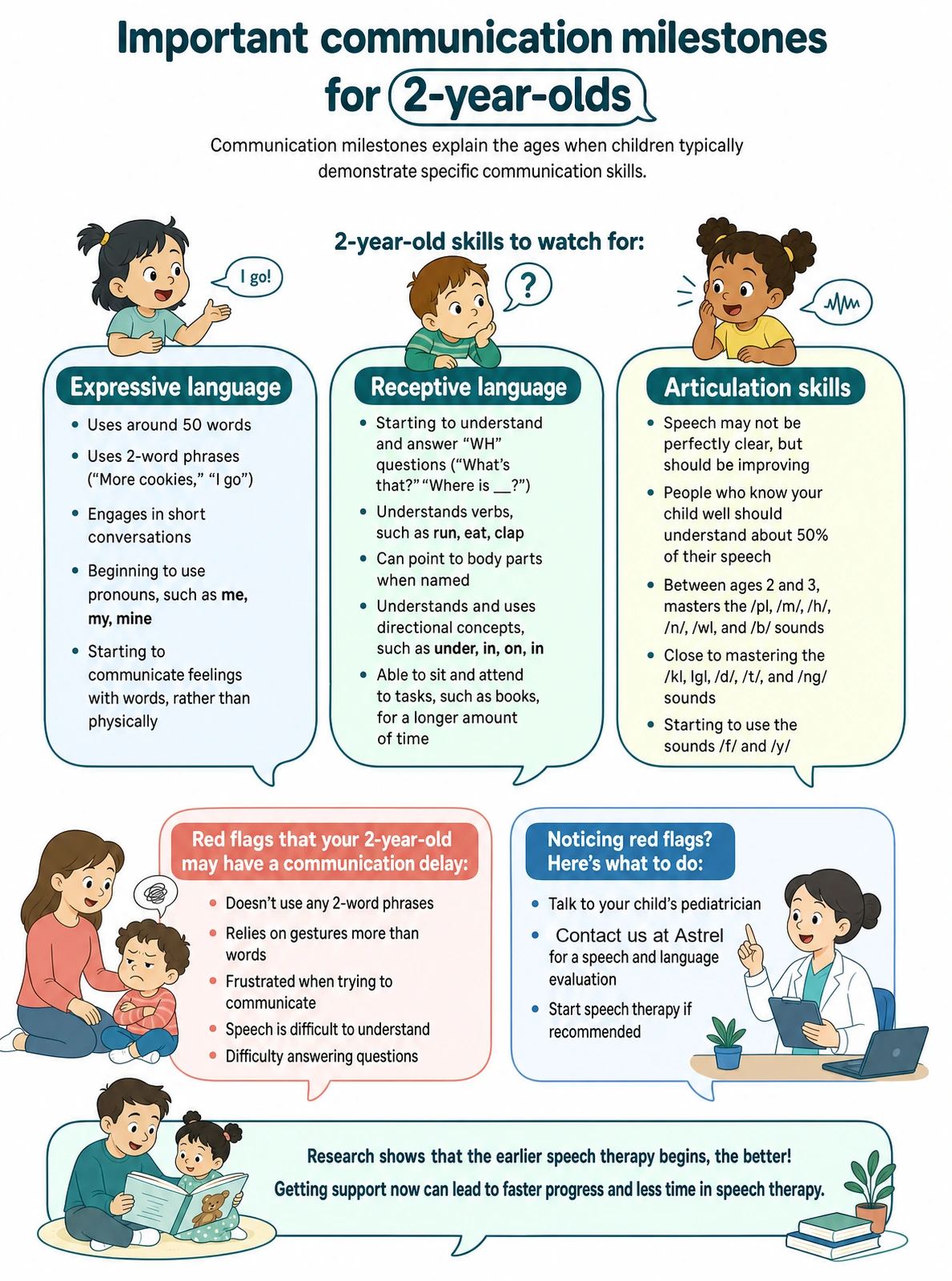
Receptive language is the ability to attend to, process, and understand language. It is one of the most important building blocks for a child’s social and academic development. During your child’s second year, you should begin to notice the following skills:
- Beginning to answer some “WH-” questions. Your child should start understanding and responding to questions that begin with who, what, when, where, and why. Examples include “What’s that?” “Who is __?” and “Where is __?” They should also be able to point to an object based on its description, such as when asked, “What do you wear on your feet?”
- Pointing to body parts when someone names them
- Understanding and using directional concepts such as under, in, on, in
- Starting to understand differences in size, including big, large, small, little
- Understanding “yours” and “mine,” along with turn takingthrough phrases such as “my turn” and “your turn”
- Understanding action words such as jump, run, throw
- Listening to books and stories for longer periods and pointing to objects that interest them while someone reads
Free 30-minute evaluation
Looking for a speech therapist?
Talk through what you are noticing and get clear next steps.
Book free evaluation
Expressive language skills during the second year
Expressive language is how we use sounds and words to communicate our wants and needs. At 24 months, we expect a child to communicate primarily with words. During year 2, you should begin to notice your child doing the following:
- Using two-word phrases around 24 months
- Taking part in short conversations
- Beginning to use pronounssuch as me, my, mine
- Beginning to express feelings and emotions with words rather than through physical behavior
- Having a spoken vocabulary of about 50 words
- Possibly attempting to answer simple questions
- Making requests verbally
Other important milestones for 2-year-olds
In addition to speech and language, children generally develop many other important skills between the ages of 24 and 36 months.
For example, a child’s play skills commonly expand during this period. Play activities become more complex as children begin engaging in pretend play and using toys for their intended purposes. You may see your toddler playing house, talking on a pretend telephone, or having conversations with their dolls.
Pretend play helps your child build language and social skills.
Toddlers are still learning to communicate through language. When you join your child in simple pretend play, you help them expand these foundational language and social skills. Joint attention happens when the two of you share an experience, such as playing kitchen. It also supports abilities such as paying attention, which is crucial in an academic setting.
Your toddler will also begin parallel play. This means playing around and near other children without joining them in a shared game just yet. Shared play typically comes around ages 3 to 4 years old.
At age 2, children should also be exploring most foods and textures. They should feed themselves independently with a fork or spoon and use a pincer grasp, which means holding an object between the thumb and first finger. They should begin drinking from an open cup or straw and stop using a bottle and pacifier. Toddlers may have a strong preference for macaroni and cheese, but 2-year-olds will also try new foods. After a few attempts, they may accept those foods as part of their diet.
What should a 2-year-old’s speech sound like?
Every child is different, but this general guideline can help: By 24 months, familiar listeners, including family members, should be able to understand about 50% of your child’s speech.
Your child should also be learning new speech sounds during this period. Between the ages of 2 and 3, children are expected to have mastered the /p/, /m/, /h/, /n/, /w/, and /b/ sounds. They should be close to mastering /k/, /g/, /d/, /t/, and /ng/, and they should have started using /f/ and /y/.
You may still hear your child say “nana” instead of “banana,” or “ca” instead of “cat,” leaving off the final sound. However, these speech errors should resolve by the time a child turns 3. If you do not hear improvement as your child approaches 3 years old, it may be time to consult a speech therapist. We discuss this in more detail below.
Related guides




How can you tell if your 2-year-old needs speech therapy?
Some toddlers need extra help developing speech and language. Language abilities build on one another over time, much like the rungs of a ladder. When children miss important early communication milestones, they are often at risk of falling behind.
The earlier you intervene, the more likely children are to reach their communication goals. Watch for the following signs:
- At 24 months, consider whether your child’s language seems limited. Are they using at least 50 words? They should also begin combining words into two-word phrases. Pay close attention to how easily you can understand your child’s language and whether they appear to be regressing in their development.
- By the time your child turns 36 months, notice whether their language is limited to single-syllable words without final consonants. Other concerns include using few or no multi-word phrases, being unable to ask common “WH-” questions such as what and where, or having speech that is difficult to understand. These may be signs of a speech delay. It may also be cause for concern if your child has frequent tantrums or other behavioral difficulties because they cannot communicate effectively, or if they have echolalia , which means repeating or parroting speech without trying to communicate.
Don’t take a “wait and see” approach
If your child is not meeting age-appropriate milestones or does not seem to talk as much as other toddlers, do not panic. What matters is speaking with your pediatrician and a qualified speech therapist. You can click here to get matched with an Astrel speech therapist who has experience working with toddlers.
Because age 2 is such a critical year for learning, children need the right support to express themselves and fully communicate their wants and needs.
Although you may be tempted to take a “wait and see” approach, research shows that early intervention benefits children socially and academically as they grow older. Addressing speech or language delays early can reduce frustration for both you and your child while helping them learn more effectively and participate in the world around them.