


If you have an 18-month-old at home, you may wonder how many words your toddler should be saying. If your 18-month-old uses only a few words, or is not talking much at all, is that considered “normal”?
The first three years of a child’s life bring tremendous growth and development. Once toddlers begin talking, the number of words they use typically rises quickly. Here, we’ll look at how many words an 18-month-old should say and how they should use those words. You’ll also learn how to support your child’s speech at home and when to consider speech therapy for your toddler.
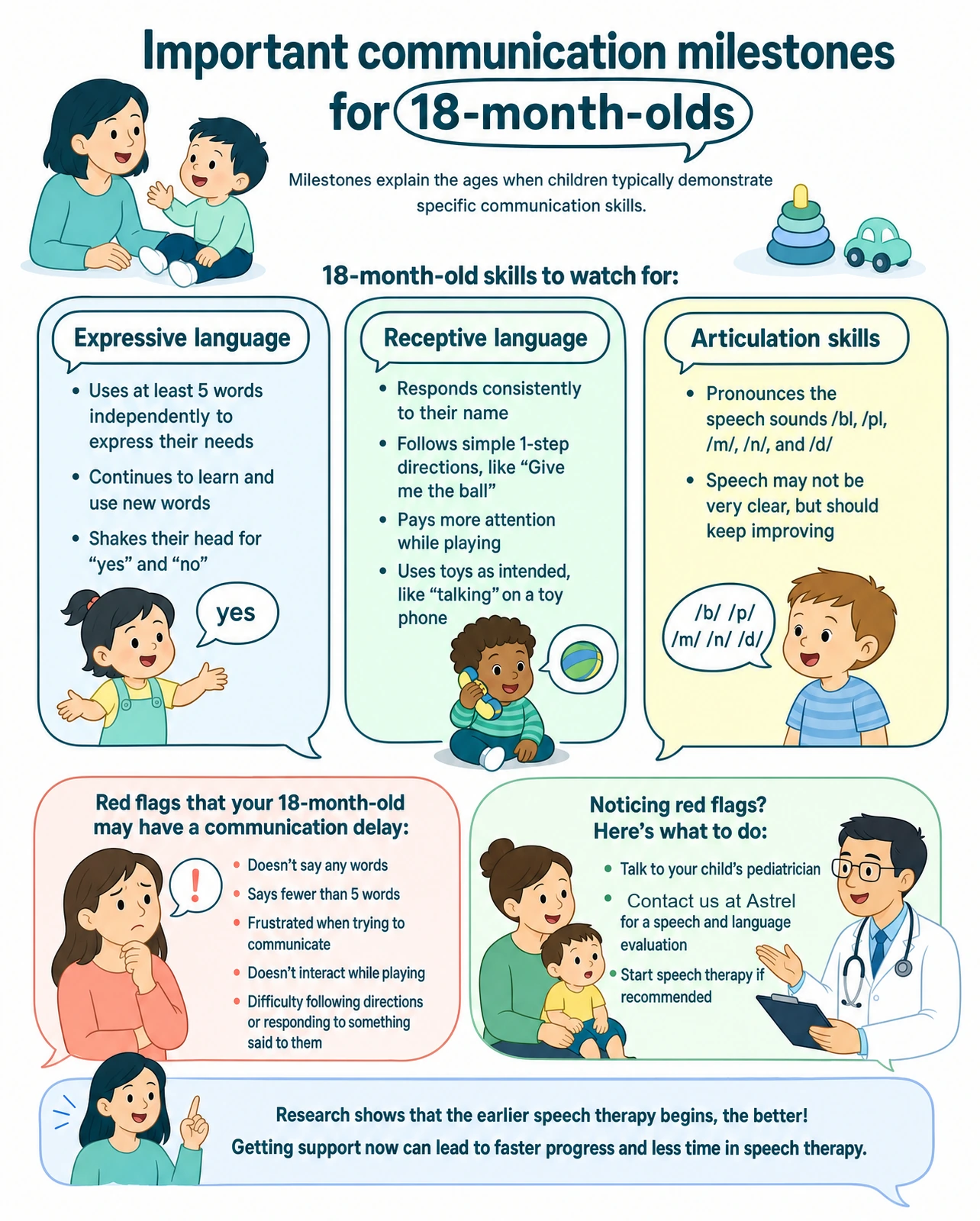
Speech milestones for 18-month-olds
Every child develops communication skills at their own pace, but it is still important to understand the speech and language milestones expected at different ages.
When do toddlers begin talking? Children typically say their first word at around 12 months old, although it may happen a little earlier or later. By 18 months, you definitely want to have heard your child’s first word. CDC guidelines state that by age 18 months, children typically try to say at least three words other than “mama” or “dada.”
Children typically say their first word at around 12 months old.
Remember that by age 24-30 months, we want toddlers to have at least 50 words in their expressive vocabularies. As they grow, the number of words they can say should increase steadily.
Babies and toddlers typically begin talking by labeling people and objects, meaning they say their names. As they use more words more often, you’ll begin to hear those words serve different purposes. Your child will also start saying words independently instead of simply copying you. Here is more of what to expect from your 18-month-old’s speech.
Free 30-minute evaluation
Looking for a speech therapist?
Talk through what you are noticing and get clear next steps.
Book free evaluation
What should your 18-month-old’s speech sound like?
Children first learn to imitate the sounds and words they hear you say, then begin producing them independently. Toddlers should still repeat new words, but they should also start saying some words spontaneously.
For example, an 18-month-old should be able to say something like “milk!” when thirsty or “ball!” when they want to play. These are functional words, meaning words used for a particular purpose, such as asking for something. When toddlers communicate this way, they are beginning to understand that communication can help them get what they want.
Your toddler should also begin using different consonant sounds in words or babbles. The earliest developing sounds include /b/, /p/, /m/, /n/, and /d/. Children who are 18 months old should be able to produce most of these consonants on their own. Learning new sounds will help them pronounce new words more clearly.
How to help your toddler learn to talk
If you want a few simple ways to help your child at home, try these 3 tips.
1. Model language for your child
One of the simplest and most effective ways to support your child is to model, or demonstrate, language. The approach is straightforward: Just talk to your child often, even when they do not respond. Children learn a great deal from the people they spend the most time with. By watching and listening to you, your child can learn words, understand what those words mean, and hear how to pronounce them.
2. Encourage your child to imitate you
Imitation skills are important to a child’s speech and language development. If your child is not copying sounds yet, practice animal noises or the sounds made by trains and cars. These sounds are often fun and motivating for toddlers to imitate.
Once your child begins copying these sounds, move on to speech sounds such as vowels and consonants. Try simple babbles like “ma-ma.” As your child becomes more comfortable with these sounds, you can begin practicing the imitation of simple words.
If you have tried these activities and your child is still having difficulty with verbal imitation, practice gesture imitation. Children need to learn how to copy gestures and movements before moving on to speech. Start with simple actions such as waving, blowing kisses, and clapping hands.
3. Play with your toddler every day
Another simple way to support speech is to play with your child every day. Play supports communication skills. The more you play together, the more opportunities your child has to communicate about what is happening, what they see, or what they enjoy. Play may not always seem important to adults, but it is how young children learn and grow. Make time to sit on the floor and interact with your child. You can build their language skills while having fun together.
How can you tell if your toddler needs speech therapy?
If your child is 18 months old and is not developing the skills discussed in this article, contact a speech therapist. The therapist can evaluate your child and determine whether speech therapy could benefit them.
Having an evaluation does not obligate you to begin speech therapy. You can meet the speech therapist, listen to their feedback, ask questions, and then decide what to do next. The therapist will provide a formal recommendation.
If a child has a speech or language delay, starting speech therapy earlier means they can begin making progress sooner.
Keep in mind that when a child has a speech or language delay, receiving intervention earlier allows them to begin making progress sooner. Language development builds one skill at a time, much like climbing a staircase. Each step must come before the next. If a child does not develop the skills that come next for them, they will not be able to reach the skills that follow. That is why a “wait and see” approach is not always a good idea when considering speech therapy.
Related guides






How to find a speech therapist for your toddler
Begin by talking with your child’s pediatrician. They will likely be able to recommend speech therapists and can write a prescription for speech therapy if one is needed.
If you want to explore using health insurance to cover speech therapy, call your insurance company. A representative can explain the process and suggest speech therapists who are in your plan’s network.
You can also contact speech therapists or speech therapy practices directly. They can explain the steps required to schedule an evaluation and begin therapy.
What does speech therapy look like for an 18-month-old?
Speech therapy for toddlers focuses on using play to work toward therapy goals. Following the evaluation, the speech therapist will create a treatment plan with goals specific to your child. These goals may include imitating sounds or words or independently using a wider variety of gestures or words.
Whatever your child’s goals, the speech therapist will use play routines to motivate them to complete therapy tasks. Sessions often include music, games, fun toys, and activities such as bubbles or crafts to help young children stay interested and engaged throughout therapy.
Your speech therapist will monitor your child’s progress and offer guidance and ideas for practicing at home. Home practice is essential for helping your child continue learning and move closer to their goals. It may even help them “graduate” from speech therapy sooner. Work with your speech therapist to identify exactly how you can support your child. With both of you working together, your child can continue strengthening their ability to communicate and connect with others.