

If your 1-year-old isn’t talking yet, you’re not alone. By 12 months, most babies say “mama,” “dada,” or another first word. But about 10-20% of toddlers are considered “late talkers.” Many catch up on their own, while some do not, and no test at age 1 can predict which group your child will fall into. That’s why doctors and speech-language pathologists recommend monitoring your child’s speech and scheduling an evaluation if you’re concerned. Waiting rarely helps, but taking action early almost always does.
Here’s a closer look at typical milestones for 12- to 24-month-olds, what early speech delays may mean, and what you can do if your 1-year-old isn’t talking yet.
Key takeaways
- Speech and language develop at different rates among 1-year-olds. A child who isn’t saying many words may still be developing typically.
- A speech delay by itself does not mean a child is autistic. Early signs of autism at 12 months may include limited babbling, fewer gestures, or not responding to their name.
- You can support your child’s communication at home by playing together, encouraging imitation, and modeling language.
- If you’re concerned about your child’s communication, a pediatrician or speech therapist can help identify appropriate next steps and provide early support.
Free 30-minute evaluation
Looking for a speech therapist?
Talk through what you are noticing and get clear next steps.
Book free evaluation
Why isn’t my 18-month-old talking?
Toddlers reach speech milestones at different times, so your child may simply be developing at their own pace. About 10-20% of toddlers are considered “late talkers,” and many eventually catch up on their own.
However, an 18-month-old may not be talking for other reasons, including a hearing problem, an expressive language delay, difficulty moving their mouth correctly for speech, or early signs of autism. This is why it’s important to monitor your child’s communication and speak with your pediatrician if you have concerns. Early speech therapy or other support can make a huge difference.
Pay attention to what your child is doing as well. Are they babbling, pointing, making eye contact, or understanding simple words? These behaviors show that your child is building communication skills, even if spoken words haven’t emerged yet.
My 1-year-old isn’t talking but is babbling. What does that mean?
If your 1-year-old isn’t talking yet but is babbling, that is a very encouraging sign. Babbling is one of the earliest foundations of speech. It shows that your child is learning how sounds work well before true words appear.
Why babbling is a positive sign
Babies typically begin babbling around 4 to 6 months, and those babbles become more complex over time. Speech-language pathologist and mom of two Adhvika Shettysays, “When your baby babbles, it means their brain and mouth are practicing the skills needed for speech!” Each “ma,” “ba,” and squeal is another step toward words.
By around 10 months, many babies begin using “conversational babbling.” Their sounds start to resemble the tone and rhythm of adult conversation. They may pause, shift their pitch, or “talk” as though they expect an answer. This is an important step toward talking.
Typical development and signs to watch more closely
If your 1-year-old babbles, makes eye contact, points, and responds to you, those are strong signs that their communication is developing on track, even if they aren’t using actual words yet, Shetty says. Many toddlers move from babbling to their first words at around 12 months, although this may happen slightly earlier or later depending on the child.
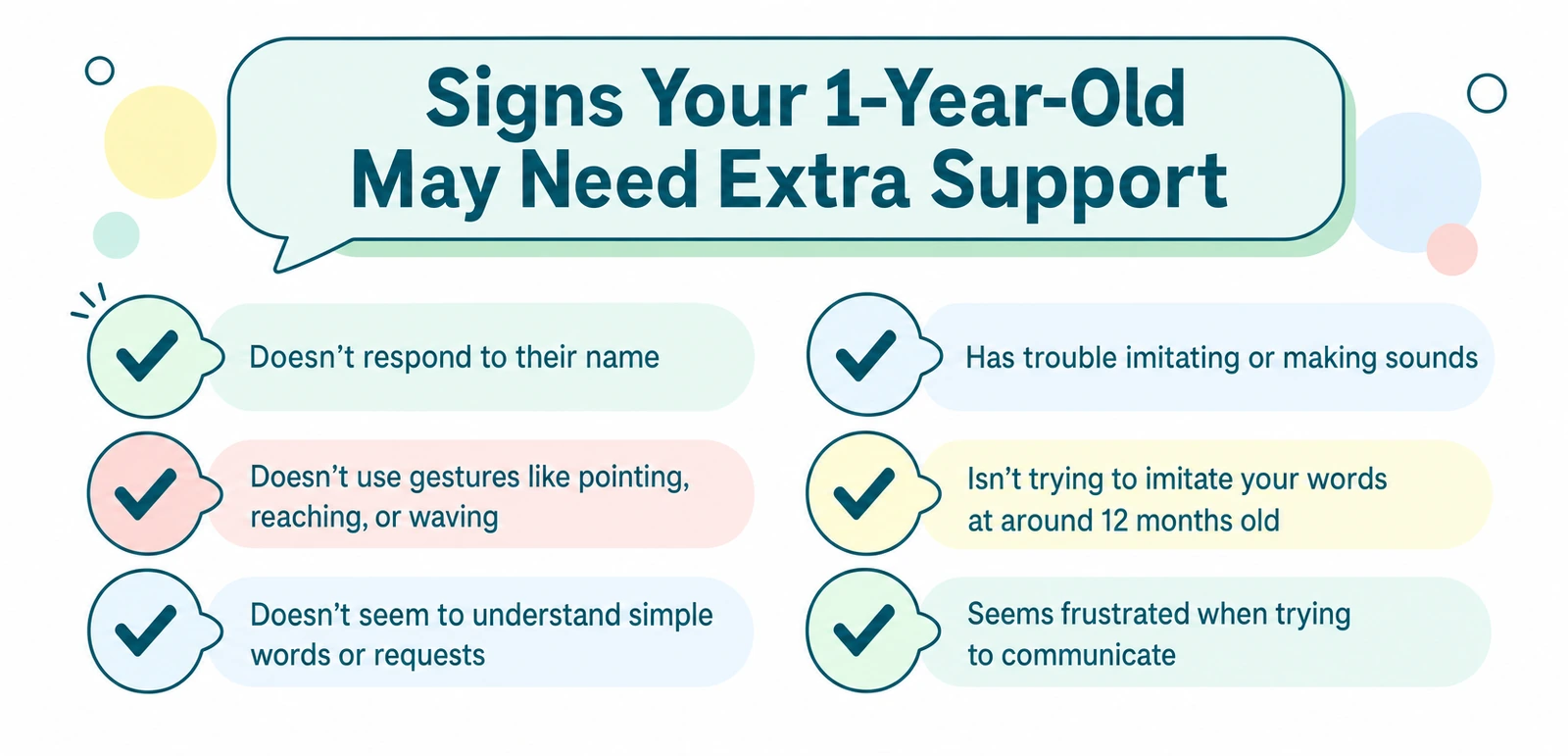
Still, it helps to watch for certain signs. Consider speaking with your pediatrician or a speech therapist if your child:
- Has difficulty imitating or making sounds
- Doesn’t use gestures such as pointing, reaching, or waving
- Doesn’t try to imitate your words around their first birthday
- Doesn’t seem to understand what is being said or respond to their name
- Appears frustrated when trying to communicate
These behaviors can be early signs that a child may need additional support.
What if my 12-month-old isn’t talking but understands me?
If your 1-year-old isn’t talking yet but appears to understand you, that can be a positive sign. Language development has two parts: expressive language and receptive language.
Expressive language is how a person communicates thoughts, feelings, and ideas. We often think of communication as spoken words, but nonverbal language is communication too. Pointing, gesturing, and using signs are all forms of expressive language. An expressive language disorder makes it difficult for a child to communicate what they want, need, or feel.
Receptive language is a person’s ability to understand words spoken to them. For example, when a parent says, “Stop!” or “Come here!” a child must understand those words to respond appropriately. Children with receptive language delays have trouble understanding conversation and knowing how to respond when someone speaks to them. This can make communication between a child and caregiver difficult.
Some children have stronger receptive language skills than expressive language skills. If so, you may notice that your toddler understands what people say and can respond nonverbally.
For example, your child may follow a direction such as “Bring me your ball.” They might also point to their feet when you ask, “Where do your shoes go?” At the same time, they may not yet use words to communicate clearly.
If your 1-year-old understands words well, their receptive language skills are likely on track. If they seem to be a “late talker,” this may point to an expressive language delay or a speech delay.
Can signs of autism appear in a 1-year-old?
Some early signs of autism may appear around 12 months, but it’s important to remember that every child develops according to their own timeline.
At this age, most toddlers look toward something you point to, check back in with you, and use early communication skills such as babbling, waving, or smiling back.
An autistic 1-year-old may communicate differently. You may notice very little babbling, limited gestures such as pointing or waving, no response to their name, or that they seem to “tune out” when you point to something. As Shetty explains, “These signs don’t mean something is ‘wrong.’ They’re simply early differences in how a child connects and communicates.”
A speech delay does not automatically mean autism. Autism involves a pattern of differences rather than a difference in only one skill area.
It’s also important to understand that a speech delay does not automatically indicate autism. Many autistic toddlers have delays in spoken language, but many children have speech delays without autism. Autism involves a pattern of differences, not just one area of development.
If you notice several signs or have a gut feeling that something is different, it’s always OK to discuss it with your pediatrician. An early conversation may lead to support, reassurance, or a referral to a professional who can take a closer look. Autism can sometimes be diagnosed at age 18 months or younger. By age 2, most diagnoses made by qualified professionals are reliable. However, some children do not receive a diagnosis until they are older.
Next, consider the communication skills that should develop at 12 months, 18 months, and 24 months old.
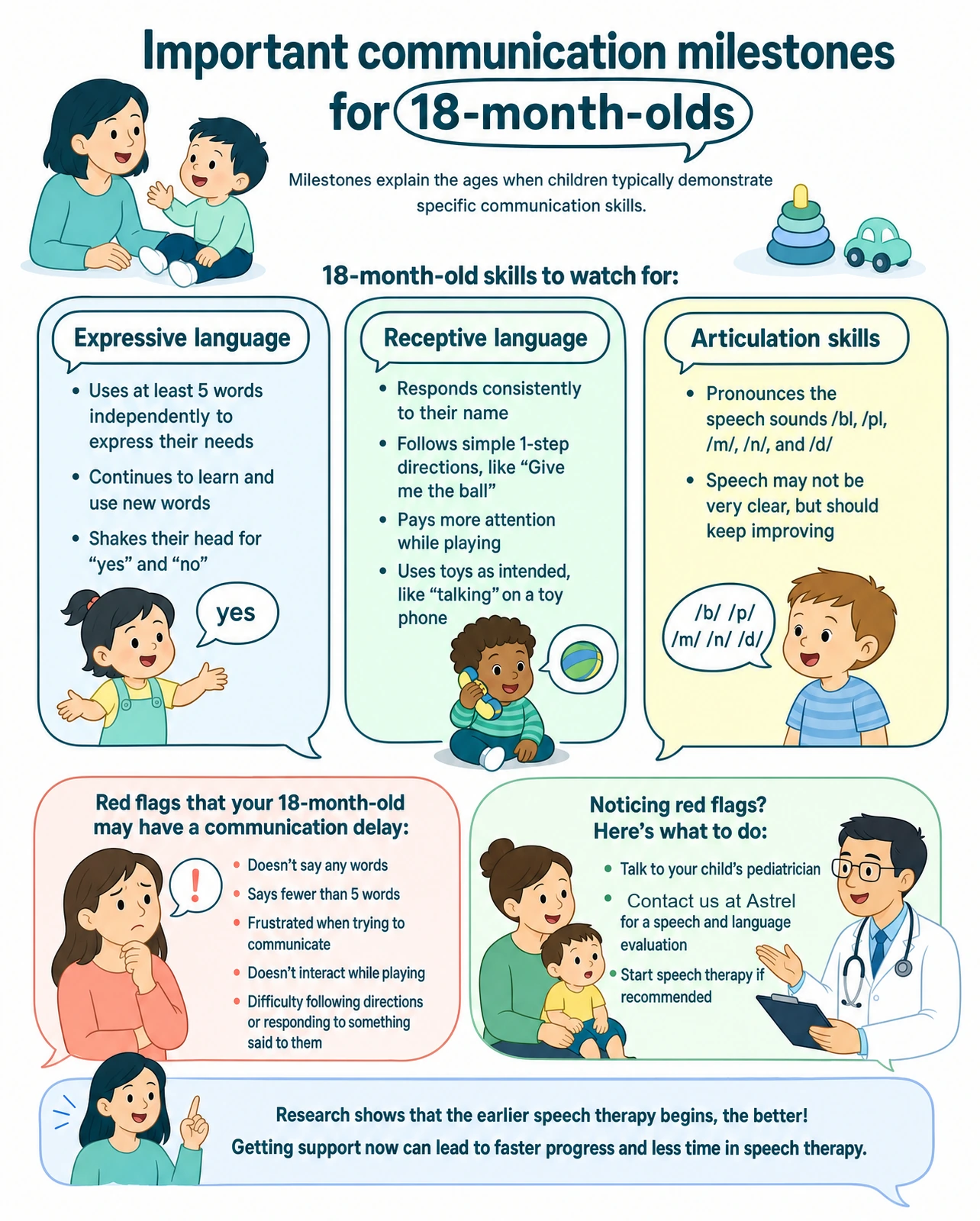
Milestones for toddlers ages 12 to 18 months
Receptive language skills (12-18 months)
- Responding to their name
- Following simple one-step directions: Examples include “Come here,” “Sit down,” and “Give me _____.”
- Playing: As a general guideline, your child should be able to stay engaged in some type of play for at least 1-2 minutes before moving to another task. This focused attention creates more opportunities to use words and interact back and forth with another person. During reading, for example, your 18-month-old should be able to sit long enough to engage with you and the book. They may even begin pointing to pictures when you ask.
- Playing with objects: At this stage, your child should begin playing with objects and using them appropriately. They might hold a phone to their ear or pretend to drink from a toy cup. When a child starts using objects for their intended purposes, more imaginative and pretend-play skills are likely just around the corner.
Expressive language skills (12-18 months)
- First words: Children typically say their first word at around 12 months old, although it may happen a little earlier or later. You may start hearing the word “no” quite often as your 1-year-old expresses their new sense of independence.
- Spontaneous utterances: Children learn to imitate sounds and words before producing them independently. Toddlers should continue imitating new words, but they should also begin saying words spontaneously. For example, an 18-month-old might say “milk!” when thirsty or “ball!” when they want to play. They’re beginning to recognize that communication helps them get what they want.
- Consonant sounds: Your toddler should begin using several different consonant sounds in words or babbles. The earliest developing sounds include /b/, /p/, /m/, /n/, and /d/. Eighteen-month-olds should be able to produce most of these consonants independently.
Related guides

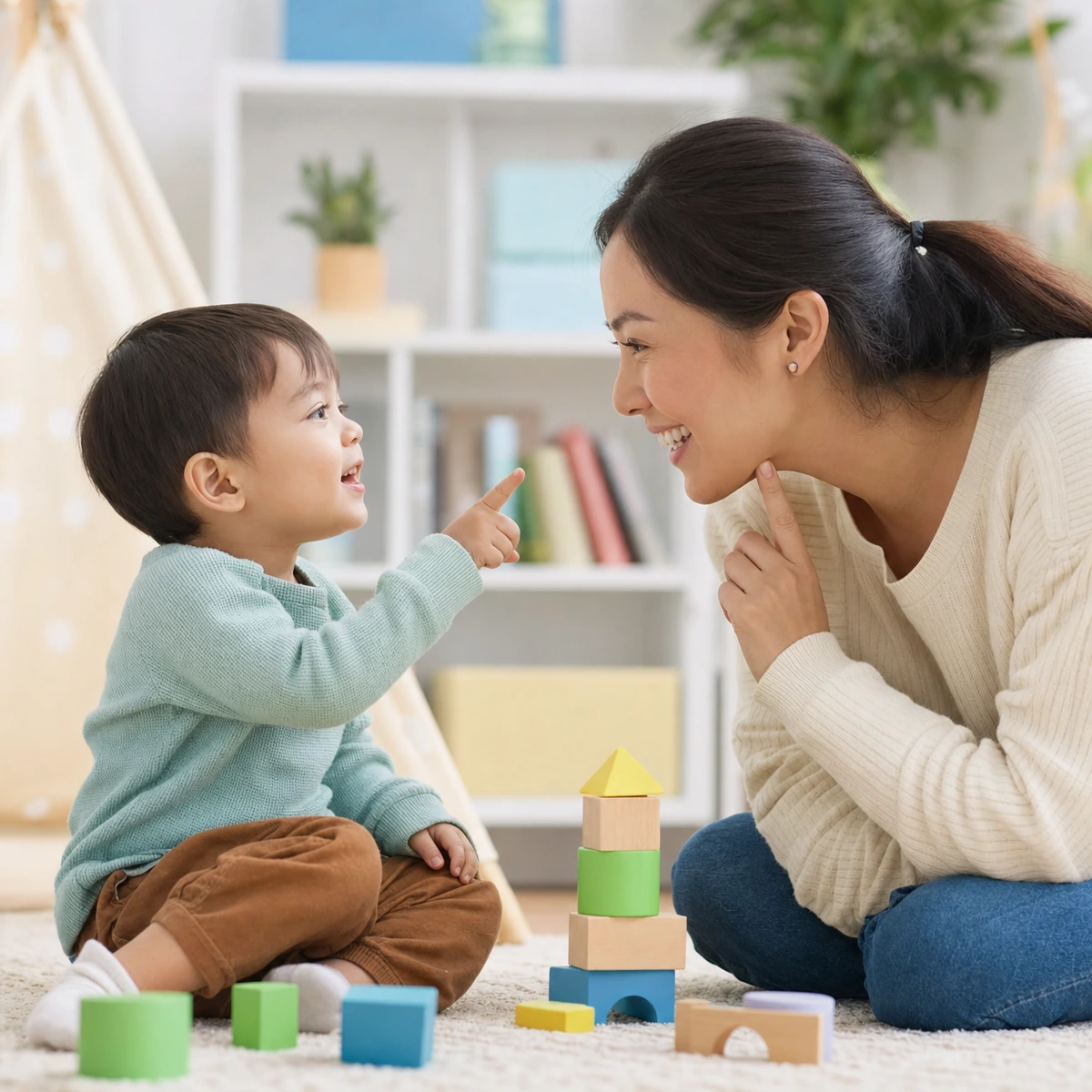






Milestones for toddlers ages 18 to 24 months
Receptive language skills (18-24 months)
- Comprehension skills: Between the ages of 18 months and 2 years old, children should make a major leap in comprehension. Toddlers should understand at least 50 different words, even if they cannot say all of them. You can observe this by watching how your child follows simple directions and identifies objects. If you mention shoes or a dog, your toddler should be able to point to those things.
- Playing appropriately: Your toddler should start using objects more appropriately during play, including using two objects together. They might pretend to stir with a spoon in a bowl or give a baby doll a bottle. You should also see your child begin using objects toward themselves and other people. For example, your toddler may pretend to feed you or brush your hair.
- Eye contact: While playing with your toddler, you should see them make consistent eye contact with you.
Expressive language skills (18-24 months)
- A larger vocabulary: By 18-24 months, your child should regularly and spontaneously say at least 5-10 words. They should also keep imitating words they hear. Simple words they may use to request something include “more,” “help,” “eat,” and “go.”
- Consonant-vowel combinations: When your child imitates or says words, they may use different consonant and vowel combinations. You might hear a consonant-vowel (CV) production such as “go,” or an approximation of the word boat such as “bo.” You may also hear consonant-vowel-consonant-vowel (CVCV) productions, such as “wawa” for water. Eventually, you may hear emerging consonant-vowel-consonant (CVC) productions such as “pop” or “mom.” As your child grows, their word attempts will sound increasingly like true words.
- Two-word phrases: Some toddlers in this age range begin using very simple two-word phrases, such as “I want,” “Give me,” or “More please.” Most children reach this milestone at, or shortly after, age 2 years old.
If your 1-year-old isn’t developing some of these abilities, it may be a sign of a speech or language delay. You can also review the communication milestones for birth to 12 monthsto see how your child is doing with those skills.
How to find a speech therapist for your toddler
If your 1-year-old isn’t talking or you’re concerned about their progress, it’s always OK to ask for help. A pediatrician or speech-language pathologist can assess your child more closely, explain what may be happening, and guide you toward appropriate support. The good news is that early intervention makes a big difference. The sooner a child begins speech therapy, the sooner they can start developing language. Language grows one skill at a time, much like climbing a staircase. Each step must come before the next. If a child does not develop the skills next in sequence, they will not be able to reach the skills that follow.
The earlier a child begins speech therapy, the sooner they can start building language skills.
To find a speech therapist, begin by speaking with your child’s pediatrician. They will likely have recommendations and can write a prescription for speech therapy if needed.
You can also contact speech therapy practices directly. Their staff can explain the steps involved in starting therapy.
Speech therapy begins with an evaluation. This allows the speech therapist to understand your child’s current communication strengths and weaknesses. It is also a valuable time to describe what you observe at home and discuss your goals for your child.
Most children attend speech therapy one to two times each week, though the length of treatment varies. Working closely with your speech therapist and practicing regularly at home can help your child make progress faster.
4 ways to support your child’s speech at home
You may be wondering what you can do at home to support your toddler’s speech and language. The good news is that there is a lot you can practice, without making major changes or buying expensive materials. Communication practice fits naturally into simple, everyday interactions with your child.
1. Get down to their level and play
Many people underestimate how important play is to a child’s development. Play mirrors communication: One person takes a turn, then the other person responds, and the exchange continues. These back-and-forth actions work much like conversation.
Making time to play with your child can support their speech and language development. If you’re unsure where to begin, try some fun, simple toys for 1-year-olds.
2. Read together every day
Spending time reading with your little one offers remarkable benefits for communication. Children who hear one book each day are exposed to 78,000 extra words per year.
Reading together helps your child learn more words, understand sentence structure, and strengthen phonological awareness. This is a child’s ability to recognize the sounds that make up words and their meanings. These speech and language abilities are linked to school success as children grow older.
Reading together can also strengthen your bond with your child. Make storytime part of your daily routine.
3. Practice imitation skills
Imitation skills also play an important role in speech and language development. If your child isn’t copying sounds yet, practice animal soundsor the noises made by trains and cars. These sounds are often fun and motivating for toddlers to imitate.
Once your child can imitate these noises, move on to speech sounds such as vowels and consonants. Start with simple babbles such as “ma-ma.” As these skills improve, you can begin practicing simple word imitation.
If you have tried these activities and your child still has difficulty imitating speech, practice gesture imitation. Children need to learn to copy gestures and movements before progressing to speech. Start with simple actions such as waving, blowing kisses, and clapping hands.
4. Model language for your child
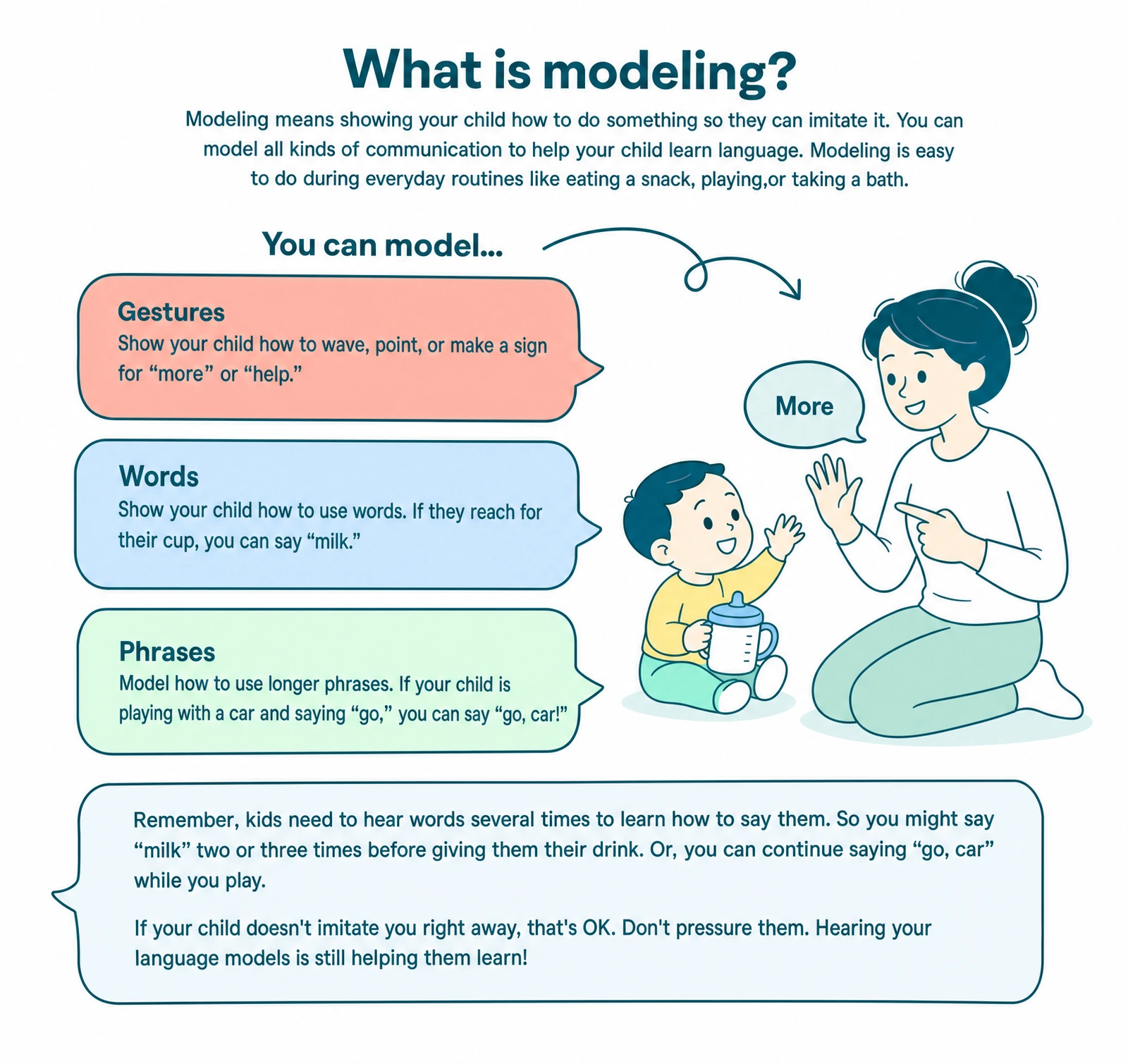
One of the simplest and most effective ways to support your child is to model, or demonstrate, language for them. Talk to them often, even when they do not respond. Children learn a great deal from the people they spend the most time with. By watching and listening to you, your child can learn words, what those words mean, and how to pronounce them.
Frequently asked questions (FAQs)
Why isn’t my 1-year-old talking yet?
Many 12-month-olds use few or no words. That can be typical, particularly if they are babbling, making eye contact, pointing, and understanding what you say. These are signs that communication is developing. If your child has very limited babbling or gestures, does not respond to their name, or has not said a first word by 15 months, speak with a pediatrician or speech therapist.
My 1-year-old isn’t talking but is babbling. Should I be concerned?
Babbling is one of the strongest signs that speech is developing. Babies babble to practice the mouth movements, timing, and rhythms used in real speech. Many toddlers progress from babbling to words between 12 and 15 months. If your child is babbling and showing signs of connection, such as pointing to things or responding to you, that is typically a positive sign.
Can signs of autism appear in a 1-year-old?
Some early signs of autism may appear around 12 months. Autistic toddlers may communicate differently, with limited babbling, fewer gestures, no response to their name, or less shared attention. A speech delay alone does not indicate autism. The overall pattern of communication is what matters.
What if my 12-month-old isn’t talking but understands everything?
If your toddler follows directions, responds to routines, or points to familiar objects when you speak, that is a strong sign of well-developed receptive language skills. At this age, many 1-year-olds understand much more than they can express. Some simply develop expressive language, or spoken words, a little later.
How can I tell if my 1-year-old needs speech therapy?
Speak with a speech therapist if your child isn’t babbling, rarely imitates sounds, doesn’t use gestures such as pointing or waving, doesn’t respond to their name, or isn’t meeting the communication milestones for their age. A speech evaluation can clarify what is happening and what kind of support may help.