

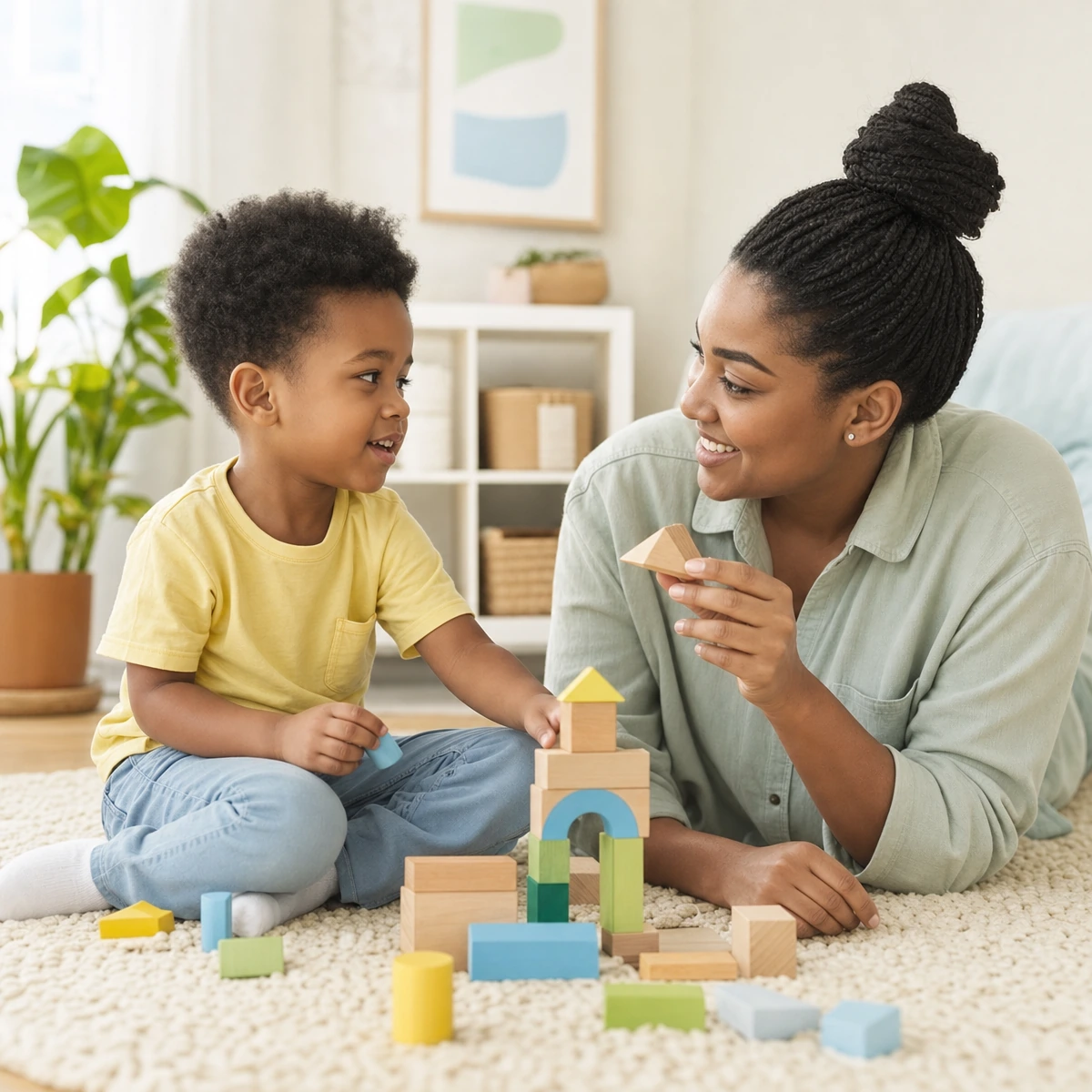
Speech delay and autism can look similar in a young child. Both may involve late talking, a small vocabulary, or difficulty communicating needs. But speech therapists look closely at four key areas: joint attention (whether your child follows your gaze and shares interest), eye contact, gestures such as pointing, waving, and showing, and sensory or repetitive behaviors. A child with a speech delay typically talks later but otherwise follows expected patterns. Autistic children often show differences across several of these areas. This guide explains those distinctions step by step and outlines when to request an evaluation.
Key takeaways
- Children with speech delays generally follow the typical developmental path but need more time to reach speech milestones. Autistic children usually show a range of differences involving communication, behavior, and social interaction.
- Key signs of autism include difficulty with joint attention or eye contact, not using gestures such as pointing, and showing repetitive or sensory behaviors.
- A child with a speech delay will usually become frustrated when others do not understand and keep trying to communicate. An autistic child may quietly disengage and return to a favorite activity.
- If you are unsure, request two evaluations: a speech-language evaluation and a developmental or autism screening. Each answers different questions, and neither rules out the need for the other.
- Early intervention through speech therapy is key for any child with a speech delay, and speech therapy can also benefit autistic children.
Free 30-minute evaluation
Looking for a speech therapist?
Talk through what you are noticing and get clear next steps.
Book free evaluation
Typical communication milestones for babies and toddlers
Understanding the main speech and language milestones for young children can clarify what to expect and help you recognize when your child may need support.
The first three years of a child’s life are critical for speech and language development. From the moment a child is born, communication begins. Parents hold their breath as they wait to hear their newborn’s first cry. During the first three months, babies typically look at their caregivers, respond to voices, smile at people, and react to sounds. They also begin cooing and crying, and we interpret those sounds to anticipate what they need.
Between 6 and 9 months, babies often recognize familiar people, enjoy games such as “peek-a-boo,” and begin imitating sounds and actions. Language also starts to emerge through babbling, including sounds such as “mamama” and “bababa.” At around 12 to 18 months, children begin saying their first words and using simple gestures such as waving and pointing.
By 18 months, a child should consistently use about 50 words. By age 2, vocabulary expands rapidly to 250–300 words, and children should begin putting words together into simple phrases. By age 3, children typically answer questions and follow 2-step directions, such as “First clean up your toys, and then go get your shoes.”
How is a speech delay different from autism?
A speech delay affects how or when a child talks, while social skills, eye contact, and shared attention develop on schedule. Autism affects social communication more broadly, including joint attention, eye contact, gestures, and responses to other people. Research indicates that 40% to 70% of autistic children have language delays, but late talking is only one possible sign of autism. It is not the full picture.
“An autistic child and a child with a speech delay may both speak very little for their age, or not speak at all,” says Adhvika Shetty, a licensed speech therapist with Astrel. “Both may have difficulty expressing their wants and needs and may communicate through behaviors such as tantrums. However, there are important differences between autism and a speech delay.”
Children with speech or language delays generally follow the same developmental path as their peers, only at a different pace. They may reach milestones later, but they are often eager to connect with other people. These children may enjoy hugs, seek attention, and try to copy the actions of those around them. They might become upset or lonely when left alone and show a natural interest in social interaction, even when their words develop more slowly.
Autistic children, by contrast, may be less interested in social engagement. They might prefer exploring objects or concentrating on their own activities rather than interacting with people. Imitating actions such as clapping or waving may not come naturally. They may also find it harder to understand or use nonverbal cues, including eye contact, facial expressions, and gestures.
When communication is difficult, autistic children may not show frustration in the same way as children with speech delays. Rather than continuing to communicate, they might quietly return to an activity they enjoy. Many autistic children also use self-soothing behaviors, such as watching wheels spin, lining up toys, or mouthing objects. They may not consistently respond to their name or seek attention in the same way as other children.
Understanding the differences between speech delay and autism can help you identify the support that fits your child’s needs. Whatever the cause of a delay, the right support and encouragement can help every child grow and thrive.
Signs of speech delay and autism: A side-by-side comparison
To understand the difference, look beyond how much a child talks. These are the specific behaviors speech therapists and developmental pediatricians consider.
Signs that are more consistent with a speech delay
- Makes and maintains eye contact while playing and eating
- Follows your gaze when you look toward something (joint attention)
- Points, waves, and communicates with gestures before words emerge
- Consistently responds to their name by 12 months
- Imitates familiar actions, such as clapping, blowing kisses, or feeding a doll
- Participates in back-and-forth pretend play
- Becomes frustrated when others do not understand and continues trying to communicate
- Has typical sensory responses to sounds, food textures, and touch
Signs that are more consistent with autism
- Makes limited or fleeting eye contact, particularly during social interactions
- Does not follow a caregiver’s pointing or gaze
- Uses few gestures and may pull a caregiver’s hand toward an object instead of pointing to it
- Responds inconsistently to their name, even when hearing is normal
- Makes repetitive movements, such as hand flapping, spinning, or lining up toys, or focuses intensely on parts of objects, such as wheels or fans
- Reacts strongly to sensory input. For example, the child may cover their ears in response to ordinary sounds, refuse certain food textures, or seek out spinning lights
- Uses echolalia (repeating phrases from television shows or overheard speech) instead of creating their own language
- Quietly disengages rather than becoming frustrated when other people do not understand
One or two of these signs alone does not mean that a child is autistic. Many typically developing children flap their hands when excited or go through periods of avoiding eye contact. Speech therapists look for a pattern: several behaviors occurring together, continuing beyond 18 to 24 months, and appearing alongside a language delay.
Other autism signs related to communication
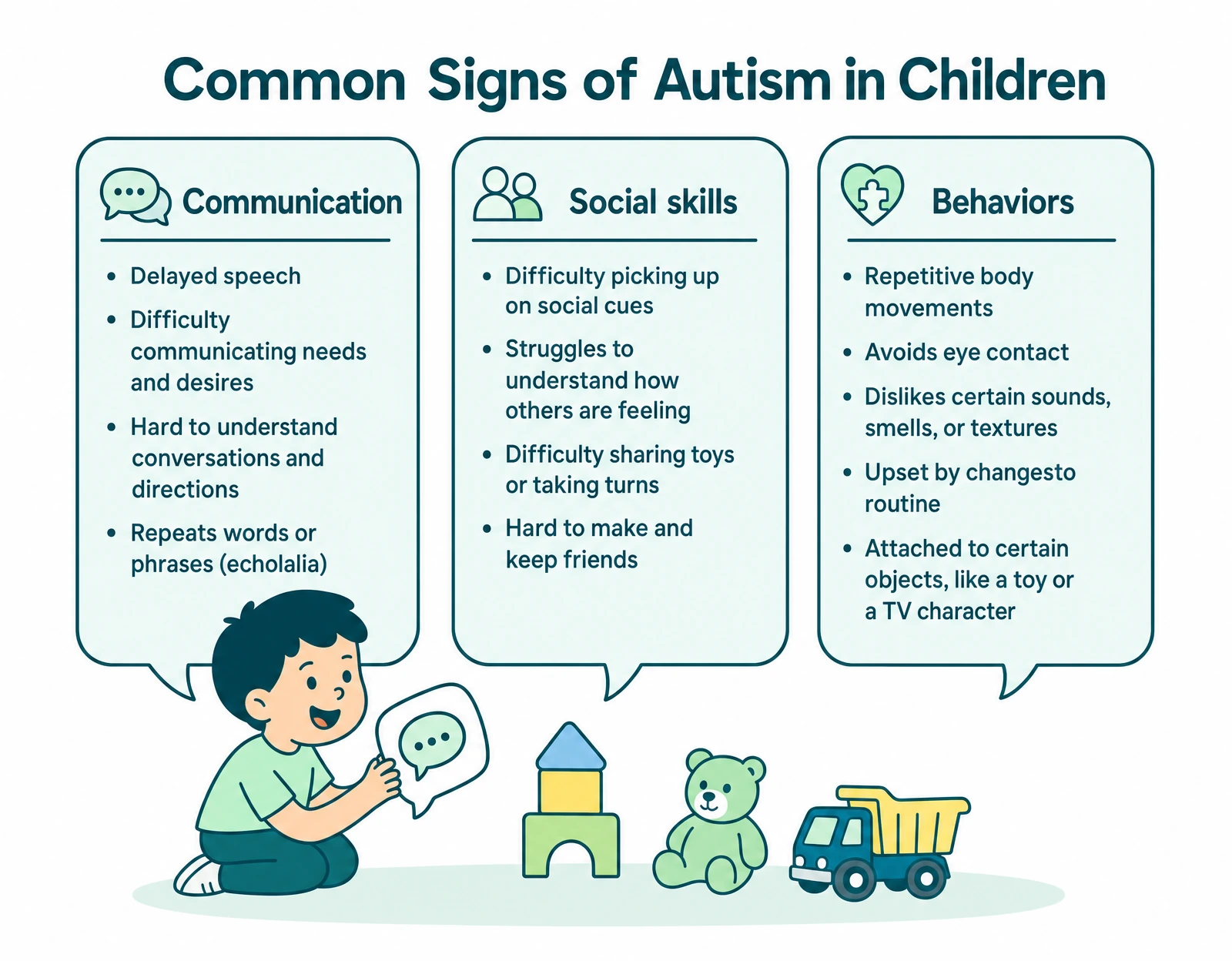
Autism is a complex developmental condition, and it affects each child differently. “There’s a common saying: ‘If you’ve met one child with autism, you’ve met one child with autism,’” Shetty says. Autistic children may also experience the following communication differences and challenges:
- Responds slowly when someone tries to get their attention
- Compulsively labels objects instead of commenting or making requests
- Speaks in a “robotic” voice with little inflection or intonation
- Has difficulty with reading and writing. Some autistic children can read but struggle to understand the words on the page, which is called hyperlexia)
- Seems to look through people or appears unaware of others
- Has trouble taking turns and shows no interest in playing with family members or other children
For a closer look, read our complete guide to how autism affects a child’s communication, social skills, and behavior. To learn about early red flags, see our guide to the early signs of autism in toddlers. If your child has received a diagnosis, our guide to speech therapy for autism explains what you can expect.
Related guides







Other reasons children may have speech delays
Not every child who talks late is autistic. The most common causes of speech delay unrelated to autism include hearing loss, often due to ear infections, oral-motor issues, developmental language disorder, and limited opportunities for conversation at home. For details about each cause and what you can do, read our guide to common causes of speech delay in children.
How do speech delays and language delays differ?
Speech and language delays share some features, but there are important differences for parents to understand.
“Speech” describes how children produce sounds and words to express their needs, wants, and desires. Children with a speech delay continue along the typical developmental path, but often progress more slowly than other children their age.
For instance, they may continue struggling with sounds that are difficult to pronounce, such as /r/, /s/, or /z/, after other children have mastered them. As a result, they may be harder to understand, and their speech may sound less mature.
“Language” is different from the physical production of speech sounds. It refers to the words we use and how we use them to communicate our thoughts, wants, and needs. Children with a language delay may pronounce sounds and words correctly but be unable to combine those words into understandable phrases or sentences. They may also have trouble understanding what other people say. Challenges can include processing information, following directions, and learning the meanings of new words.
Read this in-depth guide to learn more about language delays.
What to do if you suspect a speech or language delay
If you are concerned, start by discussing your child’s behavior with their pediatrician. The pediatrician may recommend a developmental pediatrician or pediatric neurologist. In many cases, you may also receive a referral to a speech-language pathologist, who can conduct an evaluation and take an important role in your child’s treatment.
Early intervention through speech therapy is key for any child with a speech or language delay. Research has consistently found that intervening early is crucial for helping children catch up and express themselves more effectively.
If your child is diagnosed with autism, their pediatrician may recommend speech therapy as well. Speech therapy can help autistic people strengthen verbal and nonverbal communication, understand body language, ask and answer questions, and build conversational skills. “The goal of speech therapy for autism is to help children function better in everyday life and learn to communicate in a way that feels authentic and fulfilling to them,” Shetty says.
Should I ask for an autism evaluation, a speech evaluation, or both?
You can request both. They address different questions, and neither evaluation rules out the other. A licensed speech therapist conducts a speech-language evaluation to determine whether your child’s language skills are developing on track. A developmental pediatrician, psychologist, or specialist team conducts a developmental or autism evaluation. This evaluation considers social communication, play, sensory responses, and behavior in different settings.
For children younger than 3, both evaluations are free through your state’s Early Intervention program, and they can take place at the same time. If your pediatrician recommends that you “wait and see,” you can still ask for an evaluation. An evaluation is used to diagnose your child, not to provide treatment, and requesting one does not commit you to anything.
Wherever your child is in their communication journey, your support, love, and patience can make a meaningful difference. With appropriate help, every child has the potential to find their voice and share it with the world.
If you have concerns about your child’s speech development, reach out. We can answer your questions and help you identify the best next steps. Find a speech therapist for your child today. We are here to support your family throughout the process.
An important note: When referring to any community as a whole, we believe the best approach is to prioritize that community’s voices, needs, and preferences. The larger autism community currently prefers identity-first language, so that is the language we use in our content. Astrel is committed to listening to and learning from the people we serve. If their preferences change, we will adjust our approach accordingly.
Frequently asked questions
What is the difference between a speech delay and autism?
A speech delay is a delay in spoken language. Autism is a broader condition that can affect social skills such as joint attention, eye contact, gestures, and play, along with sensory responses and other behaviors. Late talking is one possible sign of autism, but a speech delay does not mean a child is autistic.
Can a child have both autism and a speech delay?
Yes. Autism and speech delay can occur together. Up to 30% of autistic children may never develop functional spoken language, and some autistic children also have a speech delay. However, a speech delay does not necessarily mean a child is autistic. Other possible causes include hearing loss, difficulty moving the mouth for speech, and a learning disability. That is why scheduling a speech evaluation is so important if your child appears to be behind. If your speech therapist notices possible signs of autism, they can also recommend an autism screening.
How can I have my child evaluated for autism or a speech delay?
Consider starting with your pediatrician. Request two referrals: one to a speech-language pathologist for a speech evaluation, and another to a developmental pediatrician or your state’s Early Intervention program for an autism screening. If someone advises you to “wait and see,” ask for the referral anyway. It is better to have your child evaluated sooner rather than later. Children younger than 3 also qualify for free evaluations through Early Intervention in every state, and no referral is required.