


Autism spectrum disorder (ASD) is a complex developmental condition. It can look different from person to person, but it commonly affects speech, language, and social skills.
Speech therapy is among the most common therapies recommended for autistic people. At Astrel, our licensed speech therapists help autistic children, teens, and adults communicate more effectively. This guide explains common signs of autism, how autism can affect speech and language, how it is diagnosed, and how speech therapy for autism works.
What is autism?
Autism is a complex, lifelong diagnosis that commonly emerges during early childhood. It refers to a broad range of developmental conditions and behaviors, including challenges with speech, nonverbal communication, interpersonal relationships, and social interaction.
Like ADHD, dyslexia, and dyspraxia, autism is a form of neurodivergence. This term describes people whose brains work differently from what society considers “normal.” Neurodivergent people may have differences in communication, learning, social preferences, and behavior.
The phrase “on the spectrum” refers to an autism diagnosis and the broad spectrum of symptoms it can involve. Autism may have only a minimal impact on someone’s life. It may also be a major developmental difference that requires significant support.
Autistic people may find it hard to have understandable conversations or express themselves with words, gestures, or facial expressions. They may struggle to recognize social cues or understand what others are thinking and feeling. Some autistic people do not speak and use other ways to communicate.
Autistic people may also have highly specific interests or repetitive behaviors. For example, they might focus intensely on a particular object, toy, or TV show, or resist changes to their daily routines.
Free 30-minute evaluation
Looking for a speech therapist?
Talk through what you are noticing and get clear next steps.
Book free evaluation
How common is autism?
According to the Centers for Disease Control and Prevention (CDC), about 1 in 31 children in the United States is autistic. Boys are 3.4 times more likely than girls to be diagnosed with autism. Overall autism prevalence is lower among non-Hispanic White children than among Black, Hispanic, Asian or Pacific Islander, American Indian or Alaska Native, and multiracial children.
Perhaps most importantly, the CDC states: “Timely evaluation and identification of Autism Spectrum Disorder (ASD) among young children continue to be important public health goals because evidence links early treatment and services for ASD with improved outcomes.”
What causes autism?
There is no known cause of autism. This reflects both the condition’s complexity and the wide variation in symptoms. However, most researchers agree that certain genetic and environmental risk factors may increase the likelihood of an autism diagnosis.
Genetic links to autism
According to research, several genes appear to be involved in autism, and their presence can increase a child’s risk. Some genetic mutations may be inherited, while others occur randomly.
A child may inherit one or more of these gene mutations from a parent, even if that parent is not autistic. Again, most of these gene changes do not cause autism on their own, but they can increase the risk of developing the condition.
Environmental links to autism
Researchers continue to study whether pregnancy complications, air pollutants, lead poisoning, or other environmental factors play a role in triggering autism.
Other possible autism risk factors
According to the Mayo Clinic, several other factors may increase a child’s likelihood of developing autism, including:
- Gender: Boys are about 3 times more likely than girls to develop autism.
- Family history: Families with one autistic child appear to have a higher likelihood of having another child with the condition. Parents or relatives of an autistic child may also have minor challenges with social or communication skills.
- Certain medical conditions: Some medical conditions can increase a child’s chance of autism. Examples include fragile X syndrome, also called Martin-Bell syndrome, tuberous sclerosis, and Rett syndrome.
- Parents’ ages: There may be a connection between autism and being born to older parents.
Note: Extensive research has found no link between childhood vaccines and autism. This claim is unfounded and has no factual basis. The original study that sparked the debate was debunked and retracted because of misrepresentation, poor study design, and questionable research methods.
What are the signs and symptoms of autism?
Signs and symptoms of autism generally appear early in childhood, often before age 3. They can range from mild to severe. Some are easy to notice, while others may not be recognized until a child starts school.
If you notice developmental differences in your child, talk with your healthcare provider or a speech therapist. Early intervention is one of the best ways to help an autistic child make progress and address their challenges.
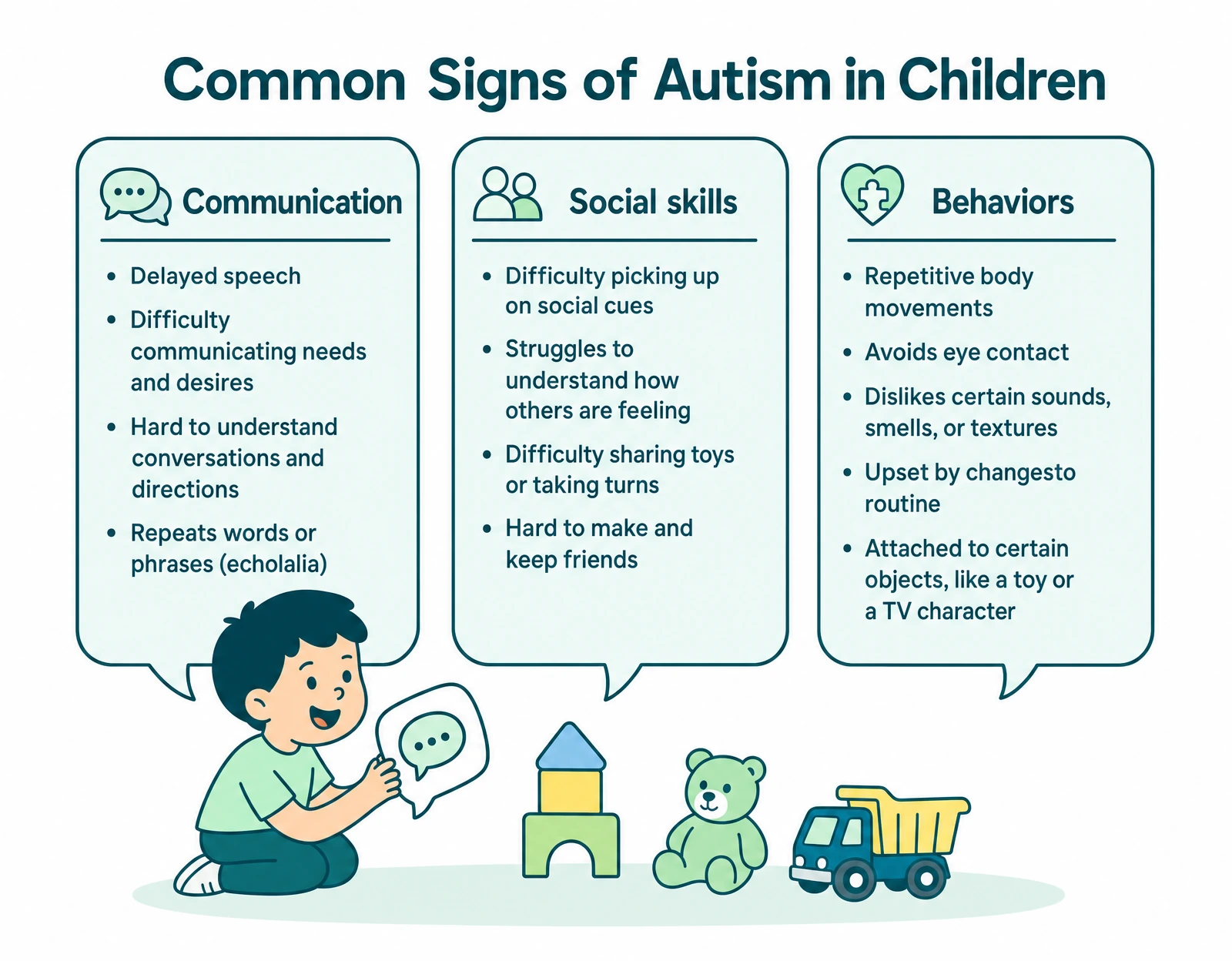
According to the American Speech-Language-Hearing Association (ASHA), autism typically affects communication, social skills, and behavior. Here are common signs in each area.
Communication-related signs of autism
Communication includes speaking, reading, writing, and understanding language. Signs of autism may include:
- Delayed spoken language, including speaking very little for their age or not speaking at all
- Difficulty starting or maintaining a conversation
- Difficulty communicating needs and wants
- Difficulty understanding conversations or instructions, including repeating a question instead of answering it
- Using challenging behaviors, such as crying or tantrums, instead of words or gestures to communicate what they want
- Difficulty learning to read and write. Some autistic children can read but have trouble understanding what they read, which is also called hyperlexia)
- Repeating words or phrases heard moments, days, or weeks earlier, known as echolalia. Some autistic children are gestalt language processors
- Speaking in a robotic voice with little inflection or intonation
It can sometimes be difficult to distinguish autism from a speech delay. Speech delays are common among autistic children, but having a speech delay does not automatically mean a child is autistic.
Both an autistic child and a child with a speech delay may speak very little for their age or not at all. Both may struggle to express their needs and wants and use behaviors such as tantrums to communicate. However, there are important differences between autism and a speech delay. Read more about them in this article.
Social-skill signs of autism
An autistic person may find it difficult to relate to other people. They may struggle to make friends or interact with peers, or they may show little interest in doing so. They may find it hard to:
- Recognize social cues and understand social situations
- Understand how other people feel
- Share attention with another person and focus on the same object or event
- Develop peer relationships, including sharing toys, taking turns, and making and keeping friends
Behavioral signs of autism
Autistic children may show a range of behavioral differences, including:
- Restricted or repetitive patterns of behavior, including repeated hand or body movements
- Avoiding eye contact
- Preferring not to be touched, held, or cuddled
- Laughing, crying, or becoming upset easily for unknown reasons
- Disliking particular sounds, smells, or textures, such as eating very few foods or choosing foods based on texture
- Becoming distressed when a daily routine changes
- Becoming attached to particular objects, such as a toy or TV character
- Repeating unexpected behaviors, such as lining up toys, rocking the head back and forth, spinning the body, or having trouble staying still
Early signs of autism in toddlers
Along with the symptoms above, several early signs may suggest that a toddler is autistic. Children who are not autistic can show these signs and behaviors too, but it is often better to be cautious. If you notice any of these signs in your toddler, talk with your child’s doctor about an evaluation.
Signs of autism at age 1
Most infants are highly social. Even at this early age, signs of autism may be noticeable in how a baby or toddler interacts with the world. Signs in a 1-year-old may include:
- Not noticing or responding to their mother’s voice
- Not recognizing their own name
- Being unable to look people in the eye
- Limited speech and language abilities, including not babbling or pointing at this age
- Not smiling, laughing, or responding to social cues
Signs of autism at age 2
Signs of autism may become more apparent during a child’s second year, when language skills begin to develop more fully. Signs of autism in a 2-year-old may include:
- Not saying simple, single words by 16 months
- Being unable to use simple two-word phrases, such as “Go up”
- Losing language skills they previously had
- Showing little interest in the world around them, such as not responding when a caregiver points out a large tree or a plane flying overhead
How is autism diagnosed?
Diagnosing autism can take time. To make a diagnosis, a healthcare provider will generally consider your child’s developmental history, communication, and behavior.
Autism can sometimes be diagnosed at 18 months or younger, and by age 2 most professional diagnoses are reliable. However, some people are not diagnosed until later childhood, adolescence, or adulthood.
An autism diagnosis involves several steps. The CDC explains each step in detail. Proper monitoring, screening, evaluation, and diagnosis are essential for connecting your child with the care and services they need to live a fulfilling life.
Developmental monitoring for autism
Most children reach certain developmental milestones at typical ages. These milestones cover how a child plays, learns, speaks, behaves, and moves. The CDC offers a developmental milestone checklist organized by age.
Developmental monitoring means watching how your child grows and changes over time. Not reaching certain milestones is often the first warning sign of autism. Parents, caregivers, and teachers should all help monitor the child and note anything that seems atypical or out of character. Sharing these observations with your child’s doctor can help them evaluate your child and make a professional recommendation.
Developmental screening for autism
Developmental screening is a more thorough, formal way to assess a child for autism. However, screening alone does not provide a diagnosis.
Screening often includes a brief test or questionnaire about your child. These research-based tools ask about language, movement, thinking, behavior, and emotions. A doctor or nurse typically administers them, though other healthcare professionals may do so as well.
Comprehensive developmental evaluation for autism
If screening identifies a concern or risk factor, your healthcare provider may recommend a more formal evaluation. This comprehensive, in-depth review of a child’s development is usually conducted by a pediatrician, child psychologist, speech-language pathologist, or another specialist.
The evaluation may include a detailed examination of your child, a test for your child to complete, and questionnaires for you. The results help determine whether your child may be autistic and what treatment they need.
An official autism diagnosis is typically made by a pediatrician, pediatric neurologist, psychologist, or psychiatrist.
How is autism treated?
There is no known cure for autism, and treatment is not one-size-fits-all. Its goal is to support social, communication, and behavioral skills while improving the person’s ability to function in daily life.
As a parent, you may feel overwhelmed by the number of autism therapies available. Your child’s needs may also change over time. Work closely with your healthcare provider and other specialists, such as a speech therapist, to develop a care plan tailored to your child.
According to the Mayo Clinic, autism treatment options include, but are not limited to:
- Educational therapies: Autistic children often prefer routines, and many do well in highly structured learning environments. Preschool children who receive intensive, individualized behavioral interventions have been shown to make good progress.
- Behavioral therapies: Applied behavior analysis (ABA) uses a reward-based system to help children learn new behavioral skills and apply them in different situations.
- Family therapies: Caregivers and other relatives can learn ways to play and interact with their child. This coaching may also help them manage behavioral challenges and teach daily living skills.
- Speech and language therapy: Speech therapists can address verbal, nonverbal, and social communication challenges in autistic people. More information appears below.
- Other therapies: Many other therapies may be helpful, depending on your child’s needs. For example, occupational therapy focuses on teaching activities of daily living, while physical therapy can help improve movement.
- Medications: Medication cannot cure autism, but certain medications may help control symptoms. Ask your healthcare provider which medications, if any, could be helpful.
How does speech therapy for autism work?
Speech and language challenges, like all autism symptoms, differ from person to person. Some autistic people may not speak at all. Others may enjoy talking but find it difficult to sustain a conversation or interpret social cues such as body language and facial expressions.
Speech-language pathologists, also called speech therapists, play an important role in supporting autistic people. They help people of all ages strengthen verbal and nonverbal communication, which can support relationships and day-to-day functioning.
Your speech therapist will assess your child’s communication strengths and challenges, then create a treatment plan personalized to your child and family. Learn more about speech and language evaluations for autism.
Speech therapy for autism may address skills such as:
- Verbal communication: Speech therapists can help people produce clearer speech sounds and words, making it easier to express their thoughts and be understood.
- Body language: Body language is a highly expressive part of communication. It can show whether someone is joking, serious, sad, or excited. Speech therapists can help autistic people interpret body language, connect emotions with facial expressions, and recognize subtle physical signals.
- Asking and answering questions: Knowing how to form and ask questions, and how to understand answers, helps people navigate daily life. Speech therapists can build these essential skills through recognizing and practicing question-and-answer formats.
- Social pragmatics: An autistic person may know phrases such as “good morning” and “thank you” but struggle to understand when, how, or with whom to use them. Social pragmatics involves learning when and where particular types of communication are appropriate in social situations.
- Prosody: Prosody is the melodic quality of a voice as it rises and falls during conversation. Many autistic people have flat prosody, which others may perceive as emotionless. Speech therapists can help them develop vocal skills and vary their tone.
- Conversation skills: Making short, simple statements is different from sustaining a back-and-forth conversation. Speech therapists help autistic people exchange information naturally, develop conversation skills, and begin a dialogue without prompting.
- Social skills: Speech therapists often help autistic people build social communication skills. This may include communicating, playing, and interacting with friends and family; standing an appropriate distance from someone during conversation; recognizing social cues; and more.
- Grammar: Some autistic people may refer to themselves in the third person or use verb tenses incorrectly. Speech therapists can help address these grammar errors.
Related guides







Will nonspeaking autistic children ever talk?
Not every autistic child is nonspeaking, but some are. A child may be nonspeaking for a short time and later begin to talk, while another may remain nonspeaking or minimally verbal throughout life. Every autistic child is different.
Children who do not speak need another way to communicate. Several assistive devices and technologies can help. These tools are known as augmentative and alternative communication (AAC). Your speech therapist can determine whether your child may benefit from AAC and teach you how to use it.
AAC methods for autistic people may include:
- Sign language
- Picture Exchange Communication System (PECS)
- Communication apps on a tablet or iPad
- Speech-output devices, such as Dynavox
Speech therapy for autistic teens and adults
Autistic teens and adults may choose speech therapy that focuses on skills such as:
- Social skills: These may include having two-way conversations, staying on topic, knowing how and when to change topics, and understanding another person’s perspective.
- Understanding social cues: This may involve interpreting someone’s tone, recognizing sarcasm, and other related skills.
- Making friends: When conversation is challenging, making friends can be difficult. Speech therapy can help autistic adults build on their strengths and natural conversational style to communicate more effectively.
- Communicating through technology: Speech therapy can help people build texting, social media chat, and direct-messaging skills. Therapy may also focus on workplace communication.
- Time management: A speech therapist can teach strategies for managing time, helping a person prepare for work responsibilities and other real-life situations.
- Problem-solving: Speech therapy may also address problem-solving. Learning to think through each step of a problem can be extremely helpful for autistic adults.
How Astrel treats autism-related speech and language disorders
Astrel matches families with licensed speech therapists trained to evaluate and treat autism-related speech and language disorders. All therapy takes place online through face-to-face video conferencing. Our therapists provide neurodiversity-affirming speech therapy. This approach supports autistic and other neurodivergent people by accepting their differences, building on their strengths, and helping them develop new skills.
Your child’s age and developmental level shape how the speech therapist works with them by video:
- Ages 0 to 3: Caregivers work directly with their child’s speech therapist to learn cues and at-home strategies. They can then practice confidently between sessions and support their child’s communication. Learn more about caregiver involvement in an autistic child’s speech therapy in this article.
- Ages 3 to 6: Caregivers join video sessions with their child so both can learn valuable skills from the speech therapist. Reinforcing these lessons between sessions supports continued skill-building at home.
- Ages 7 and older: Children can attend video sessions independently when possible. Caregivers remain informed through updates and tips provided during each session.
Autistic adults can attend sessions independently, though loved ones or family members are welcome to join. Because therapy is online, loved ones can participate from anywhere.
Learn more about Astrel’s clinical approach to supporting autistic people in our treatment guide.
Support between sessions: The Astrel portal
Speech therapy does not end when a session is over. At Astrel, you and your loved ones receive access to our client portal, designed to make communication practice easier and more effective. It includes:
- Learning Paths that explain and reinforce communication strategies
- Demonstration videos showing real speech therapy techniques in action
- Home-practice activities that fit into everyday routines
- Text-message support for asking questions and receiving reminders or tips from your therapist between sessions
Using the portal tools and practicing regularly can help you or your child progress faster and communicate more independently.
Ways to support your autistic child
You know your child better than anyone and are well positioned to support them at home and throughout daily life. The following strategies can help parents and caregivers stay involved, advocate for their child, and create a safe, nurturing environment where the child can grow, learn, and thrive.
Be proactive
This point is worth repeating: If you suspect something is wrong, contact your child’s doctor promptly. Research shows that earlier intervention leads to better outcomes, and early treatment can reduce autism-related challenges over time.
Here are several ways to stay engaged and proactive in your child’s care:
- Learn as much as you can: The more you understand about autism, the better prepared you will be to make informed choices. Keep learning, speak openly with healthcare providers, and participate in every treatment decision.
- Ask plenty of questions: The only “dumb” questions are those you never ask. Do not feel embarrassed. Ask as many questions as you need to.
- Build a team of trusted professionals: Autism treatment often involves doctors, case managers, speech therapists, social workers, teachers, and other professionals. Research your options and choose a care team that keeps your child’s best interests at the center.
- Keep organized records: Your child may have many appointments, evaluations, and meetings with members of their care team. Maintain an organized file of paperwork to help you consider treatment options and track progress.
- Know your child well: The more information you share with your child’s healthcare provider and speech therapist, the better equipped they are to make treatment decisions. What does your child enjoy? What makes them uncomfortable, calm, or afraid? What behaviors do you notice? How do they communicate or express their feelings?
- Accept your child: Try not to compare your child with their peers. Enjoy their quirks, celebrate their achievements, and love and accept them unconditionally for who they are. You have entered an unfamiliar world, and it may feel frightening and exhausting. Do not give up. No one can predict the course of your child’s autism. They have a lifetime to grow and develop.
Create a safe, structured environment
You spend more time with your child than anyone else. Making home life safe, enjoyable, and responsive to your child’s needs can make daily life easier for everyone.
- Follow a schedule: At home and in the classroom, autistic children often prefer routines. Try to maintain a structured schedule with regular times for meals, play, therapy, screen time, school, and bedtime.
- Continue therapy strategies at home: Your child may work with several specialists, but they may struggle to apply something learned in one setting to another. Stay in contact with their therapists and practice the same techniques at home to create consistency and support progress. For example, if your child practices particular speech sounds in therapy, make flashcards featuring those sounds for home practice.
- Use positive reinforcement: Praise and encouragement are extremely important for autistic children. Praise your child for learning or using a new skill, and make sure they understand why you are praising them. If they enjoy a particular food, toy, or activity, you can use it as a reward.
Communicate verbally and nonverbally
Many autistic children have speech-related challenges. While your child works on these skills, you can also connect and bond in other ways.
- Notice nonverbal cues: Your child may communicate in many ways, so stay aware and observant. Notice the gestures they use when tired, bored, or hungry, as well as specific sounds and facial expressions. You can also communicate through your tone of voice, movements, and body language.
- Watch for triggers: Many autistic children are hypersensitive to light, sound, touch, taste, or smell. Try to identify which triggers lead to disruptive behavior or positive responses. This may help you prevent situations that make your child uncomfortable.
- Understand your child’s motivation: Like anyone else, autistic children may become frustrated when they feel misunderstood. That frustration can lead them to act out. A tantrum can be a way of communicating frustration, and parents should try to understand what caused it.
- Make time for fun: Your child may have a full schedule of therapy and education, but sometimes they simply need to be a child. Do not let playtime fall by the wayside. Find what makes your child laugh and smile, then enjoy those activities together. Play is a central part of learning.
Prioritize your own needs
Although much of your time may center on your child, do not lose sight of your own needs. Raising an autistic child can require considerable time, energy, and attention, and feeling discouraged at times is understandable. Your health and well-being matter too. These strategies may help:
- Support groups: An in-person or online support group can connect you with families in similar circumstances. Caregivers often exchange information, offer practical advice, and mentor parents of newly diagnosed children.
- Respite care: Do not feel guilty about taking a break. Respite care allows a qualified caregiver to take over your responsibilities for a short period, whether for a few hours or several days.
- Counseling: If you are experiencing stress, anxiety, or depression, consider seeing a psychologist. Counseling gives you a safe, accepting place to discuss your feelings and experiences.
Get matched with a speech therapist
If you are seeking speech therapy for autism, contact Astrel. We will match you with a licensed speech therapist who can perform an evaluation and help identify the most appropriate next steps. Find the right speech therapist for you or your child.
An important note: When discussing any community as a whole, we believe the best approach is to prioritize that community’s voices, needs, and preferences. The broader autism community currently prefers identity-first language, such as “autistic child” rather than “child with autism,” so we use that language in our content. Astrel is committed to listening to and learning from the people we serve. If their preferences change, we will adjust our approach accordingly.