


Echolalia happens when a child repeats words or phrases they have heard, either right away or at a later time. It is often a normal, meaningful part of language development, not “just repetition.” Echolalia does not always require treatment, but speech therapy can help when it interferes with communication or daily life.
Key takeaways
- Echolalia is the repetition of words or phrases a child has heard, either immediately or later. It is often a meaningful form of communication.
- Children may use echolalia during typical development, and it can also occur with autism or ADHD. Echolalia by itself is not a diagnosis.
- Echolalia can support language learning, emotional regulation, and social interaction, particularly for gestalt language processors.
- Over time, many children naturally move from echolalia toward more flexible language, especially when they receive the right support.
- Speech therapists help children turn echolalia into functional communication and coach families in supportive, neuro-affirming strategies.
Free 30-minute evaluation
Looking for a speech therapist?
Talk through what you are noticing and get clear next steps.
Book free evaluation
What is echolalia?
One day, your child echoes a phrase you just said. The next, they quote a favorite TV show in a moment when the line seems out of place. If you are wondering whether to be concerned, you are not alone.
Echolalia is the repetition of words or phrases a child has heard before. The language may come from a parent, teacher, favorite TV show, or video. A child might repeat it immediately or much later.
Some repetition is a normal part of early language development. Toddlers often echo words while learning how language works. As their communication develops, most children start forming original phrases and sentences. By about age 3, many children use simple sentences of their own, and frequent repetition generally declines.
Some children, however, continue to depend mainly on repeated phrases rather than generating new ones. Their language development may look different, but that does not necessarily make it “wrong.” Instead of beginning with single words, they use longer, memorized chunks of language known as gestalts. Many gestalts are forms of echolalia, including lines repeated from TV shows or familiar phrases used by adults.
Children who acquire language in this way are often known as gestalt language processors. In this context, echolalia is not “just repetition.” It is a meaningful way for some children to process, practice, and use language. Echolalia occurs in typical development and is also common among neurodivergent children, including children with autism or ADHD.
Common examples of echolalia
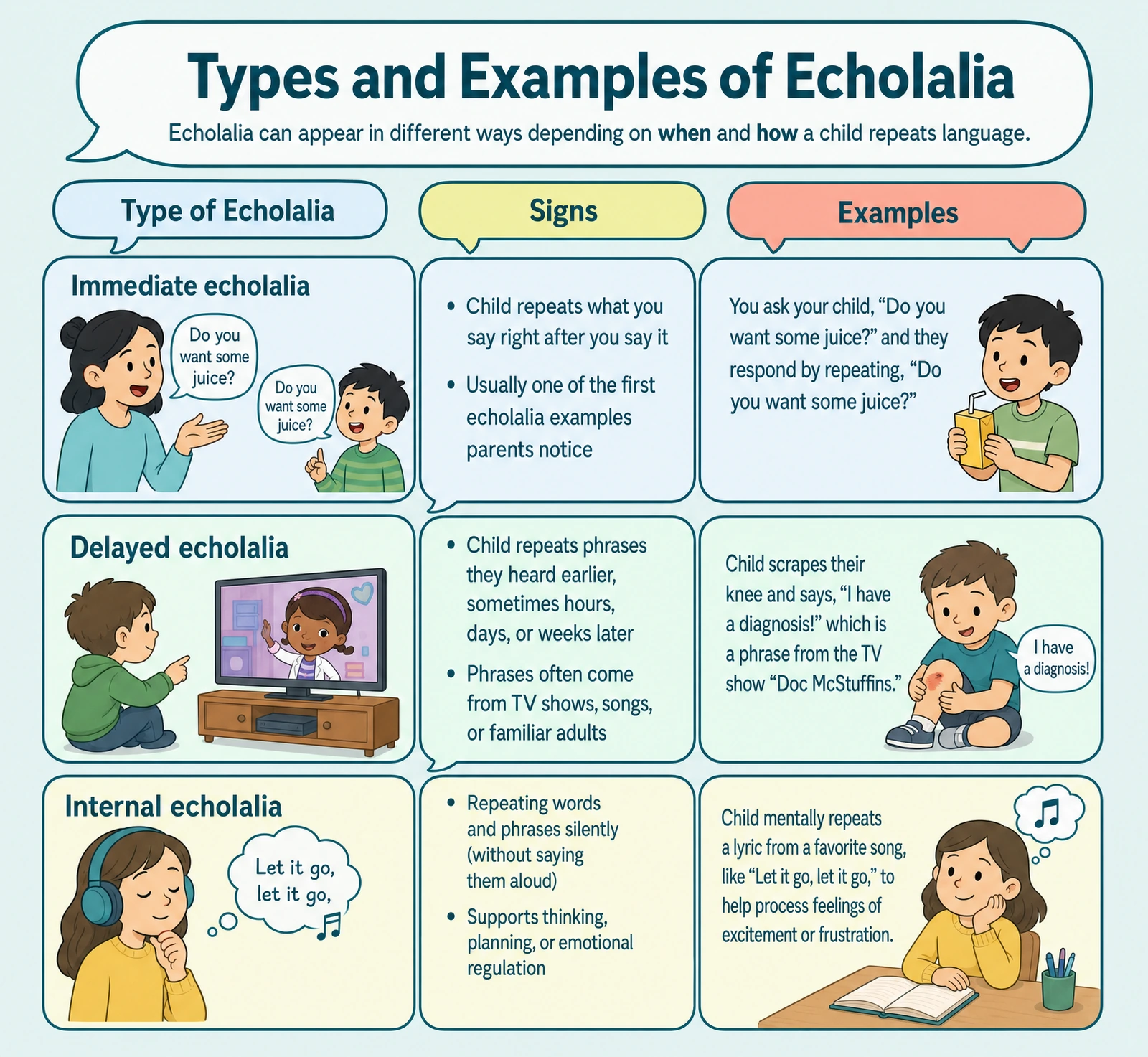
Ciara Smith-Vazquez, M.S., CCC-SLP, is a speech-language pathologist who specializes in autism. She explains that echolalia can take different forms depending on when and how a child repeats language. Parents commonly notice these three types.
Immediate echolalia
Immediate echolalia occurs when a child repeats your words directly after hearing them. If you ask, “Do you want some juice?” for example, the child may answer, “Do you want some juice?”
This repetition is not necessarily meaningless. The child may be using your words to show what they want, meaning that they do want juice, particularly while they are still developing independent expressive language.
Note: This is often one of the first forms of echolalia that parents notice.
Delayed echolalia
Delayed echolalia is the repetition of language heard earlier, sometimes hours, days, or even weeks before. These phrases frequently come from songs, TV shows, or familiar adults.
For instance, a child who scrapes their knee might say, “I have a diagnosis!” The phrase comes from the TV show Doc McStuffins. On the show, the line is used when a character is hurt and needs care. Although the exact words do not fit the situation, the child is using them meaningfully to express pain and seek help.
This type of echolalia is common among gestalt language processors, who use learned phrases, or gestalts, as complete units of communication.
Internal echolalia
Internal echolalia involves silently repeating words or phrases rather than saying them aloud. It may help with thinking, planning, or regulating emotions.
For some autistic children and adults, internal echolalia is a natural part of cognitive processing. Smith-Vazquez says it can support self-regulation or language comprehension.
Is echolalia a sign of autism or ADHD?
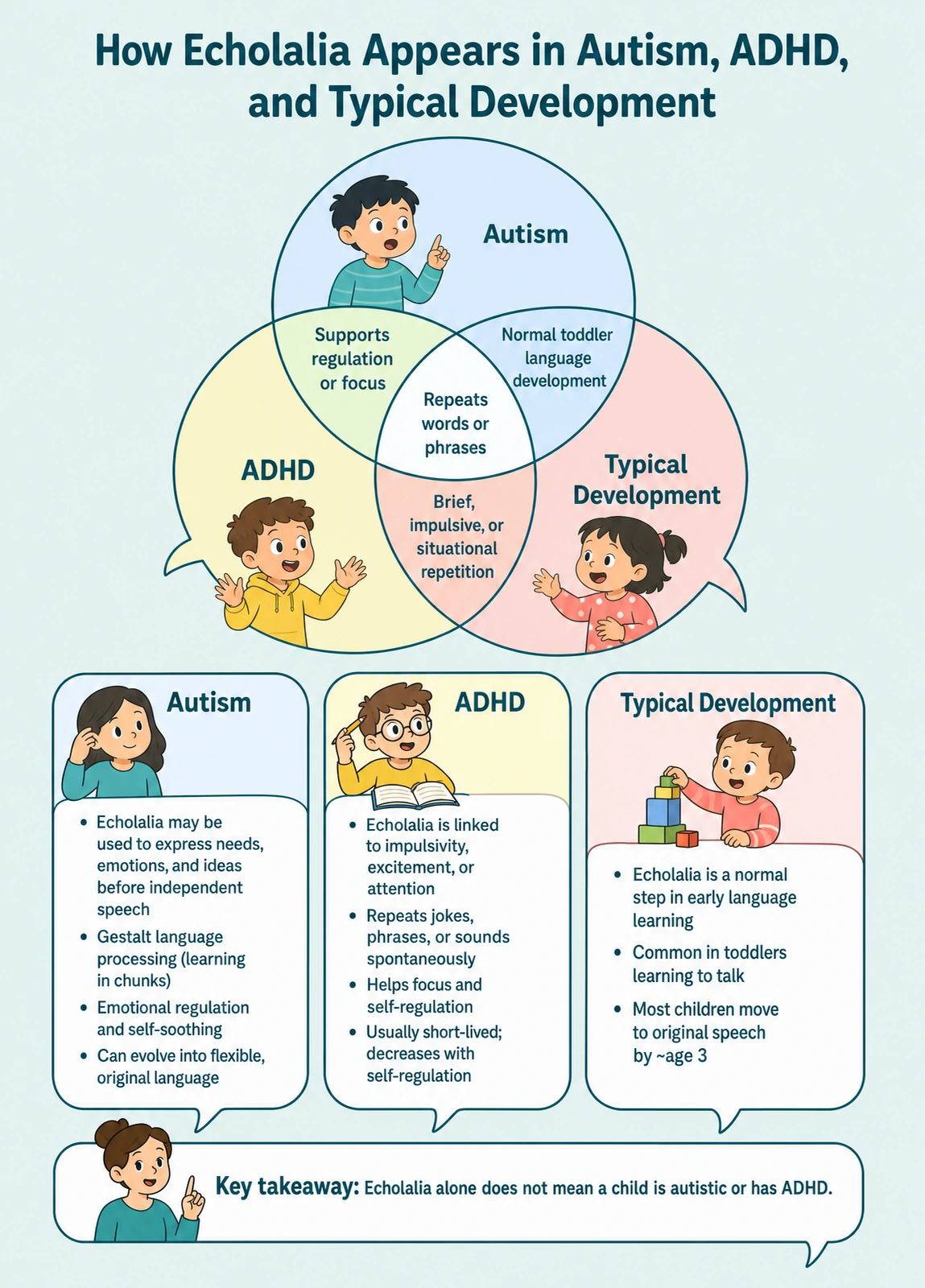
Many parents ask this after hearing repeated phrases or scripts in their child’s speech. The short answer is that echolalia can occur with autism, with ADHD, and during typical development. On its own, echolalia is not a diagnosis.
It is more important to understand how and why a child uses echolalia than to focus on repetition alone.
Echolalia and autism
Echolalia is commonly associated with autism, especially among children who are gestalt language processors. Their repeated phrases are not random. Repetition gives them a way to communicate before they can break language into smaller pieces. Smith-Vazquez notes, “Echolalia often serves as a bridge to more flexible communication. It helps children express their needs and process language while they develop independent speech.”
For autistic children, echolalia may:
- Provide a way to communicate while spontaneous speech is still developing
- Support emotional regulation or self-soothing
- Intentionally express needs, emotions, or ideas
Echolalia in autism often changes over time. With support, a child may progress from repeating whole phrases to using flexible language of their own.
Echolalia and ADHD
Children with ADHD may also use echolalia. In these cases, it is generally connected to impulsivity, attention, or regulation rather than differences in language processing.
In children with ADHD, echolalia may:
- Occur during periods of excitement or high energy
- Include the impulsive repetition of jokes, phrases, or sounds
- Help support focus or self-regulation
In these situations, echolalia is usually less persistent and may decline as a child develops stronger self-regulation skills.
Echolalia during typical development
Echolalia can also be a normal feature of early language development. Many toddlers repeat words and phrases while learning how language works.
Most children naturally use less echolalia once they begin creating their own sentences, often at around age 3. If repetition persists beyond this stage or takes the place of independent speech, consider speaking with a speech therapist.
What to remember
Echolalia alone does not indicate that a child is autistic or has ADHD. Before making recommendations, speech-language pathologists consider the child’s overall development, including communication skills, social interaction, play, and emotional regulation.
Why do children use echolalia?
Toddlers often repeat words and phrases as they figure out how language works. At this stage, repetition helps them practice sounds, develop vocabulary, and learn how words fit together.
Echolalia can also be a valuable communication tool for children who find it difficult to generate language independently. For some children with speech or developmental differences, including autism, repeating familiar language may be the easiest way to share thoughts, needs, or emotions before they can create original sentences.
Children may rely on echolalia for several important purposes:
- Processing language: Repeating phrases can help children understand the language they hear and store it for future use.
- Early attempts to communicate: The words may not be original yet, but echolalia can still convey a clear message, such as a request for help or comfort.
- Self-regulation: Familiar phrases may feel calming and help children cope with big emotions or sensory overload.
- Memory and meaning-making: Children often repeat scripts connected with particular experiences, routines, or emotions.
“Persistent echolalia is common in autistic children, especially those who are gestalt language processors. But it’s important to remember that echolalia does not automatically mean a child is autistic,” says Smith-Vazquez.
If you are not sure what your child’s echolalia is communicating, a speech therapist can help interpret its meaning and identify the best ways to support your child’s language development.
Do children grow out of echolalia?
Many children do grow out of echolalia, particularly when it occurs as part of typical language development. In this context, “growing out of echolalia” does not mean the repetition was a problem. It means the child’s language is continuing to develop and mature.
Autistic children and children with other developmental differences may continue using echolalia for longer. Often, the echolalia changes instead of disappearing. A child may start separating phrases into parts, combining those parts in new ways, or using the phrases more deliberately to communicate needs, thoughts, and feelings.
Signs that echolalia is developing into more flexible language may include:
- Applying echoed phrases in new situations
- Modifying parts of a repeated phrase
- Combining echolalia with gestures, eye contact, or other forms of communication
Smith-Vazquez reassures parents and caregivers that, with speech therapy and appropriate support, many children can learn to communicate more independently and clearly. A speech therapist can identify how a child uses echolalia and help them take their next steps in communication.
How echolalia can help children
Echolalia can be useful. For many children, it has an important role in communication, learning, and emotional regulation. What sounds like simple repetition is often meaningful.
Echolalia may help a child:
- Communicate their intent when creating original sentences is difficult
- Learn patterns of language and how conversations work
- Regulate emotions or feel calm and organized
- Connect socially and participate in interactions
Children who use echolalia often connect meaning to an entire phrase instead of understanding every word separately. This pattern is common among gestalt language processors, who learn language in chunks called “gestalts.”
A child might use echolalia to:
- Request something
- Respond to a question
- Begin an interaction
- Take conversational turns
- Communicate yes or no
For example, when a child realizes it is bedtime, they might say, “Which story do you want to read?” They know the phrase belongs to the bedtime routine, even if they do not yet understand every word in it.
“Remember,” says Smith-Vazquez, “echolalia isn’t meaningless repetition. It’s often a bridge toward more independent language, especially when children are supported in the right way.”
Related guides







How to support a child who uses echolalia
If you want to help a child who uses echolalia, a speech therapist can provide individualized, supportive guidance. Speech therapy aims to help children communicate with greater clarity and confidence, not to eliminate echolalia altogether.
Smith-Vazquez recommends trying these strategies at home:
1. Model language from your child’s perspective
Rather than asking questions or correcting your child, model a phrase as they would say it. For example, you might say:
- “I found my race car!” rather than
- “Do you see the race car?” or “You found your race car.”
This approach gives your child language that feels meaningful and ready to use.
2. Focus on the meaning, not the precise words
Notice what your child is doing, feeling, or responding to when a familiar phrase appears. Echolalia often carries a message, even when the words are not an exact match for the situation.
3. Let your child lead
Avoid filling the interaction with questions or commands. When possible, allow your child to take the lead. Following their interests builds connection, lowers pressure, and gives communication room to develop naturally.
Demanding that a child “say it differently” or repeatedly correcting them is usually not helpful. It can increase frustration and make the child less likely to communicate.
How speech therapy supports children with echolalia
Speech therapy can provide important support for children who use echolalia. The aim is not to stop the echolalia. Instead, therapy helps children develop it into functional, flexible communication.
This process usually begins with a speech and language evaluation. The speech therapist examines how your child communicates, how echolalia functions in their communication, and which supports help them understand and express language.
Speech therapy for echolalia may address:
- Building functional communication skills
- Supporting gestalt language processing
- Developing strategies for regulation and self-advocacy
- Coaching parents and caregivers to support communication at home
Family involvement is particularly important. When caregivers understand the purpose of a child’s echolalia and know how to respond, children often make faster, more meaningful progress.
Get matched with a speech therapist experienced in treating children who use echolalia.
Echolalia evaluations and when to seek help
Echolalia is not a diagnosis. It is a communication style or language pattern. If your child uses echolalia and you have noticed other developmental concerns, such as signs of autism, speak with your pediatrician. Your child’s doctor may recommend a speech and language evaluation and, in some situations, an autism evaluation.
Signs that your child may benefit from support include:
- Using few original words or sentences
- Having difficulty responding to their name or engaging socially
- Relying on behaviors such as tantrums to communicate their needs
- Using speech that sounds monotone or has little variation in tone
- Reacting strongly to sensory input, including noise or food textures
For autistic children, echolalia is often a meaningful, important part of communication development. A speech therapist can help the family understand how the child uses echolalia and support the gradual development of more flexible language.
Read our guide to speech therapy for autismfor more information, or use our free screener to learn whether your child might benefit from a speech evaluation.
Frequently asked questions about echolalia
Can someone have echolalia without being autistic?
Yes. Echolalia can occur in people who are not autistic. It is common during typical toddler development and can also appear in children with ADHD. Although many autistic children use echolalia, echolalia alone is not a diagnosis.
What is an example of echolalia?
One common example is a child immediately repeating a question. Instead of answering yes or no, the child might echo, “Do you want to go to the park?” Delayed echolalia is another example, such as quoting a line from a TV show later to communicate a feeling or need.
What is internal, or internalized, echolalia?
Internal echolalia is the silent repetition of words or phrases without saying them aloud. Some children and adults use it while thinking, planning, or regulating emotions.
Does echolalia require treatment?
Echolalia often does not need treatment. In many cases, it is a useful and appropriate stage of language development. Treatment may be recommended when echolalia limits communication, creates frustration, or interferes with everyday activities.
What does at-home treatment for echolalia involve?
At-home support generally involves modeling meaningful language, following the child’s lead, and responding to the intent of repeated phrases instead of correcting the words. A speech therapist can suggest specific strategies for everyday routines.