


First, you’re thrilled to hear your child say a word. Before long, they’re talking nonstop, in the best possible way. Listening to that little voice is wonderful, but some children have trouble forming certain sounds. Does that mean parents should worry? This speech sound development chart explains which sounds are expected at each age and how you can help at home. Hint: Keep the conversation going.
At well visits, my children’s pediatrician always “interviews” them. What do they want to be when they grow up? Do they like school? Which sports do they play? I didn’t realize that these conversations also helped the doctor listen to how my children pronounced sounds.
During one visit, my son’s doctor made an observation that helped us: “You know, he’s having a hard time with the letter ‘r.’ Have you considered speech therapy?” We scheduled an evaluation. After improving his /r/ pronunciation, he “graduated” from therapy a few months later.
A knowledgeable pediatrician matters, but parents also benefit from understanding speech development. That’s where a speech sound development chart can help. This guide covers what to expect as your child develops speech sounds, when to consider an evaluation, and practical ways to support them at home.
Key takeaways
- Speech sounds develop gradually over the first five years of a child’s life.
- By age 4, familiar listeners should be able to understand your child. By age 7, anyone listening should be able to understand them.
- Consider a speech therapy evaluation if your child is not meeting speech milestones or if their speech regresses, meaning it gets worse.
- You can support speech sound development at home in many ways. Choose playful, enjoyable activities that hold your child’s interest.
Free 30-minute evaluation
Looking for a speech therapist?
Talk through what you are noticing and get clear next steps.
Book free evaluation
How to use this guide
Use this guide for quick at-home checks and practical strategies for children ages 1 through 7 and older:
- Go to the speech sounds by age chart, find your child’s age, and review what typical sound development looks like.
- Review the intelligibility milestones and warning signs to decide whether a speech evaluation may be appropriate.
- Choose one or two home strategies to begin supporting your child’s speech sound development.
Speech sounds by age chart
Sounds that are easier to produce tend to develop first. That’s why one of my sons used to say “strawbabies” instead of “strawberries.” I still love remembering it. Every child develops differently and has their own strengths and support needs. If your child has difficulty with one sound, it does not necessarily mean they have a speech problem.
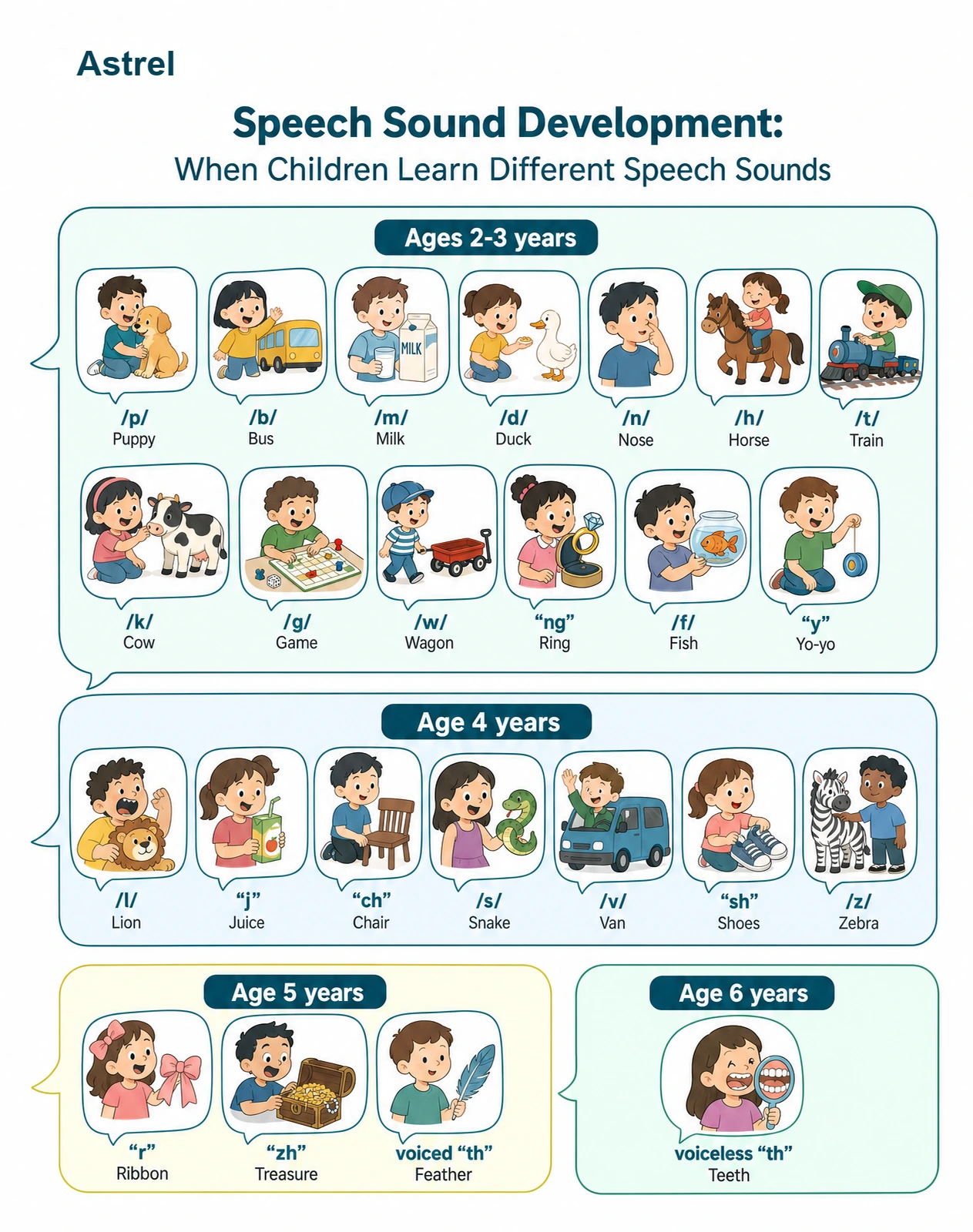
This speech development chart shows when children are generally expected to form different sounds:
Ages 6 months to 1 year
- Babbles in long strings of sounds, such as mimi, upup, bababa, and mamamama
Ages 2 to 3 years
- /p/, /b/, /m/, /d/, /n/, /h/, /t/, /k/, /g/, /w/, /ng/, /f/, /y/
Age 4
- /l/, /j/, /ch/, /s/, /v/, /sh/, /z/
- May still make errors with /s/, /sh/, /ch/, /j/, /ng/, /th/, /z/, /l/, and /r/
Age 5
- /r/, /zh/, and voiced /th/, as in “that”
- By age 5, most children can produce all types of speech sounds
Age 6
- Voiceless /th/, as in “thick”
Speech intelligibility milestones
Children’s speech usually becomes clearer as they grow. Guidelines describe how understandable their speech should beat different ages. Speech therapists call this intelligibility. Here are the milestones they look for:
- Age 2: About 50% of speech is understandable to familiar listeners, meaning people who talk with the child often
- Age 3: About 75% of speech is understandable to familiar listeners
- Age 4: About 90% of speech is understandable to familiar listeners, and more than 50% is understandable to unfamiliar listeners, meaning people who do not talk with the child often
- Age 5: About 75% of speech is understandable to unfamiliar listeners
- Age 7: About 90% of speech is understandable to anyone the child speaks with
Common speech sound errors
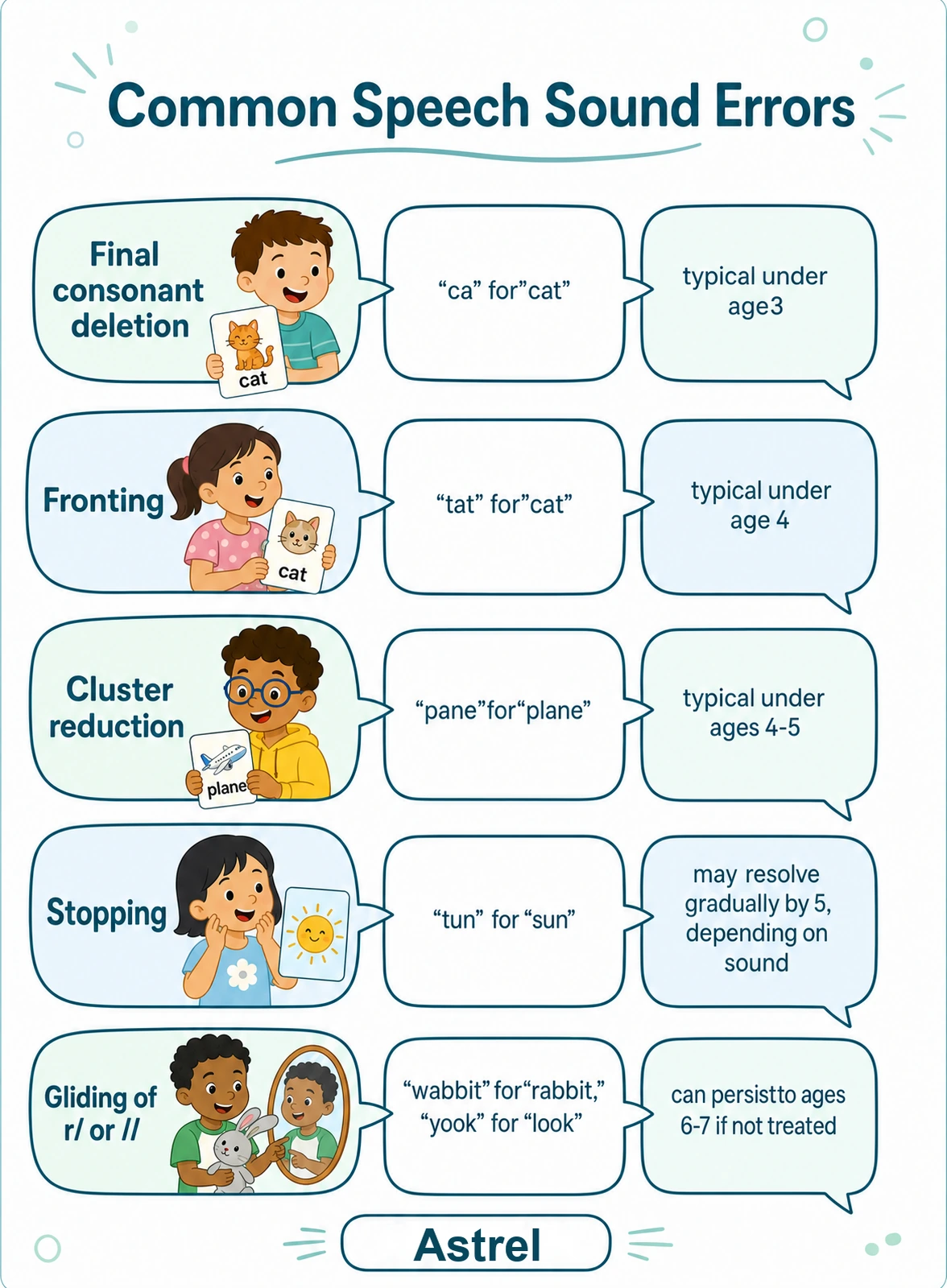
Children develop language at different rates, and some speech sound “errors” are both normal and expected. You may hear your child say “tat” for “cat” or “wabbit” for “rabbit.” These patterns usually fade over time.
These are some common speech sound patterns to listen for:
- Final consonant deletion (saying “ca” instead of “cat”): typical before age 3
- Fronting (saying “tat” instead of “cat”): typical before age 4
- Cluster reduction (saying “pane” instead of “plane”): typical before ages 4-5
- Stopping (saying “tun” instead of “sun”): may gradually resolve by age 5, depending on the sound
- Gliding of /r/ or /l/ (saying “wabbit” for “rabbit” or “yook” for “look”): can persist until ages 6-7 without treatment
Word examples for each sound
If your child is having difficulty with a particular sound, you can use these parent-friendly words as prompts:
- p/b/m: puppy, bus, milk
- t/d/n: train, duck, nose
- k/g/ng: cow, game, ring
- f: fish
- v: van
- s/z/sh/ch/j: snake, zebra, shoes, chair, juice
- l: lion
- r: ribbon
- zh: treasure
- th (voiced): feather
- th (voiceless): teeth
- Blends: star, blue, train, splash
When to monitor speech and when to seek an evaluation
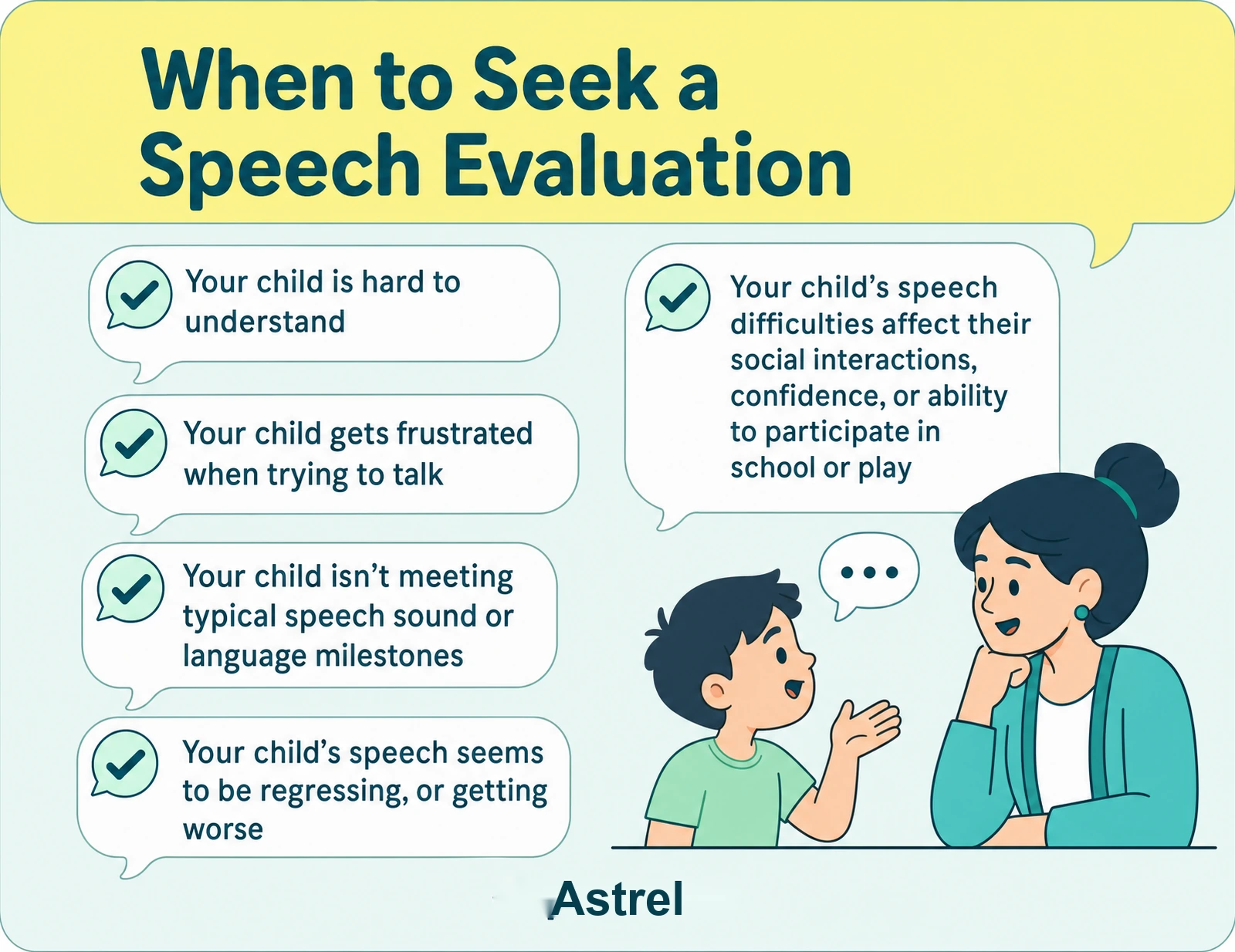
“All children develop speech sounds at their own pace, and it’s normal for them to make certain sound errors as they learn,” says Adhvika Shetty, a speech-language pathologist with Astrel. Even so, some signs deserve attention. Consider scheduling an evaluation with a speech therapist if you notice any of the following:
- Your child is difficult to understand
- Your child becomes frustrated when trying to speak
- Your child is not meeting typical speech sound or language milestones
- Your child’s speech appears to be regressing, or getting worse
- Speech difficulties affect your child’s social interactions, confidence, or ability to take part in school or play
An evaluation may show that your child’s development is on track. Still, it is better to have concerns evaluated sooner. “Early evaluation can help determine if a child’s speech is developing typically or if therapy could support clearer, more confident communication,” Shetty says.
Speech sound development in bilingual and multilingual children
If your child speaks two or more languages, learning multiple languages does not cause speech sound delays, Shetty says. “Children may make different sound errors in each language because the sounds and rules can vary,” she explains. Keep speaking and reading with your child in every language they use. “Consistent exposure helps strengthen overall speech and language development.”
However, if a child has the same speech sound difficulty in every language, a speech sound disorder may be the cause. A speech therapist can determine which sounds need support and provide help in both languages.
Related guides





What happens during a speech therapy evaluation
Once you have scheduled your child’s speech therapy evaluation, you may wonder what to expect. “We use a variety of tools and activities to understand how the child produces sounds and what might be causing any difficulties,” Shetty says. She describes these parts of the evaluation process:
- Oral mechanism exam: Examines how the child’s lips, tongue, jaw, and palate move and work together during speech. It can reveal physical concerns, such as muscle weakness or dental problems, that may affect speech.
- Hearing screening: When needed, a hearing screening can help rule out hearing issues that may contribute to speech sound production difficulties.
- Speech sound assessment: Often uses a standardized test, such as the Goldman-Fristoe Test of Articulation-3 (GFTA-3). “This helps identify which sounds the child can say correctly and which ones they find difficult,” Shetty says.
- Speech sound collection: The speech therapist engages your child in play or conversation while listening for patterns in sound errors, consistency, and intelligibility.
For more information about how Astrel evaluates and treats articulation difficulties in children, read our speech sound disorder treatment guide.
Home practice: Simple, play-based strategies
Practicing at home can make a meaningful difference in your child’s speech sound development. Shetty says parent involvement is essential. “When we’re talking about a child with speech sound difficulties, the ultimate goal of speech therapy is generalization. This means that a child has learned to pronounce and use their target sounds in all settings and situations, no matter who they’re talking to,” she explains. Generalization is important because it supports a child’s safety, including the ability to express themselves in an emergency, as well as reading, confidence, and the ability to make friends, she says.
Try these ways to make practice an enjoyable part of everyday life:
- Listen closely: Pay attention to the sounds or words your child finds difficult, then share those observations with their speech therapist, Shetty says.
- Model the correct sounds: Rather than correcting your child, demonstrate the correct pronunciation, Shetty says. If your child says, “pwaying wif da ball,” for example, you can respond, “You’re playing with the ball!”
- Narrate your day: Talk throughout the day. “When you’re around your child, tell them everything you’re doing,” says Clare Short, M.Ed., CCC-SLP, an Atlanta-based speech-language pathologist and author of Bo the Boat, a book created to support early speech development. “When you narrate your daily activities, your child is exposed to language all day long.”
- Read books: “Reading is our number one favorite way to encourage sound development,” Short says. “Reading once a day introduces children to thousands of words and more complex language than they hear in their daily routine.”
- Try flashcards or word lists: Create your own at home, or purchase flashcard sets online or in a store. You can also buy talking toy flashcard devices .
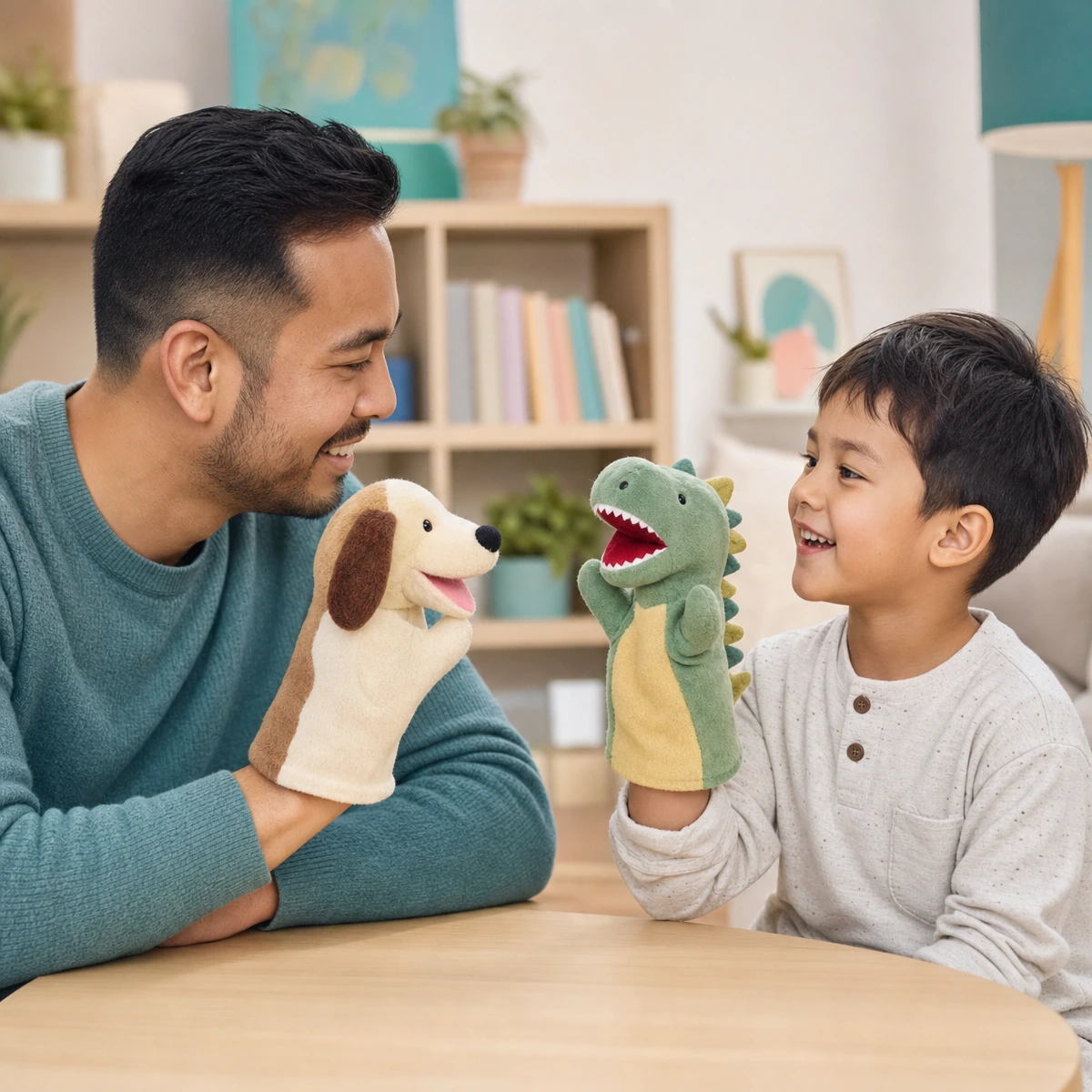
Most importantly, keep the focus on play and enjoyment. Few children want to practice a target sound for 20 minutes without a break, so build practice into an activity they already like. Your child might enjoy making crafts, kicking a soccer ball, doing yoga poses, or playing board games. Use those interests to make practice engaging. Before each craft step, kick of the ball, or turn in the game, ask your child to practice one or two words.
Tips for the classroom
Tell your child’s teacher which sounds you are practicing together. This can help in several ways. “It’s common for parents and close family to understand more of what a child says than unfamiliar listeners like teachers or new friends. This can sometimes be frustrating for both the child and family,” Shetty says.
Ask the teacher how they can encourage your child’s speech sound development. Remind them to give your child their full attention when the child speaks. Depending on your child’s age, the teacher might also use tools such as word lists or visual blends. Your speech therapist can suggest guidance and ideas to share with the teacher.
Keep speech practice positive and supportive
Supporting your child’s speech at home can be both meaningful and rewarding. Inclusivity begins with acceptance. Your child will make errors when speaking, and that is OK.
“It’s often tempting to stop and correct your child right away. However, this can make your child feel discouraged and frustrated,” Short says. Instead, return to modeling. Your child can hear the correct articulation of sounds without feeling that they have done something wrong or disappointed you.
By modeling speech, you let your child hear sounds articulated correctly without making them feel that they are doing something wrong.
Make home practice part of your normal routine, too. Ask your child questions after school or during dinner. In the car, talk about what you see together. Look for ways to hear and understand your child more easily. For example, turn off the television or music during conversations to reduce background noise.
Speech practice supplies
You do not need many supplies to support speech sound development. Simply talking together can be fun and helpful. If you want additional tools for home practice, consider word lists, paper or electronic flashcards, a home practice tracking log, or a reading log. Books are useful, too. Look for stories with repetition, which helps children absorb sounds. Short recommends:
- Brown Bear, Brown Bear by Bill Martin Jr.
- Goodnight Moon by Margaret Wise Brown
- Chicka Chicka Boom Boom by Bill Martin, Jr., and John Archambault
- Where's Spot by Eric Hill
- The Very Hungry Caterpillar by Eric Carle
- Wishy Washy by Tabitha Paige
- Imitation by Stephanie Anderson
- Hi, How Are You by Holly Rosensweig
You can also explore our therapist-recommended book lists organized by sound:
- Books for practicing the /s/ sound
- Books for practicing the /r/ sound
- Books for practicing the “SH” and “CH” sounds
- Books for practicing the /l/ sound
- Books for practicing the “TH” sound
Frequently asked questions
Is it normal for my 3-year-old to say “tat” instead of “cat”?
Yes. Saying “tat” instead of “cat” is very common and typically fades as a child gets older. If the pattern continues after age 4, consider a speech evaluation.
My 4-year-old is still hard for strangers to understand. What should I do?
At age 4, children are expected to be 50% understandable to strangers. If strangers cannot understand what your child is saying, it may still be normal. If you are concerned for any reason, schedule a speech evaluation.
Do children “outgrow” lisping?
If you think your child has a lisp, schedule an evaluation with a speech therapist. In some cases, a lisp results from incorrect tongue placement, which could further affect how the teeth are arranged. An uncorrected lisp can continue into adulthood. Speech therapy can correct a lisp in both children and adults.
Can practicing an incorrect sound make it worse?
It is OK if your child uses an incorrect sound, and you do not need to correct them. Instead, model the correct speech sounds during conversation. This is one of the best ways to help your child develop the sound correctly.
Does bilingualism cause speech delays?
No. Bilingualism and multilingualism do not cause speech delays. Families are encouraged to speak and read together at home in all of their languages.