


If you have a young child, you have probably heard them mispronounce a few words. It can be adorable when a toddler says, “Let’s pway outside!”
As charming as these mispronunciations can be, there comes a point when they may be clinically classified as an articulation disorder. How can you tell whether your child has articulation difficulties? We’ll look at the causes and signs of this speech sound disorder so you can recognize possible concerns in your child’s speech. We’ll also explain how speech therapy can improve articulation.
What is an articulation disorder?
Articulation is the way we produce speech sounds. Making these sounds requires coordinated movement of the lips, tongue, teeth, palate (the roof of the mouth), and respiratory system (the lungs).
Children with articulation disorders have trouble coordinating these motor functions to physically produce the correct speech sounds. As a result, they may be unable to form clear, understandable words beyond a certain age, making their speech difficult to understand.
The prevalence of speech sound disorders among young children is approximately 8% to 9%. By first grade, about 5% of children have noticeable speech problems.
Free 30-minute evaluation
Looking for a speech therapist?
Talk through what you are noticing and get clear next steps.
Book free evaluation
How can you tell if your child has an articulation disorder?
As noted above, it is completely normal for toddlers and young children to mispronounce sounds as they grow. Every child develops at a different pace, but children are generally expected to produce certain sounds correctly by particular ages. If your child cannot pronounce those sounds by the expected age, you may notice these errors in their speech:
- Errors related to differences in orofacial structures, such as the mouth, tongue, or teeth (saying “hip” instead of “ship”)
- Distorting or mispronouncing sounds within words (saying “thith” instead of “this”)
- Substituting one sound for another in a word (saying “wadio” instead of “radio”)
What causes speech articulation problems?
Parents and caregivers often want to understand what is causing their child’s speech difficulties. In many cases, a speech sound disorder has no known cause.
In other cases, several factors may play a role. These include differences in orofacial structures, hearing problems, and genetic disorders such as Down syndrome.
According to the American Speech-Language-Hearing Association (ASHA), certain factors may make a child more likely to develop a speech sound disorder. They include:
- Gender: Speech sound disorders are more common among males than females.
- Pre- and perinatal problems: Maternal stress or infections during pregnancy, birth complications, preterm delivery, and low birthweight are associated with speech sound problems.
- Family history: Children with parents or siblings who have speech or language difficulties may be more likely to have a speech disorder.
Why is clear speech so important?
Clear articulation that is appropriate for a child’s developmental stage helps them communicate as effectively as possible. Other people may not always understand children with speech sound problems, especially unfamiliar listeners who do not know them well. These children may feel self-conscious and struggle socially and academically after they start school.
Studies have also shown that children with poor speech sound skills may have trouble with reading and other literacy tasks as they get older. This is another important reason to identify and treat articulation problems as early as possible.
Related guides






How does speech therapy address articulation problems?
Speech therapists work with children to correct articulation problems, and many children make major gains in their ability to speak clearly through speech therapy. A speech therapist will identify your child’s specific difficulties, create an individualized treatment plan, and work with you to improve your child’s articulation.
Articulation therapy involves progressing through what is called a “speech sound hierarchy.” This step-by-step sequence helps your child learn to produce each sound correctly. Here is what the hierarchy can look like when the /s/ sound is used as an example:
- Isolation level: Producing the sound on its own (sssssssss)
- Syllable level: Combining the sound with a vowel (say, see, sigh, so, sue)
- Word level: Producing the sound within a word (sun, dinosaur, house)
- Phrase level: Combining several /s/ words in short phrases of two or three words (hot soup, sit down)
- Sentence level: Producing longer, more complex sentences that contain /s/ words (The sun sets at 6 pm)
- Conversation level: Using /s/ words with 100% accuracy in connected conversational speech
To help your child move through this hierarchy, the speech therapist will first teach articulatory placement. This includes tongue position and tension, lip shape, and voice use. The goal is to help your child learn the correct “motor pattern” for producing the sound accurately. Once your child can make the sound correctly in isolation, such as “sss,” they have a foundation for producing it at more complex levels, such as in “hot soup.”
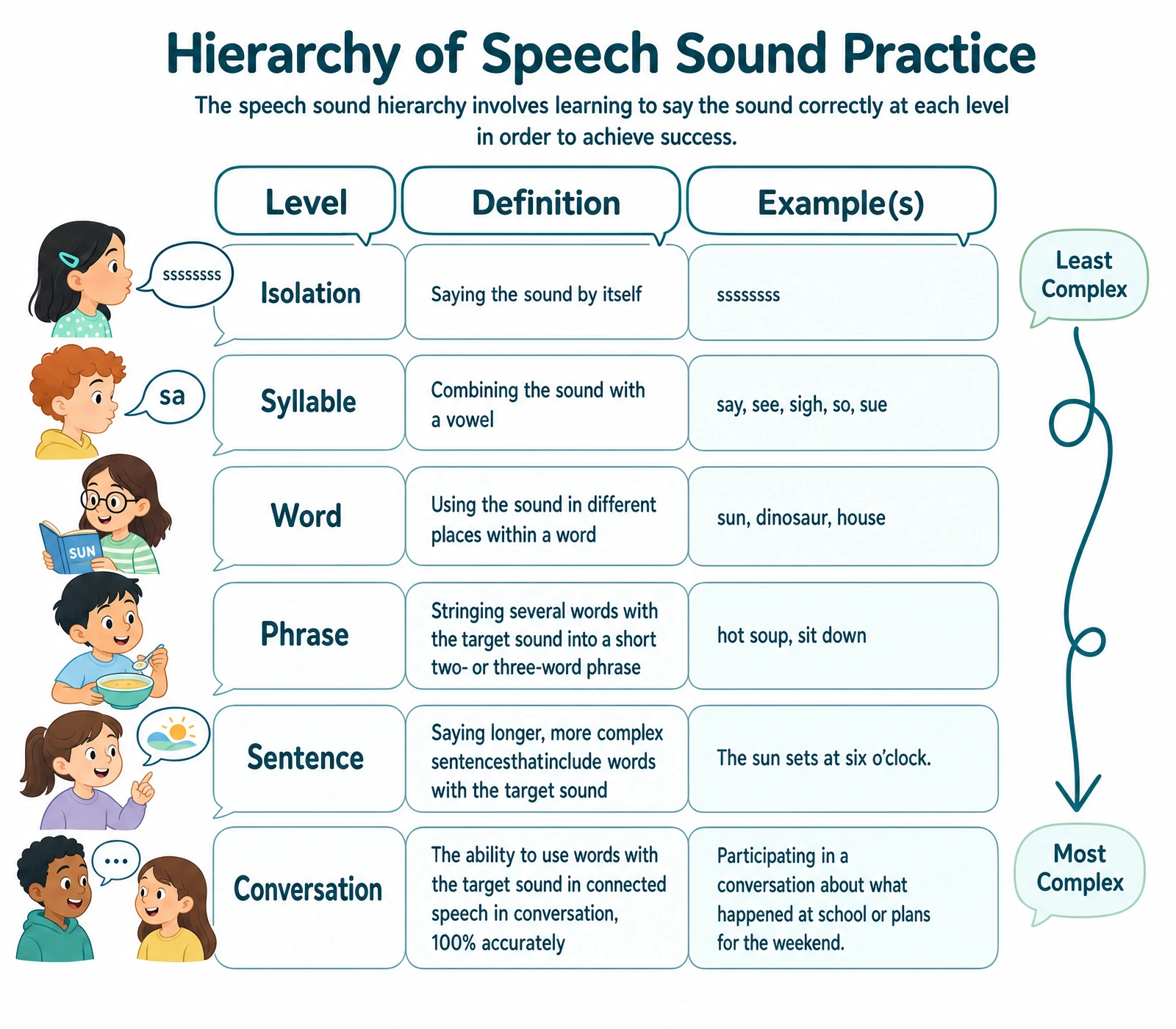
In some cases, the speech therapist may start practice at a higher point in the hierarchy, such as the word level instead of isolation. As your child becomes ready, the therapist will guide them in practicing a range of words that place the sound in different positions, such as sun, dinosaur, and house. The therapist will use clinical judgment to help your child make the quickest progress.
At every level, the speech therapist will use “multimodal cues” to help your child learn correct articulation. These cues may include prompts such as:
- Explaining how to position the mouth, lips, and tongue
- Modeling, or demonstrating, the correct tongue placement
- Using a gesture to represent the sound
- Asking you or your child to touch specific parts of the mouth to guide the tongue into position
How can you find a speech therapist for articulation?
If your child’s speech is difficult to understand, ask your pediatrician for a speech therapy referral. Your pediatrician will likely be able to recommend speech therapists.
You can also ask friends or relatives whose children have received speech therapy. A recommendation from someone you know can be especially helpful.
If you plan to use insurance, contact your insurance company for a list of speech therapists who are in network with your plan.
Ideally, you want a speech therapist who works well with both your child and you. The therapist should make sessions fun and engaging for children, keep you informed about your child’s progress, and provide weekly activities to practice at home. Take some time to research your options and find the right speech therapist for your child. To be matched with an Astrel speech therapist, start our simple signup process here!