


Speech sound disorders, also known as articulation disorders, are common among young children who are learning to talk. Some children have trouble pronouncing a few sounds but eventually catch up without treatment.
If a child continues to have difficulty saying sounds or words correctly beyond a certain age, it may be a sign of a speech sound disorder. For caregivers, watching a child struggle to speak clearly can be stressful, especially when other people cannot understand them.
Adultscan also have speech sound disorders. Some adults have speech difficulties that began in childhood, were never properly treated, and persisted over time. Other speech problems may develop after a stroke or traumatic brain injury.
Speech sound disorders are a common condition treated at Astrel. This comprehensive guide explains what can cause speech articulation problems, which signs to watch for, and how speech therapy can help you or your child speak more clearly.
What is a speech sound disorder?
A child who cannot pronounce certain sounds or words by the expected age may have a speech sound disorder. People with these disorders can be difficult to understand. In many cases, the speech problem affects a person socially, at school, or at work.
Producing speech sounds correctly requires us to (1) understand how to make each sound and (2) coordinate the movements needed to produce it. These include movements of the jaw, tongue, and lips, along with breathing and vocalizing.
Free 30-minute evaluation
Looking for a speech therapist?
Talk through what you are noticing and get clear next steps.
Book free evaluation
Types of speech sound disorders
Speech sound disorders generally fall into two categories: functional and organic. Identifying the type is essential for effective treatment, which is why assessment and diagnosis by a licensed speech-language pathologist, also called a speech therapist, are so important. Speech problems can be treated, and research shows that earlier interventions lead to better outcomes.
Functional speech sound disorders
The two types of functional speech sound disorders are articulation disorders and phonological disorders. Their cause is usually unknown.
- Articulation disorders: Making a sound requires coordinated movement of the lips, tongue, teeth, palate (the top of the mouth), and respiratory system (the lungs). Children with articulation disorders have difficulty using these motor functions to physically produce the correct speech sounds. As a result, they may be unable to form clear words. They might distort a sound or substitute a different sound.
For example, using the [th] sound instead of the /s/ sound, as in “thun” rather than “sun,” is an articulation disorder. In this example, the person cannot produce the /s/ sound in any word or context. - Phonological disorders: A phonological disorder involves a consistent pattern of errors. A person may be able to produce individual sounds correctly in some situations but have difficulty combining those sounds to form words.
For instance, someone with a phonological disorder may be able to produce the /d/ sound by itself but substitute it for the /g/ sound in certain words, saying “doe” instead of “go.”
Organic speech sound disorders
With organic articulation disorders, the underlying cause is known:
- Motor/neurological: Motor speech disorders occur when muscle strength or coordination is affected. They may be developmental or arise after neurological damage, such as a stroke or traumatic brain injury.
- Structural: Differences in the structure of the mouth or face can affect speech sound production. A cleft lip and palate is one example. Trauma or surgery can also cause structural differences.
- Sensory/perceptual: Hearing impairment can lead to speech sound difficulties. Children with hearing problems do not hear speech sounds in the same way that others produce them.
Articulation and phonological disorders: A closer look
Articulation and phonological disorders are very common among people receiving speech therapy, especially children. However, distinguishing between them is not always easy. This is why a diagnosis from a speech therapist matters. The type of speech sound disorder will largely shape the person’s treatment plan.
One helpful way to distinguish these disorders is:
- An articulation disorder is a difficulty at the motor and sound-production level. People with this disorder have trouble physically producing individual speech sounds.
- A phonological disorder involves difficulty understanding the meaning that sounds carry and the correct patterns for using them. As a result, the person produces sounds incorrectly. They may say a sound correctly when repeating after someone but struggle to use it correctly in words.
Compared with someone who has an articulation disorder, a person with a phonological disorder is often harder to understand.
Many children with phonological disorders and phonemic awareness disorders, which affect their understanding of sounds and sound rules in words, are likely to have literacy problems. These problems can affect their performance in school.
Signs and symptoms of a speech sound disorder
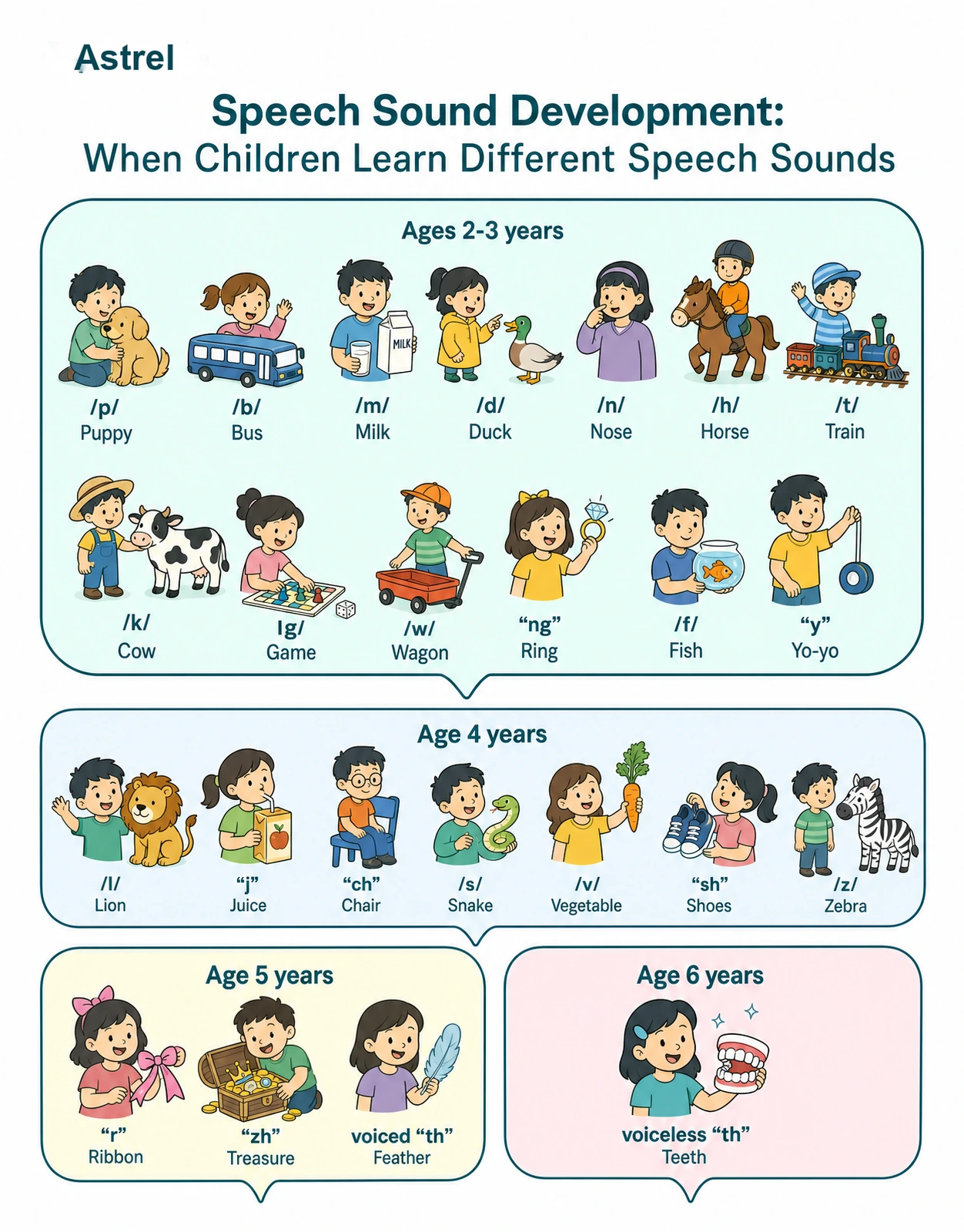
Although every child learns to talk on their own schedule, children are generally expected to produce certain sounds by certain ages. According to the American Speech-Language-Hearing Association (ASHA), most English-speaking children develop specific speech sounds by the ages listed below.
Speech milestones for babies, toddlers, and preschoolers
By 3 months:
- Makes cooing sounds
By 5 months:
- Laughs and makes playful sounds
By 6 months:
- Makes speech-like babbling sounds such as puh, ba, mi, and da
By 1 year:
- Produces longer strings of sounds, such as mimi, upup, and bababa
By 3 years:
- Uses /m/, /n/, /h/, /w/, /p/, /b/, /t/, /d/, /k/, /g/, and /f/ in words
- People who know the child can understand their words
By 4 years:
- Uses /y/ and /v/ in words
- May still make errors on the /s/, /sh/, /ch/, /j/, /ng/, /th/, /z/, /l/, and /r/ sounds
- Most people can understand the child’s speech
If your child is not meeting some of these milestones or their speech is difficult to understand, they may have a speech articulation disorder. You can read more about the signs of a speech sound disorder in this article.
How common are speech articulation disorders?
According to the National Center for Health Statistics, speech problems are the most common communication disorder among children. Of all children ages 3 to 17 years, 5% have a speech problem. Reports estimate that speech sound disorders are more common among boys than girls.
What causes speech sound disorders?
A speech sound disorder often has no known cause. In other cases, several factors may be involved. Possible causes or contributing factors include:
- Brain damage, such as from a head injury
- An intellectual or developmental disability, such as autism
- A genetic disorder, such as Down syndrome
- Hearing problems or hearing loss, such as a history of ear infections
- Physical differences that affect speech, including cleft palate or cleft lip
- Disorders that affect the nerves used for speech, such as cerebral palsy
- Excessive thumb sucking or pacifier use
According to ASHA, research indicates that the following risk factors may also make a child more likely to develop a speech sound disorder:
- Gender: Speech sound disorders occur more often in males than in females.
- Pre- and perinatal problems: Maternal stress or infections during pregnancy, complications during birth, preterm delivery, and low birthweight have been associated with speech delay and speech sound disorders.
- Family history: Children with family members who have speech and/or language difficulties may be more likely to have a speech disorder.
Apraxia of speech and dysarthria are motor speech disorders that can also cause speech problems:
- Apraxia of speech: Childhood apraxia of speech and acquired apraxia of speech (which is more common in adults) are neurological conditions that affect how the brain sends messages to muscles involved in speech production, including the lips and tongue.
A person with apraxia knows what they want to say, but signals between the brain and muscles are not transmitted correctly. As a result, the person cannot properly plan the speech movements required. - Dysarthria: Dysarthria is a motor speech disorder marked by weakness or an inability to control the muscles used for speech. A person with dysarthria may have a hoarse, soft, or strained voice, or speech that sounds slurred or slow.
How are speech articulation disorders diagnosed?
It is important to seek treatment for speech sound problems. With appropriate speech therapy, many children make major improvements in their ability to speak clearly and be understood. Clearer speech helps children communicate their needs and feelings, build relationships, and stay safe.
Studies also show that improving a child’s speech benefits their performance in school. For example, poor speech sound skills among kindergarten children have been linked to literacy problems. Research has also found that preschool children with speech sound difficulties are more likely to have difficulty reading as they grow older.
Studies show that improving a child’s speech can benefit their performance in school.
If your child’s speech is difficult to understand, speak with their pediatrician. The pediatrician will most likely begin by checking your child’s hearing.
If hearing loss is ruled out, contact a licensed speech-language pathologist, also called a speech therapist. Speech therapists are the professionals most qualified to evaluate, diagnose, and treat speech sound disorders. The earlier speech therapy begins, the more quickly speech problems can be corrected.
The speech therapist will complete an evaluation to determine whether your child’s speech difficulties are a typical part of development or the result of a speech sound disorder. The therapist will use standardized or norm-referenced tests, such as the Goldman-Fristoe Test of Articulation, 3rd Edition (GFTA-3) and the Clinical Assessment of Articulation and Phonology, 2nd Edition (CAAP-2). They will assess how easily listeners can understand your child and how your child produces age-appropriate speech sounds in words and sentences.
The speech therapist will also ask about your child’s medical history and observe how they move their lips, jaw, and tongue. This evaluation provides a complete picture of what your child is doing well and where they may need support.
Related guides






How are speech sound disorders treated?
Your speech therapist will work with you to create an individualized treatment plan designed to make your child’s speech easier to understand. The therapist will work with you and your child to:
- Provide speech exercises to prevent the condition from worsening
- Identify the sounds your child pronounces incorrectly
- Teach your child to form specific sounds correctly by using verbal, visual, and tactile cues
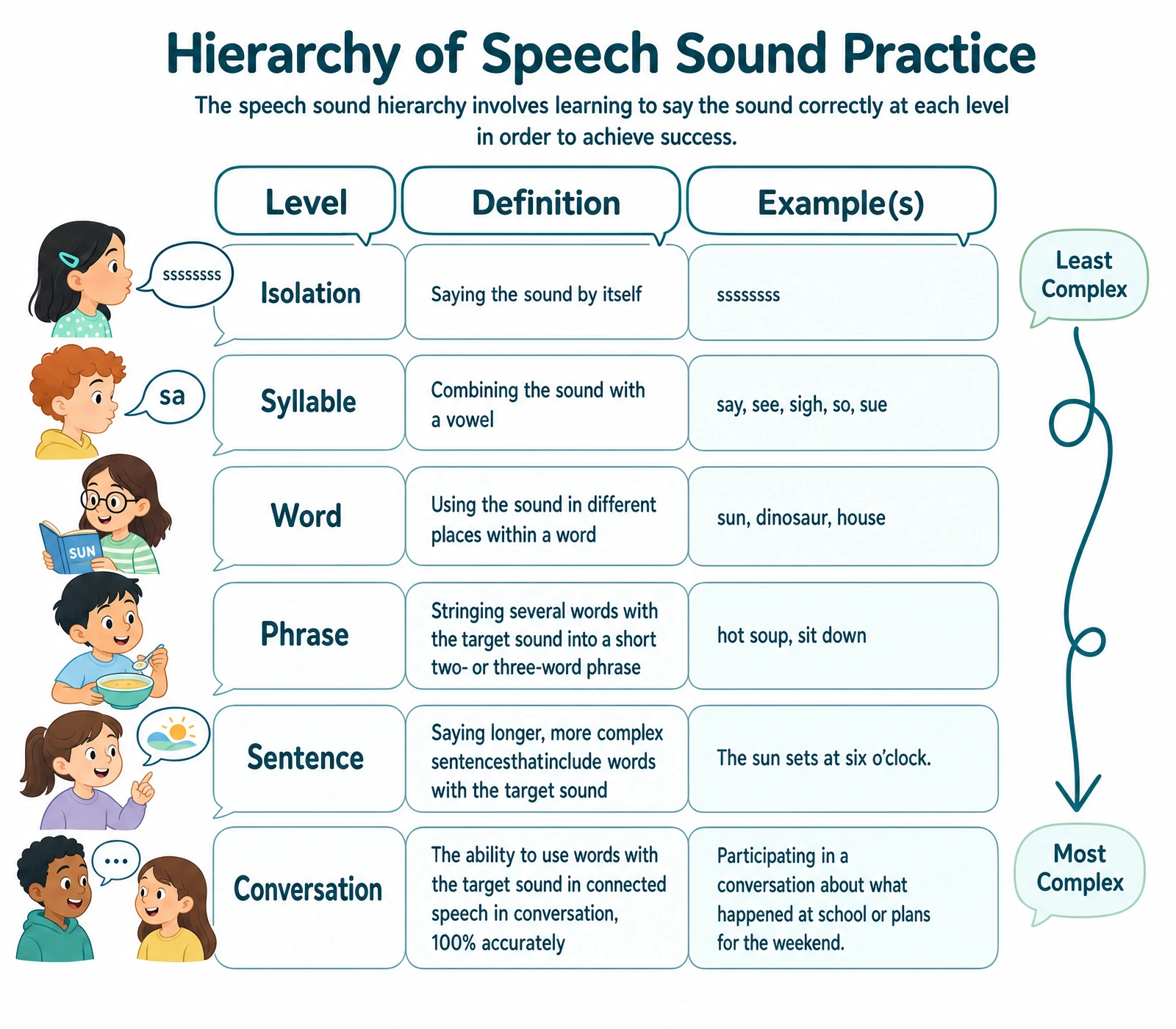
- Practice and repeat sounds in different words and longer sentences
- Share at-home strategies, activities, and games you can use to practice with your child between sessions
You can learn more about how Astrel evaluates and treats articulation disorders in our treatment guide to speech sound disorders and our treatment guide to dysarthria.
Support between sessions: The Astrel portal
At Astrel, speech therapy continues after the session ends. Every Astrel client can use our client portal, which makes practicing speech sound exercises at home easier. More practice leads to faster progress.
The portal includes:
- Learning Paths that explain and reinforce therapy strategies, such as speech modeling and the use of cues to practice specific sounds
- Demo videos that show real techniques in action, including how the mouth moves to produce different sounds
- Home practice activities that fit into everyday routines, such as practicing speech sounds during meals, in the car, or while reading a book
- Text messaging support that lets you ask questions and receive tips from your therapist between sessions
How online speech therapy works for articulation disorders
Astrel matches families and adults with a licensed speech therapist who is trained to evaluate and treat speech delays and disorders. All therapy takes place online through face-to-face video conferencing.
Your child’s age and development will shape how the speech therapist works with them during video sessions.
- Ages 0-3: Caregivers work directly with their child’s speech therapist to learn cues and at-home strategies. This helps them practice confidently with their child outside sessions and improve their child’s speech.
- Ages 3-6: Caregivers join video sessions with their child so both can learn useful skills from the speech therapist. Reinforcing these lessons between sessions supports continued skill building at home.
- Ages 7 and up: Most children attend video sessions independently, while caregivers receive updates and tips during each session.
- Adults: Adults attend sessions independently, but they may bring loved ones to sessions if they wish.
How can I help my child with speech problems at home?
Your involvement is an important part of your child’s speech therapy. Overcoming a speech sound disorder takes time and persistence, and you can help your child practice at home each day as part of your regular routines.
Try these strategies to help your child learn to speak more clearly:
- Listen closely: Write down any sounds or words that seem difficult for your child. Share your notes with the speech therapist so they can address those sounds and words during therapy sessions.
- Keep practice fun: Ask your speech therapist to recommend enjoyable games and activities you can do with your child at home.
- Use flashcards or word lists: Create flashcards or lists featuring common household objects to help your child practice particular sounds. Use them during games and other fun activities, and praise your child for working hard.
- Model sounds correctly: When your child pronounces something incorrectly, provide an accurate model so they can hear the correct sounds. Clearly restate what they said. For example, if your child says, “I’m pwaying wif da ball!” you might respond, “You’re playing with a red ball!”
Storytime is another easy, enjoyable opportunity to practice speech sounds. Explore these book recommendations from our speech therapists, each focused on a range of sounds:
- Children’s Books for Practicing the /s/ Sound
- Children’s Books for Practicing the “SH” and “CH” Sounds
- Children’s Books for Practicing the /r/ Sound
- Children’s Books for Practicing the /l/ Sound
- Children’s Books for Practicing the “TH” Sound
Find a speech therapist
If you are concerned about your child’s speech development or want to improve your own speech, Astrel can help. We will match you with a licensed speech therapist who can perform an evaluation and recommend the appropriate next steps. Begin our simple sign-up process here