

At Astrel, we often hear from parents and caregivers who want to understand childhood apraxia of speech and what it could mean for their child. If your child speaks very little or is difficult to understand, you may be asking, “Does my child have apraxia? Will they outgrow it? Will my child ever talk?” These questions are both common and important.
Learning about this motor speech disorder is the first step. We created this guide to explain speech apraxia, the signs of apraxia in children, how it is diagnosed, and how speech therapy can help. With appropriate support and treatment, progress with verbal apraxia is always possible.
Here is a closer look at what apraxia of speech means and what you can do if you are concerned about your child’s speech.
What is childhood apraxia of speech?
To speak, your brain sends signals to the muscles in your mouth, including your lips, jaw, and tongue, directing them to move in specific ways. These movements allow us to produce sounds, form words, and speak clearly with a typical speed and rhythm.
Childhood apraxia of speech, also known as CAS, speech apraxia, or verbal apraxia, is a motor-planning disorder. “Apraxia” comes from “praxis,” meaning “planned movement.” With verbal apraxia, the brain knows what it wants to say but has difficulty sending the correct signals to the muscles involved in speech.
A child may have the language skills to talk, yet their brain cannot properly plan and coordinate the mouth movements required to say words clearly. Put simply, the message gets lost somewhere between the brain and the mouth.
The brain knows what it wants to say, but it has trouble sending the correct signals to the muscles needed for speech.
As a result, children with apraxia often have difficulty combining sounds into syllables, syllables into words, and words into phrases and sentences. Their speech may sound slow or choppy and can be hard to understand. People may describe them as “difficult to understand,” even though these children know exactly what they want to say.
Children with apraxia are usually born with the condition, meaning it begins in early childhood. This differs from acquired apraxia of speech, which develops later in life, often after a stroke or brain injury.
Free 30-minute evaluation
Looking for a speech therapist?
Talk through what you are noticing and get clear next steps.
Book free evaluation
What causes childhood apraxia of speech?
In many cases, the exact cause of childhood apraxia of speech remains unknown. That uncertainty can be frustrating for families. However, even when there is no clear cause, apraxia can still be diagnosed and treated effectively.
Research into the possible causes of apraxia is ongoing. Experts believe several factors may play a role:
- Genetics: Apraxia sometimes runs in families. Many children with apraxia have a parent or close relative with a communication disorder or learning disability.
- Neurological differences: Speech apraxia may result from problems with how the brain sends messages to the muscles used for speech. Illness, injury, or seizures can cause these problems.
- Other conditions: Apraxia may occur in children who have conditions such as cerebral palsy, autism, epilepsy, or galactosemia.
- Idiopathic apraxia: Some children have no known cause and no other speech or motor difficulties. This is known as idiopathic apraxia.
Whatever the cause, recognizing the signs of apraxia early and beginning appropriate treatment are what matter most. With suitable speech therapy, children with apraxia can make significant progress toward communicating more clearly.
Common misconceptions about childhood apraxia of speech
Childhood apraxia of speech can be hard to recognize because people often confuse it with other speech and language disorders. Understanding apraxia also means knowing what it is not.
These are some common misconceptions:
“It’s just a speech delay.”
Although verbal apraxia can initially look like a speech delay , the two are different. A child with a speech delay follows the typical course of speech development, but at a slower pace. Many children with a speech delay eventually catch up. Children with apraxia, however, need speech therapy to make progress. Their speech usually does not improve without treatment.
“It’s an articulation or phonological disorder.”
Some children have difficulty producing particular sounds correctly. This may be an articulation disorder, in which a child struggles with speech sounds such as /s/ or “th.”
Other children may have a phonological disorder, which involves a pattern of speech sound errors. For example, they may consistently omit the final sound in words or replace sounds made in the back of the mouth, such as /k/ and /g/, with sounds made in the front, such as /t/ and /d/.
Neither condition involves a problem with motor planning. The difficulty lies in learning speech sounds or sound rules, rather than planning the movements needed to produce them.
“It’s dysarthria.”
Dysarthria is also a motor speech disorder, but it results from weakness in the muscles used for speech. A child with dysarthria may have slow, slurred, or strained speech. Some people have both apraxia and dysarthria, but the conditions are not the same.
Because apraxia can resemble other speech and language difficulties, your child should be evaluated by a speech-language pathologist. No single test can diagnose childhood apraxia of speech. Instead, the therapist considers a combination of signs while ruling out other possible conditions.
If you are concerned about your child’s speech, an early evaluation and the appropriate type of therapy can make a meaningful difference.
How common is childhood apraxia of speech?
There is limited research on the prevalence of apraxia. According to Apraxia Kids, some estimates suggest that childhood apraxia of speech affects about 1 in 1,000 children. Other sources indicate that the incidence of childhood apraxia may have risen in recent years.
Several factors may be contributing to the increase in apraxia diagnoses:
- Greater awareness of childhood apraxia of speech
- More research on apraxia
- More children being evaluated for apraxia at younger ages
What does childhood apraxia of speech look and sound like?
Every child is different, including every child with apraxia of speech. The symptoms of verbal apraxia can vary widely from one child to another.
In a mild case, a child may struggle with only a few speech sounds or with long, challenging words. In a more severe case, the child may not speak clearly enough to be understood at all. Some children say only a few words, while others speak more often but remain very difficult to understand.
Common signs and speech characteristics of apraxia
Many children with apraxia share certain speech patterns. Common characteristics include:
Inconsistent speech errors: A child with apraxia may pronounce the same word differently each time. For instance, they might say a word correctly one day and struggle with it later. This inconsistency is a key feature of verbal apraxia.
Distorted sounds: Children with apraxia may struggle to position their mouth muscles correctly, making their speech sound unclear. Vowels are often particularly difficult. Longer, more complex words are generally harder to produce than short words.
Groping for sounds: Some children seem to “search” for the correct sounds. They may attempt a word several times before saying it accurately. You might see their mouth moving as they work out how to produce the word.
Unusual speech rhythm or stress: Children with apraxia may have trouble using appropriate stress or tone. Their speech can sound flat or choppy. They may pause in unusual places or emphasize the wrong syllable in a word. Sometimes they omit entire syllables or blend them together in an unnatural-sounding way.
Difficulty with voluntary speech: Many children with apraxia can say automatic, familiar expressions such as “hello” or “thank you,” yet struggle when they want to say something new or begin a conversation. Their brains have more difficulty planning speech that is not practiced or routine.
Other possible signs of apraxia
The following signs may also suggest apraxia, particularly when they occur alongside speech difficulties:
- Talking late or babbling very little during infancy
- Frequent regressions, meaning the child stops using words they could previously say
- Excessive mouth movements, often without producing sounds
- Omitting or mixing up sounds in words
- Repeating the same phrases while struggling to say new things
Other challenges associated with apraxia of speech
According to the Mayo Clinic, verbal apraxia often occurs alongside other developmental differences. Apraxia does not cause these difficulties, but they are frequently seen in children who have the condition. They include:
- Language delays, including difficulty understanding other people, using grammar correctly, or combining words into sentences
- Challenges with reading, writing, and spelling, particularly as children grow older
- Fine and gross motor coordination difficulties, such as problems with balance, running, or using small hand movements
- Sensory sensitivities, such as avoiding certain food textures, disliking how clothing feels, or resisting toothbrushing
If you notice any of these signs, talk with a speech therapist. They can assess whether your child has apraxia or another speech or language disorder, then develop a treatment plan that addresses your child’s needs.
Is apraxia of speech a disability?
Apraxia is not a disability, but it often involves communication challenges, as described above. Children with apraxia may require specialized support at school. Some people with apraxia communicate through methods other than speech, including an AAC device. Learn more about the types of support children with verbal apraxia may need here.
Will a child with apraxia be able to talk?
Many children with childhood apraxia of speech learn to talk with regular, individualized speech therapy. Some eventually speak clearly and confidently. Others continue to have subtle differences in their speech. Their speech sounds may be less crisp, or the rise and fall of their voice may sound different. In rare cases, a child may need long-term communication methods such as pictures or devices.
Each child’s path is different. Progress depends on factors such as the severity of the apraxia, whether the child has another condition such as autism, how early speech therapy starts, and how frequently the child receives therapy.
No one can predict your child’s exact outcome, but there is plenty of reason for hope. With appropriate support, children with apraxia can make substantial progress and grow up to lead happy, successful lives.
How is childhood apraxia of speech diagnosed?
A speech therapist is the professional most qualified to diagnose and treat childhood apraxia of speech. Diagnosis typically begins with a comprehensive evaluation.
Diagnosing apraxia can be complex because no single test or symptom confirms it. Instead, your child’s speech therapist will look for a pattern of signs and symptoms while ruling out conditions that can cause similar difficulties, including a general speech delay.
What is included in an apraxia evaluation?
Your child’s speech therapist will closely assess several areas of communication and development, including:
- Speech sound production: The therapist will examine how your child produces sounds and words. Inconsistent errors are a key sign of apraxia. For example, your child may pronounce the same word differently each time.
- Word repetition: The therapist may ask your child to repeat a word several times or try words that become progressively longer. This can reveal signs such as groping, distorted sounds, or difficulty producing complex words.
- Expressive language: Expressive language is how your child uses gestures, words, and phrases to communicate their thoughts. Children with apraxia often have delayed expressive language skills because forming clear words and sentences is difficult for them.
- Receptive language: Receptive language is your child’s ability to understand language, including what people say or what they read. Some children with apraxia understand language at an age-appropriate level even when speaking is difficult. Others have delays in both expressive and receptive language skills.
- Medical and developmental history: The therapist will ask about your child’s developmental milestones, family history, and communication at home and in other environments.
In some cases, the speech therapist may also administer an articulation or speech sound test to evaluate how consistent or inconsistent your child’s errors are. The results can help determine whether the speech difficulty matches apraxia.
Why does an accurate apraxia diagnosis matter?
Verbal apraxia is a complex motor speech disorder, so an accurate early diagnosis helps a child receive appropriate therapy and support. Children with apraxia need frequent, individualized treatment that improves how the brain plans and coordinates the movements required for clear speech.
Related guides






How is childhood apraxia of speech treated?
Children with apraxia do not outgrow it on their own. Simply spending time around other children will not teach them the foundations of speech. They need appropriate support, provided early and often.
At Astrel, once the speech therapist understands your child’s communication abilities, they will create a personalized treatment plan for your child. Childhood apraxia of speech often calls for frequent, one-on-one speech-language therapy. Sessions are typically intensive and include substantial repetition and individual attention. Depending on your child’s needs and progress, treatment for apraxia of speech may continue for several months or years.
Speech therapy for apraxia helps your child learn to express thoughts, needs, and feelings clearly. This can benefit their confidence, social interactions, performance at school, and overall quality of life.
Many children with apraxia benefit from the following approaches:
- Repeating sounds, words, and phrases many times
- Practicing small groups of meaningful words used in daily life
- Producing words at the same time as a therapist or caregiver
- Watching demonstrations of how to move the mouth to form sounds correctly
- Using multisensory cues, including hand signs or visual models, to support accurate speech
At Astrel, speech therapy for apraxia follows the principles of motor learning. Children practice the same sound patterns repeatedly until they can produce them clearly and consistently, including during everyday conversations. This repetition helps “train the brain” so speech becomes more automatic.
As your child progresses, the therapist will gradually introduce more complex words and sentences. The goal is to help your child use new words independently and spontaneously.
Children with more severe apraxia may also need alternative or augmentative communication (AAC) tools to support their speech. Options include:
- Sign language
- Picture boards or notebooks
- AAC devices, including speech-generating tablets
These tools can ease frustration and build confidence while your child continues developing verbal skills in therapy. They are often temporary, but in the meantime, they can make a major difference in your child’s ability to communicate with others.
Because every child with apraxia is different, treatment will not look the same for everyone. As a parent or caregiver, two of the most valuable things you can do are encourage your child and practice therapy techniques at home.
How does Astrel provide online speech therapy for apraxia?
At Astrel, we provide a specialized childhood apraxia of speech program designed by clinical experts and grounded in the latest research. Our mission is straightforward: to help your child speak more clearly and confidently.
After you are matched with a licensed speech-language pathologist who is trained in apraxia, your child will receive the thorough evaluation described above. Using those results, the therapist will develop a personalized care plan around your child’s needs. This plan typically includes two speech therapy sessions each week, along with regular check-ins to update goals as your child progresses. You can also text the speech therapist during the week with questions or concerns.
Astrel speech therapists use proven strategies for treating childhood apraxia of speech, including the approaches outlined above. Parent coaching is another central part of speech therapy at Astrel. The structure of online therapy varies by the child’s age:
Ages 0 to 3: Parents or caregivers participate in sessions and work directly with the speech therapist. They learn strategies for practicing speech during everyday routines at home.
Ages 3 to 6: Caregivers continue attending sessions and learning with their child. Practice outside the session helps children keep building skills. With apraxia, repetition helps the brain and mouth coordinate more smoothly.
Ages 7 and older: Many children participate in sessions independently, while parents continue to receive updates, tips, and practice activities.
Support between sessions: The Astrel portal
To encourage learning throughout the week, Astrel provides a client portal with practical resources, including:
- Learning Paths that explain therapy strategies in straightforward language
- Demonstration videos that show how to practice speech techniques at home, including imitation and multisensory cueing
- Weekly home practice activities customized to your child’s therapy plan
- Quizzes and examples that reinforce understanding
- Text messaging with the therapist for continuing support and guidance
At Astrel, we understand that learning continues after a therapy session ends. We help families work speech therapy into daily activities, whether they are eating dinner, playing, or getting ready for bed. More practice helps your child improve faster.
Every course of therapy is different. Your speech therapist will collaborate with you to keep apraxia treatment effective, functional, and suited to your child’s communication needs. Our goal is to help your child use their speech skills confidently throughout daily life, at home, at school, and with friends.
How parents can support a child with apraxia
A child’s family can be one of their most powerful resources. Many studies show that parents play a key role in their child’s speech and language progress. Caregivers spend more time with their child than anyone else, giving them many chances to turn ordinary moments into meaningful communication practice.
Apraxia can be challenging, but there are simple ways to support your child during the day. Your speech therapist should provide strategies to use at home. They can teach you how to help your child feel understood, supported, and proud of their effort at every stage.
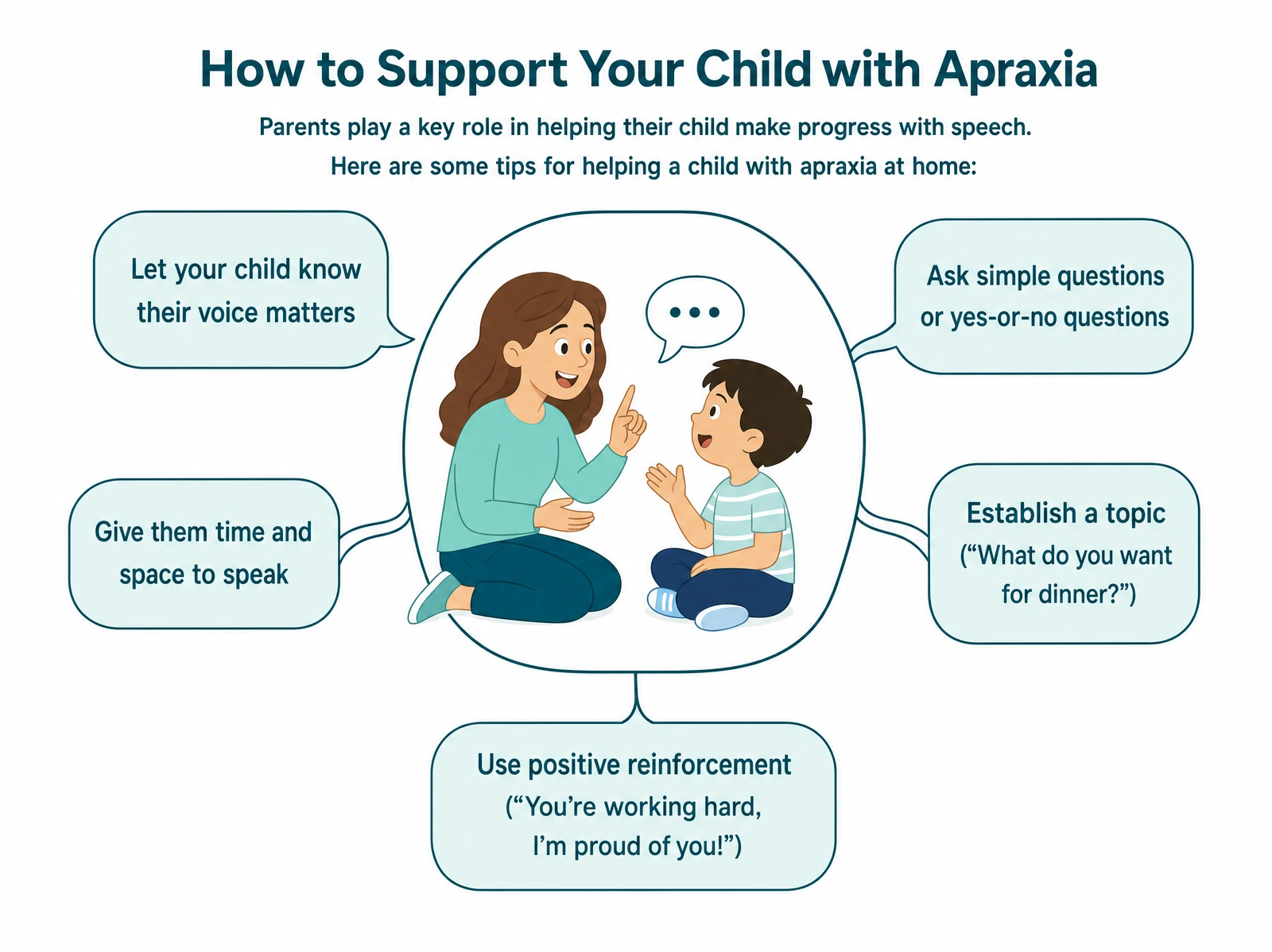
Try these tips when supporting a child with apraxia at home:
- Show your child that their voice matters. Even when their words are difficult to understand, make it clear that their thoughts and needs are important. Look to the situation, gestures, and facial expressions for clues. When you understand the message, let your child know. For example, “Oh! You’re pointing at the fridge. You must be hungry.”
- Allow time and space for speaking. Avoid pressuring your child to talk, particularly when they appear tired, frustrated, or uncertain. When they attempt to speak, wait patiently and give them plenty of time to share their message.
Even when their words are hard to understand, show your child that their thoughts and needs matter.
- Offer positive reinforcement. A little encouragement can go a long way. You might say, “You’re working so hard. I’m proud of you!” This shows your support, even when speaking feels difficult.
- Help your child feel seen and comforted. Offer comfort when your child seems upset or discouraged. A hug, gentle words, or even a smile can show that you understand how they feel.
- Set the topic. Clearly establish what you are discussing, such as, “What do you want for dinner?” A defined topic can make it easier for both of you to follow the conversation.
- Keep questions simple. When you are unsure what your child means, ask yes-or-no questions to narrow down the possibilities. Focus on understanding the main idea instead of every individual word.
Get started with Astrel
If you are concerned about your child’s speech, contact Astrel today. You can be matched with a speech therapist who has experience in your child’s area of need and availability that works for you. Start our simple sign-up here!