


Different communication disorders can have similar symptoms. Understanding the signs that are specific to apraxia of speech can help distinguish it from other conditions.
This article covers what apraxia of speech is, its main characteristics, and what to do if you think your child or loved one may have it.
What is apraxia of speech?
To produce speech, the brain sends signals that direct the muscles of the mouth to make precise sounds at a particular speed and rhythm.
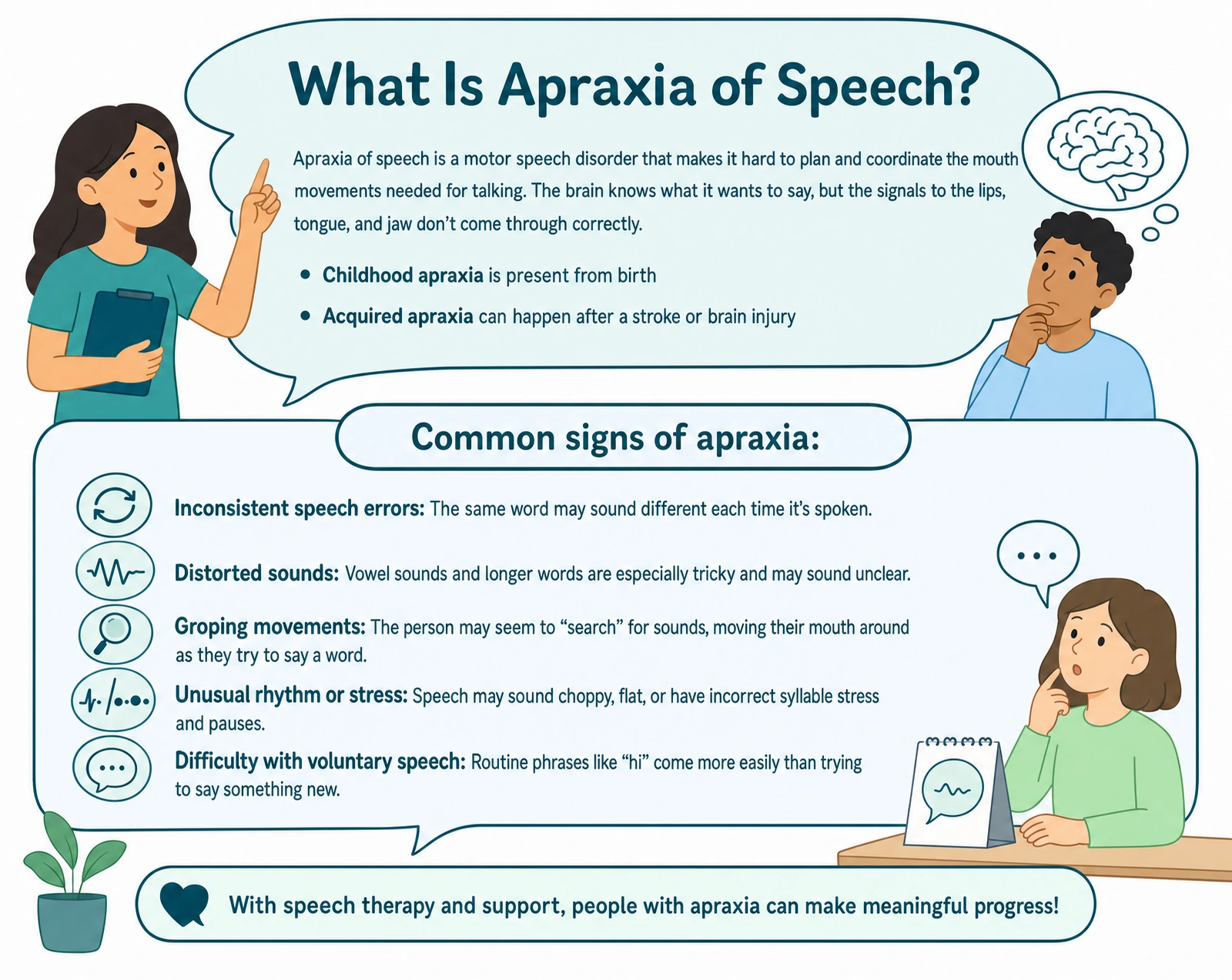
Apraxia is a neurological condition that interferes with this process. With apraxia of speech, the signals from the brain do not connect correctly with the movements of the lips, tongue, and jaw. A person often has the language ability to speak, but the brain does not send the right signals to the muscles.
In apraxia of speech, the brain’s signals do not properly connect with the movements of the mouth.
Put another way, the brain knows what it wants to say but cannot properly plan the speech movements needed to say it.
As a result, people with apraxia have trouble coordinating the mouth movements that turn sounds into syllables, syllables into words, and words into phrases. Communicating and producing clear sounds and sentences can be difficult. People with apraxia are most commonly described as “difficult to understand.”
Free 30-minute evaluation
Looking for a speech therapist?
Talk through what you are noticing and get clear next steps.
Book free evaluation
What are the two types of apraxia of speech?
Apraxia of speech falls into two categories: childhood apraxia of speech and acquired apraxia of speech.
Childhood apraxia of speech: Most children with apraxia are born with the condition. For children with apraxia, difficulty planning speech movements is the condition’s defining feature. In fact, the root word “praxis” means “planned movement.”
Acquired apraxia of speech: This type can affect people of any age, although it occurs most often in adults. Acquired apraxia results from damage to the parts of the brain involved in speech, often because of a stroke. It causes the loss or impairment of speech abilities that a person previously had.
Main symptoms of apraxia of speech
Apraxia affects each person differently, and symptoms can vary considerably. A person will typically have several symptoms rather than one primary sign.
In some cases, apraxia is mild. A person may have difficulty with only a few speech sounds or with multisyllabic words. In more severe cases, the person may not be able to communicate effectively through speech.
Most people with apraxia have some of the following symptoms or speech characteristics:
- Inconsistent speech errors: A child with apraxia may pronounce the same word differently each time. For example, they might say a difficult word correctly one day, then have trouble repeating it soon afterward.
- Distorted sounds: Because people with apraxia do not position the muscles of the mouth correctly, sounds often come out inaccurately. Vowels can be especially difficult to pronounce, as can longer, more complex words.
- Groping for sounds: A person with apraxia may appear to “grope” for words with their mouth. They might attempt a word several times before saying it correctly.
- Inappropriate intonation, stress, or rhythm: People with apraxia may struggle with the rhythm and flow of speech. They might separate the syllables within a word, leave out syllables in words or phrases, or pause at inappropriate points while speaking.
Other warning signs of childhood apraxia of speech
Parents can also watch for these additional symptoms of childhood apraxia of speech:
- Your child says their first words or makes sounds later than is typical
- Limited babbling
- Excessive mouth movements
- Persistent or frequent regression in the number of words produced, meaning your child begins saying fewer words than they used to
- Correct use of automatic words or phrases, such as saying “thank you” or reciting the alphabet, combined with difficulty producing voluntary speech
- Errors in the order of sounds within words, including leaving out, switching, or adding sounds
According to the Mayo Clinic, apraxia in children has been associated with other problems that affect communication. These problems are not caused by childhood apraxia of speech, but they are often observed alongside it. They include:
- Delayed language development, including difficulty understanding speech, a reduced vocabulary, or incorrect or inconsistent grammar when combining words into sentences
- Delays in reading, spelling, or writing
- Difficulties with gross and fine motor skills and coordination
- Hypersensitivity, such as disliking certain clothing or food textures or not wanting to have their teeth brushed
Related guides






How to get started with speech therapy for apraxia
Look for a speech therapist who has experience with apraxia of speech. There are several ways to find a speech therapistwho specializes in apraxia. Start by asking friends or acquaintances who have firsthand experience with speech therapy, since word-of-mouth recommendations can be helpful. You can also contact your pediatrician or doctor, who will likely have a list of speech therapists they recommend.
Before choosing a speech therapist, call the office and ask about the therapist’s background in treating apraxia of speech. Apraxia falls within every speech therapist’s scope of practice, but some have more experience with it than others. You can also search for online reviews of the therapist.
Apraxia is within every speech therapist’s scope of practice, but some therapists have more experience treating it than others.
Apraxia Kids provides an online registry of speech therapists throughout the United States and Canada who have experience treating childhood apraxia of speech. Search by location to find a speech therapist near you.
Consider the practical details of attending speech therapy, too. How far will you need to travel? Do the available appointment times fit your schedule? Many families find online speech therapy more convenient, particularly for conditions such as apraxia that require frequent sessions. Academic studies have found that online speech therapy is just as effective as in-person therapy.
How apraxia of speech is diagnosed
After you find a speech therapist, the process will begin with an evaluation to make a diagnosis. Write down any questions you have for the therapist and bring them with you.
Remember that other speech disorders can look similar to apraxia, including a speech delay, speech sound disorder, or aphasia. The speech therapist will determine whether apraxia is present and decide how to structure and approach your loved one’s treatment.
Do not delay starting the speech therapy process. The sooner therapy begins, the sooner your child or loved one can begin making progress.