


Parents and healthcare providers often ask how the results of online speech therapy compare with those of in-person care. Researchers have studied this question extensively across many speech and language conditions. The evidence clearly shows that, when delivered properly, teletherapy is as effective as in-person speech therapy for a range of conditions and ages.
Key takeaways
- A comprehensive 2026 meta-analysis is the latest study to find that teletherapy and in-person speech therapy both produce significant improvements. It covered a wide range of needs among children, including stuttering, speech sound disorders, dyslexia, and communication needs related to autism.
- Many individual studies have also demonstrated the effectiveness of online speech therapy specifically for toddlers, children, and adults.
- Astrel's own data supports this research: 96% of our patients make clinical progress within their first five sessions.
- Both models depend on the speech therapist's skill and expertise. Teletherapy can also make it easier for caregivers to attend sessions and learn how to support a child or loved one at home, which leads to faster progress.
- Teletherapy may be the best fit if you value flexibility, convenience, and parent involvement. In-person therapy may be better if your child needs hands-on support or highly specialized interventions.
Free 30-minute evaluation
Looking for a speech therapist?
Talk through what you are noticing and get clear next steps.
Book free evaluation
What does the research say about online speech therapy?
Most recently, a 2026 meta-analysis published in the Journal of Telemedicine and Telecare set out to answer a common question among families, clinicians, and others: Does online speech therapy work just as well? Researchers searched more than 17,000 studies and selected seven randomized controlled trials, the gold standard in research, that directly compared teletherapy with in-person speech therapy for children ages 12 and under. Across 31 different outcome measures, both approaches led to significant improvements.
The breadth of these findings makes the study especially relevant. Researchers examined stuttering, speech sound disorders, reading and dyslexia, and language and social communication among autistic children.
Parents in these studies also consistently reported high satisfaction. Many preferred online therapy because of its flexibility and convenience.
Online versus in-person speech therapy for toddlers
Many studies have demonstrated that online speech therapy can be effective for toddlers:
- De Leon et al. (2022) studied toddlers ages 1-2 years old who received early intervention speech therapy. After 6 months, the toddlers made comparable progress toward their goals whether therapy was delivered online or in person.
- Several studies comparing in-person speech therapy with telepractice for toddlers ages 18 to 30 months found that telepractice produced equivalent or higher scores on standardized language assessments (Behl et al. 2017; Blaiser et al. 2013; Constantinescu et al. 2014). In addition, Kronberg et al. (2021) found similarly high caregiver satisfaction scores in both groups.
- Research also highlights the value of parent involvement. When parents receive coaching during online speech therapy, their toddlers improve their expressive language and social communication skills (Ingersoll et al. 2024, Mettler et al. 2023).
At Astrel, our own data supports these findings. Combining child-led sessions, parent involvement, and simple home practice produces strong outcomes for toddlers.
- Caregivers attend the entire session in 99% of Astrel speech therapy appointments for children ages 0-3 years old, giving them opportunities to participate and learn how to help their child at home.
- Among 2,500 clients ages 0-3 years old, 96.4% make clinical progress within their first five sessions (as measured against documented care plan goals).
- Every Astrel client begins speech therapy with an evaluation. When children ages 0 to 3 are reevaluated later, 88% show improvement in expressive language skills, and 90% improve their receptive language skills (based on REEL-4 scores, a standardized parent-report measure of children's language ability).
Learn more about outcomes for toddlers receiving Astrel speech therapy.
Online versus in-person speech therapy for children
One of the most widely known studies was conducted at Kent State University in 2011. Over eight months, researchers compared students receiving in-person speech therapy with those receiving online therapy. The key findings included:
- Children made similar progress with both therapy models.
- Researchers found no significant difference in GFTA-2 (Goldman-Fristoe Test of Articulation) scores. The GFTA-2 is the articulation test most commonly used for children and adults.
- Parents and students overwhelmingly supported teletherapy because of its convenience and accessibility.
Similarly, a study by the Ohio Department of Public Health examined schools' use of teletherapy in response to a shortage of speech therapists. The findings were clear: When measured with the GFTA-2, students receiving online speech therapy made the same level of progress as those receiving in-person therapy.
A qualitative systematic review of telepractice for 0-7 year olds found that "the majority of studies … described telepractice as a format of service delivery that seemed to facilitate and enhance children’s, families’ and professionals’ engagement in [early intervention]." Telepractice created more opportunities to teach families how to support their children at home. Researchers also found that young children generally engage in online therapy, often better than parents or providers might expect.
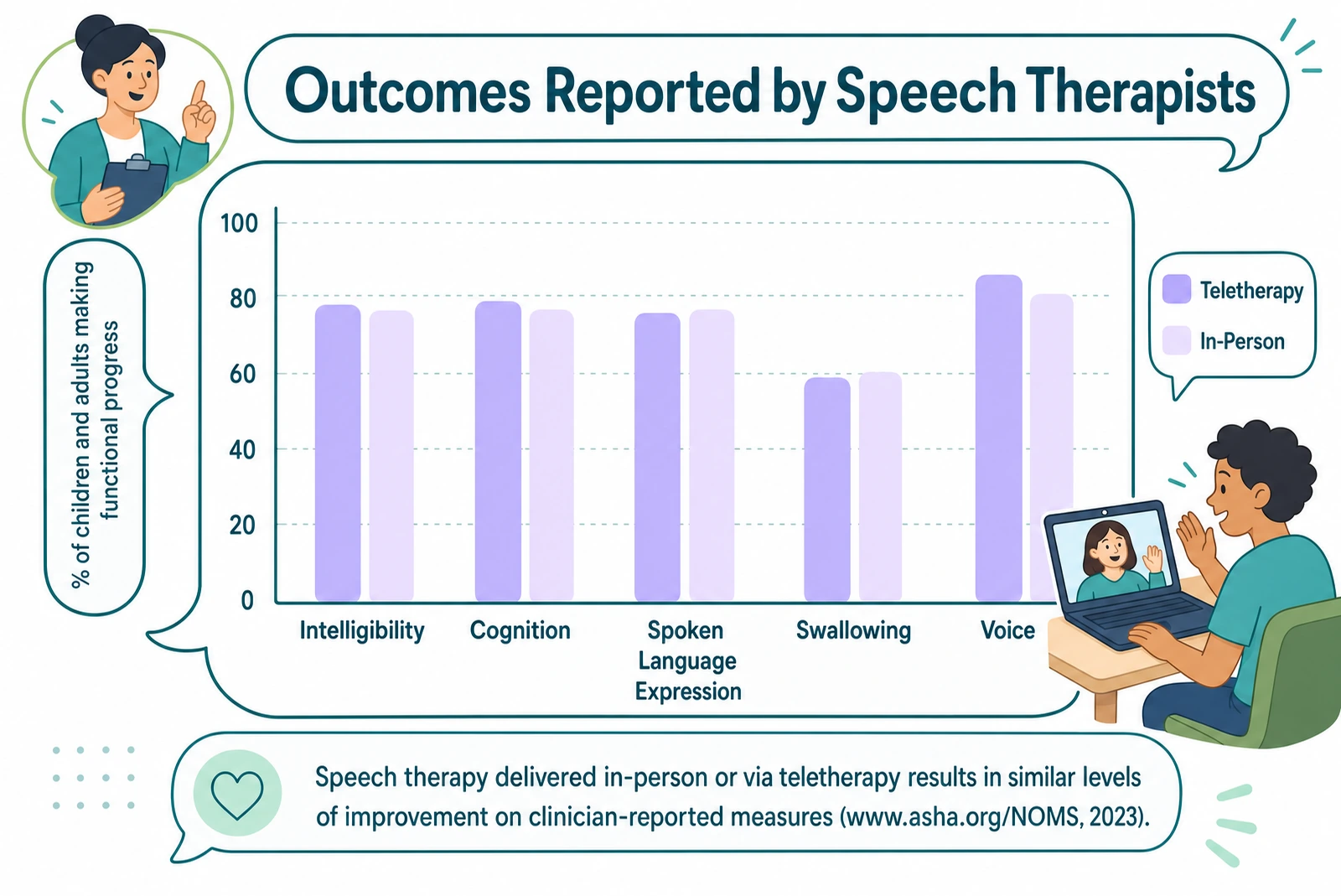
Additional studies have found that online speech therapy works as well as in-person therapy for specific conditions, including:
Online versus in-person speech therapy for adults
Other studies have examined the effectiveness of online speech therapy for adults. The research shows that it works as well as in-person therapy. For example, studies have found online speech therapy effective and reliable for adults with:
Of course, in-person therapy is the best option for some clients. For many adults, however, online speech therapy is just as helpful and offers additional benefits such as:
- More flexible scheduling
- No travel, along with the resulting cost savings
- Therapy delivered in the comfort of home
Related guides






Why is online speech therapy successful?
One important reason online and in-person speech therapy can achieve comparable results is that both depend on the therapist's skill and expertise. A great speech therapist will support the client's engagement, progress, and results, whether sessions take place online or in person.
If you choose online speech therapy for your child, look for a speech therapist with experience providing care this way. In addition to delivering excellent care, experienced online therapists know how to keep children engaged during sessions. They use a variety of techniques to hold children's attention, such as playing fun computer games or giving a child remote access to draw on a virtual whiteboard.
Another major benefit of online speech therapy is that sessions take place in the comfort and familiarity of the child's home. The speech therapist should invite you and your child to bring favorite toys, games, or books into the session.
Parent involvement should be central to online speech therapy.
Of course, we would not expect many children, especially toddlers, to focus on a screen for 30 minutes. That is why caregiver involvement matters so much, and online speech therapy makes participation easy. By attending sessions with your child, you learn how to practice speech and language skills together at home between appointments. More home practice leads to faster progress.
This approach is known as parent coaching, and it should be a central part of speech therapy delivered online.
The role of parents in online and in-person speech therapy
Studies show that parent involvement is an important factor in successful therapy, whether care takes place online or in person. A review of 12 studies examining "parent-implemented interventions" delivered through teletherapy found that, in every case:
- Caregiver participation improved speech-language outcomes.
- Parents were as effective as therapists at helping children develop language skills.
In another example, a study at Vanderbilt University examined the effectiveness of parent-implemented intervention among groups of parents trained to support their child's communication. Key results included:
- Parents understood the strategies taught by speech therapists and successfully used them with their child. As a result, children improved their verbal and nonverbal communication skills, including comprehension, vocabulary, grammar, and frequency of communication.
- Parents were as effective as speech therapists at helping their child. In fact, parents were more effective than therapists at supporting language comprehension and grammar.
- Children with several kinds of language difficulties made progress when their parents participated. These included language impairment, autism, and developmental delays.
As this and other studies demonstrate, equipping caregivers to work directly with their children can greatly improve children's speech-language skills. Online speech therapy makes parent participation easier than ever, leading to faster progress and better outcomes.
Which is better: online or in-person speech therapy?
The choice between online and in-person speech therapy ultimately depends on individual needs. Research shows that both methods are equally effective when a skilled therapist provides the care.
Online speech therapy may be the best fit for your family if you value flexibility, convenience, and parent involvement. If your child needs hands-on assistance or highly specialized interventions, in-person therapy may be the better option.
At Astrel, we’re here to help you determine which option best meets your needs. Find the right speech therapist for you or your child today.