


At Astrel, we understand that choosing speech therapy for yourself or someone you love is an important decision. One question we often hear is, “How does online speech therapy work, and is it as effective as meeting in person?”
Telehealth has expanded rapidly across the United States, including speech therapy. More families and individuals are choosing online care for its convenience, accessibility, and effectiveness. But what happens during online speech therapy, and which speech and language challenges can it address?
This guide explains how online speech therapy works, how it compares with traditional in-person care, and how to determine whether teletherapy may be right for you or your child.
What is speech therapy?
Speech therapy helps children and adults strengthen their communication skills. It can also address voice quality, oral concerns, and difficulties with feeding or swallowing.
Speech therapy may focus on improving:
- Speech patterns: Coordinating movements of the mouth to produce sounds, words, and sentences correctly
- Language skills: Understanding and expressing verbal and nonverbal language
- Cognitive-communication skills: Building memory, attention, and problem-solving skills to support communication
Speech therapy may take place in person or online. Virtual care provides a flexible, effective way to receive treatment at home.
Free 30-minute evaluation
Looking for a speech therapist?
Talk through what you are noticing and get clear next steps.
Book free evaluation
What conditions does speech therapy treat?
Speech therapy includes the evaluation, diagnosis, and treatment of many communication and swallowing problems, including:
Speech disorders:
- Delayed speech
- Speech sound disorders (including articulation and phonological issues)
- Apraxia of speech
- Dysarthria
Language disorders:
- Receptive language disorder
- Expressive language disorder
- Aphasia
Fluency and voice disorders:
- Stuttering and disfluency
- Voice disorders
Speech therapy can also help autistic individuals develop language, social communication, and self-advocacy skills.
Speech therapy may also be recommended for nonclinical needs such as public speaking and accent modification.
What is a speech therapist?
A speech-language pathologist (SLP), also called a speech therapist, is a communication specialist trained to evaluate, diagnose, and treat speech, language, and swallowing disorders.
To become a certified speech therapist, a professional must:
- Earn a master’s degree in speech-language pathology
- Complete a supervised clinical fellowship
- Pass a national certification examination
- Obtain state licensure and certification from the American Speech-Language-Hearing Association (ASHA)
Speech therapists practice in schools, hospitals, private clinics, and online, giving people more ways to access care.
What does a speech therapist do?
A speech therapist evaluates your needs, discusses your goals, and develops an individualized treatment plan. Care may include:
- One-on-one therapy: Individual attention focused on specific areas of progress
- Group therapy: Opportunities to learn and practice communication strategies with peers
- Online speech therapy: Convenient, evidence-based treatment delivered at home
During sessions, speech therapists draw on a range of strategies and techniques. These may include:
Language therapy:
- For children: Therapists use play, books, and interactive activities to develop vocabulary, grammar, and early literacy skills.
- For adults: Therapy addresses verbal and nonverbal communication to improve interactions in personal and professional settings.
Speech sound therapy:
- Focuses on accurate sound production. For example, a child might learn to pronounce the /r/ soundin “rabbit” instead of saying “wabbit.”
- Helps adults address speech errors that continued from childhood or appeared after an illness or injury.
Oral-motor, feeding, and swallowing therapy:
- Builds oral muscle strength to support safe swallowing.
- Uses texture modifications and feeding strategies to support nutrition.
Who may benefit from online speech therapy?
Speech therapy is available across the lifespan, from babies and children to teensand adults.
For children, speech therapy is most often recommended when they are having difficulty meeting communication milestones for their age. Early intervention is key. Research shows that beginning speech therapy early can support better long-term outcomes in communication, literacy, and social skills. Therapy can help children express their thoughts, feelings, and ideas clearly, which is known as expressive language. It can also strengthen their ability to process and understand language, known as receptive language.
For adults, therapy can address communication difficulties that began in childhood and were not properly treated, including stuttering and articulation errors. Speech problems may also emerge during adulthood after an illness or injury, such as a stroke , or because of a neurological condition such as Parkinson’s disease, cerebral palsy, muscular dystrophy, or ALS. Adults may also seek care for nonclinical communication goals, including professional speaking, greater confidence, or accent modification.
Many families select online speech therapy because it combines flexible, convenient access with evidence-based treatment.
How long does speech therapy take?
The duration of speech therapy varies according to several factors, including:
- The type of speech disorder or communication challenge
- The frequency of sessions each week or month
- Age
- Any underlying medical condition
Some speech and language concerns improve within a few months. Others continue into adulthood and call for long-term therapy and maintenance. For example, a child with an articulation disorder may progress within several months, while a child with severe apraxia of speech may need structured therapy for several years.
Speech therapists collect and use data to monitor progress, then adjust treatment plans when needed.
Where is speech therapy available, including online?
Speech therapy is offered in many settings, including:
- Private speech therapy clinics
- Schools
- Hospitals
- Skilled nursing facilities
- Clients’ homes
- Online through secure video conferencing
The right setting depends on your clinical needs, preferences, and schedule.
How does online speech therapy work?
In virtual speech therapy, clients meet with a speech therapist through secure video conferencing and participate in interactive exercises using digital resources. Studies indicate that online speech therapy is as effective as in-person treatment for many speech and language disorders.
Can a child be too young for speech therapy?
Speech and language development begins in infancy. Building these skills early, especially during the baby years, can establish a strong foundation for communication and literacy when a child starts school.
Speech therapy is important for children who are not meeting age-appropriate communication milestonesor who have difficulties such as stuttering or mispronunciations caused by a lisp. Speech and language patterns become more ingrained over time, so children are likely to have better outcomes when speech errors are addressed earlier.
Parents often want to know how online speech therapy works for toddlers. When paired with parent coaching, virtual therapy can be highly engaging and effective for young children.
Does speech therapy work for adults?
Yes. It is never too late to begin speech therapy. Adults commonly receive treatment to:
- Address communication barriers that began in childhood and were never properly treated, such as stuttering or an articulation issue
- Treat speech and language problems that developed after an illness or injury, including a stroke, or as a result of Parkinson’s disease, cerebral palsy, muscular dystrophy, or ALS
- Improve communication skills affected by a clinical diagnosis, including aphasia, acquired apraxia of speech, dysarthria, and other cognitive conditions
- Change the pitch, intonation, or quality of the voice
- Build confidence and strengthen communication skills that support professional development, such as interviewing and communicating with coworkers
- Reduce an accent associated with a region or country of origin
- Ease fear of public speaking and improve presentations in group settings
Through neuroplasticity, adults can make significant improvements in speech and language with targeted therapy.
For adults who want to work on communication from home, online speech therapy can be an excellent option.
How much does speech therapy usually cost?
Cost is one of the first questions many people ask when considering speech therapy. There is no single answer. As with other health-related services, speech therapy can be expensive, and costs vary based on factors such as:
- Where you live
- Your speech therapist’s professional experience
- Whether treatment is delivered in person or online
- Whether you have insurance coverage
- What type of insurance coverage you have
Speech therapy generally costs between $100 and $250 per session. Some providers charge additional fees, such as a one-time evaluation fee that typically costs a few hundred dollars, or penalties for canceling or rescheduling an appointment.
For exact pricing, contact each provider you are considering. If you have insurance, you should also confirm whether your plan covers speech therapy.
Does health insurance cover speech therapy?
If you have health insurance, ask your insurer whether your plan includes speech therapy coverage.
Unfortunately, insurers often deny speech therapy coverage for various reasons. They must provide a written explanation for a denial, which may state that:
- Treatment is not considered a “medical necessity.”
- The policy does not cover speech therapy.
- An alternative service is available, such as therapy provided through a school.
- Therapy is classified as educational or developmental rather than medical, which is common for adults seeking to improve communication.
When coverage is denied, many families go through ongoing appeals. Some insurers also limit coverage to a small number of sessions, such as 6 to 8, which may not support long-term progress.
What is Astrel online speech therapy?
Astrel provides high-quality speech therapy through secure video conferencing. The care is similar to traditional in-person therapy, but sessions take place online. If you have used Zoom, FaceTime, or Google Meet, the format will feel familiar.
On the other side of the screen, a certified speech-language pathologist works with you or your child to build communication skills.
What are the advantages of online speech therapy?
Technology has changed many parts of daily life, including how we find information, stay in touch with family and friends, and shop. Increasingly, it is also changing how people access health-related services and care.
Families choose Astrel online speech therapy for several reasons:
Affordable and cost-effective: Astrel avoids many expenses associated with operating an in-person practice, including rent, overhead, administrative costs, and certain types of liability insurance. Passing these savings to clients can, in many cases, make speech therapy with Astrel dramatically less expensive.
Convenience: Meeting with a speech therapist online lets you receive high-quality care at home, without a long commute or hours in a waiting room. People also often learn best in a setting that feels familiar and comfortable: their own home.
People often learn best in a familiar, comfortable environment: their home.
Accessibility: People in rural or remote areas may have difficulty finding quality speech therapy nearby. Distance can also make it harder to locate a clinician who specializes in their particular needs. Astrel removes these geographic barriers. We have a large team of speech therapists across the country, allowing us to match you with a professional who has experience and specialization in your area of need.
Flexible scheduling: Many speech therapy clinics operate during standard 9-to-5 business hours. School and work can make those hours inconvenient or even impossible. Astrel online speech therapy offers more flexibility, including appointments in the morning, at night, and on weekends, so therapy can fit around the rest of your life.
Astrel online speech therapy offers flexible appointment times, including mornings, nights, and weekends.
Access to therapist specialties: Speech therapy spans a wide range of specialties and diagnoses. A clinician specializing in early childhood articulation may not be comfortable treating someone with limited cognitive function after a stroke, or a child with autism. With Astrel, you are not restricted to the clinicians available at one school or clinic. Instead, you can access a wide range of speech therapists and be matched with someone well suited to your needs.
Parent and caregiver engagement: Children make more progress toward speech therapy goals when a parent or caregiver is actively involved. That is because the strategies taught by the speech therapist need frequent practice and reinforcement at home.
Developing a close relationship with a speech therapist can be especially difficult in a school setting. One clinician may serve many students, and parents may rarely have an opportunity to connect with their child’s therapist. With Astrel, you can sit beside your child or loved one during sessions, making it easier to participate actively in their care.
Which speech therapy services can be provided online?
Most speech and language disorders can be treated effectively through teletherapy. Online services may address:
- Articulation disorders, or difficulty pronouncing sounds
- Language delays, including late talking and difficulty understanding or using language
- Stuttering
- Speech and language rehabilitation after a stroke
- Voice conditions such as vocal nodules and presbyphonia
- Cognitive-communication difficulties related to brain injuries
- Some feeding and swallowing difficulties
Related guides






Is online speech therapy as effective as in-person care?
Many studies have found that teletherapy works as well as in-person speech therapy for a range of conditions. In one landmark study conducted by Kent State University, researchers compared the progress of children receiving speech therapy online and in person. Standardized testing showed that students in both groups made considerable progress toward their goals. Survey results also showed that students and parents overwhelmingly preferred online delivery because it was more convenient.
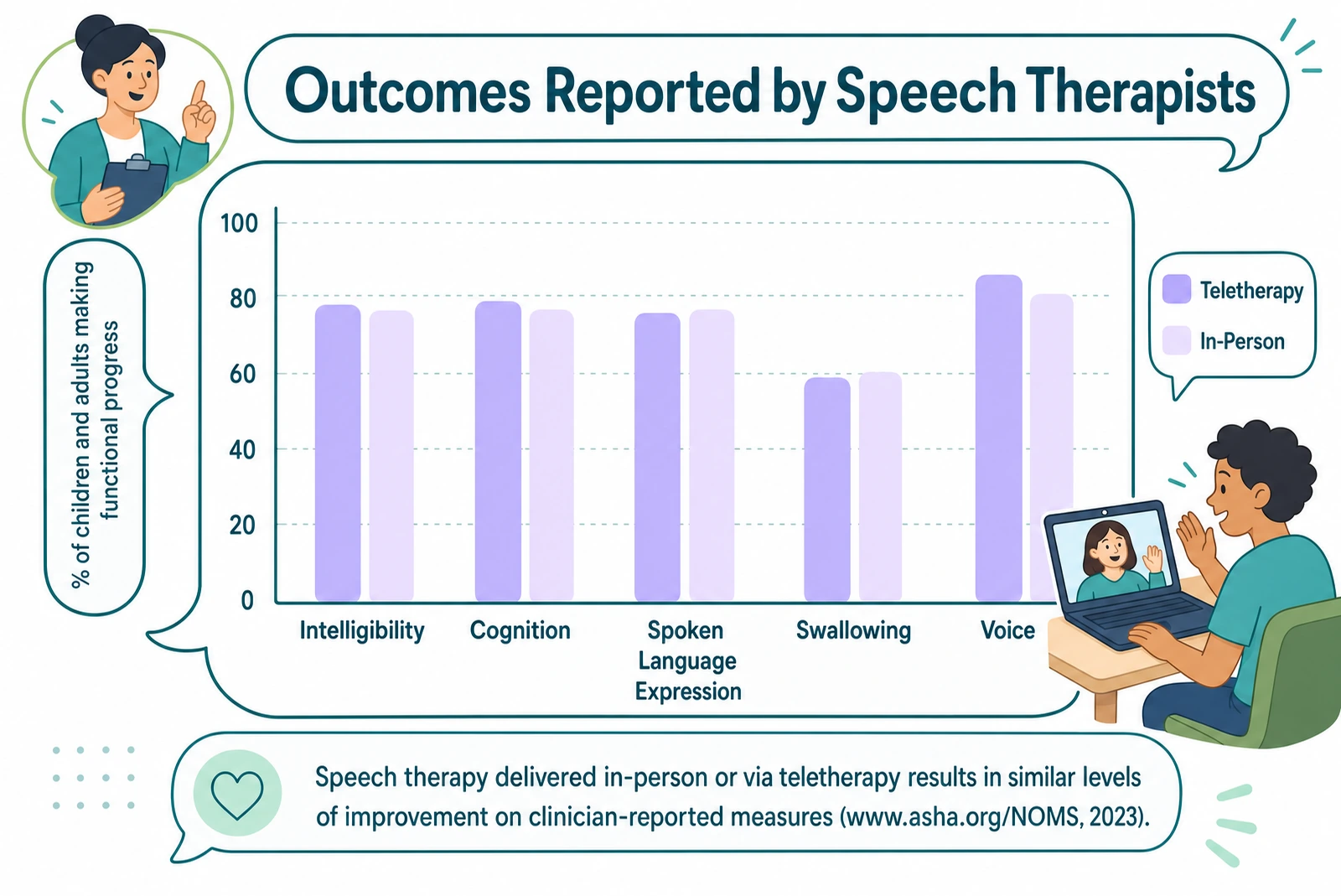
Additional studies support these findings:
- De Leon et al. (2022) studied toddlers ages 1 to 2 who received early intervention speech therapy. After 6 months, the toddlers made comparable progress toward their goals whether therapy was provided online or in person.
- Several studies of toddlers ages 18 to 30 months found that telepractice produced equivalent or higher standardized language assessment scores than in-person speech therapy (Behl et al. 2017; Blaiser et al. 2013; Constantinescu et al. 2014).
- Research also shows that when parents receive coaching during online speech therapy, their toddlers improve expressive language and social communication skills (Ingersoll et al. 2024, Mettler et al. 2023).
- In a qualitative systematic review of telepractice for children ages 0 to 7, Retamal-Walter et al. (2023) found that “the majority of studies…described telepractice as a format of service delivery that seemed to facilitate and enhance children’s, families’ and professionals’ engagement in [early intervention].” Telepractice created more opportunities to teach families how to help their children at home. The researchers also found that young children are generally engaged in online therapy, often more than their parents or providers expect.
Based on this substantial body of evidence, the American Speech-Language-Hearing Association (ASHA), the credentialing association for speech-language pathologists, recognizes online speech therapy as a valid way to deliver care.
Still, a small group of conditions may be better suited to a hands-on, interactive approach. These include certain feeding and swallowing difficulties and tracheotomy management. Children with these needs often require significant tactile cueing or sensory input, so in-person sessions may be more appropriate.
No therapy format is a perfect match for everyone. Each person has different learning preferences, comfort levels, and needs. Even so, online speech therapy is an appropriate and effective option for most communication disorders, and most people who try it enjoy the experience.
How online speech therapy works for toddlers and young children
Many young children thrive in virtual speech therapy. Interactive activities, digital games, and playful exercises help children stay focused and motivated during sessions. Astrel also emphasizes caregiver participation, teaching parents strategies they can use at home to support ongoing language development. Research shows that children progress more quickly when their parents are more involved in speech therapy.
Astrel clients have seen this firsthand. One parent said: “[Our SLP] is patient and perceptive. She notices the gains in my son’s language acquisition skills and teaches me to incorporate skill-building in our everyday routines to foster his growth and development at exactly the level he is learning. Her expertise is a blessing to us!”
What happens during online speech therapy?
Online speech therapy sessions are adapted to each person’s age and communication needs.
Ages 0 to 3: For babies and toddlers, our therapists work directly with caregivers, helping them reinforce new skills and recommended practices at home. Speech and language development happens throughout a child’s day, from playtime and dinner preparation to bedtime routines. Your therapist will provide education, tools, cues, and home strategies so you can practice communication skills during everyday activities. Children are encouraged to sit with their caregivers during virtual sessions, but this is not required for this age group.
Ages 3 to 6: Children at this age are more independent and can benefit from direct instruction during therapy. In many cases, a child and caregiver attend video sessions together so both can learn useful skills from the speech therapist. If a child finds it difficult to focus during online learning, the therapist will continue working with the caregiver to make the lessons easier to incorporate at home.
Ages 7 and older: Many older children attend sessions on their own, although caregivers are always welcome to participate. Parents also receive updates and tips. Secure text messaging gives them direct access to the speech therapist, so they can ask questions at any time.
Adults: For adults, one major advantage of online speech therapy is the ability to fit sessions around work and family responsibilities. Adults can attend independently or invite a spouse, relative, or caregiver to join them.
What do I need for online speech therapy?
To begin Astrel online speech therapy, you need an internet connection and a computer or tablet, such as an iPad. You can use a smartphone when necessary, but a larger screen is generally preferable.
At Astrel, we take privacy and confidentiality seriously. Our technology, including our secure video and text-messaging platforms, is HIPAA compliant. The Health Insurance Portability and Accountability Act (HIPAA) is a federal law that helps protect sensitive information by regulating the use of safe, compliant technology.
How does Astrel work?
Getting started with Astrel online speech therapy takes a few straightforward steps:
1. Get matched with a speech therapist
We will pair you with a speech therapist who has experience in your area of need. Speech therapy includes many services and specialties, so finding a professional who is well suited to help is important. We will also collect detailed intake information, giving your therapist the background needed to provide effective care.
2. Complete an evaluation
The process begins with a comprehensive evaluation of your communication strengths, areas of difficulty, and goals. Learn what the evaluation process involves for children and adults.
3. Select your session schedule and frequency
Your speech therapist will recommend a session frequency based on your communication needs and goals, often two sessions each week. Some people need a more intensive schedule. Others may need therapy only a few times per month to address minor issues or maintain progress. Ultimately, you choose how often to attend, taking your goals, budget, and availability into account.
4. Start therapy
At the time you selected, click the secure link we send to connect directly with your speech therapist. You can also communicate through our secure text-messaging platform, making it easy to ask questions at any time or reschedule an appointment.
How much does Astrel cost?
At Astrel, our mission is to make speech therapy affordable, convenient, and accessible to everyone. Because Astrel provides therapy online, we avoid many expenses associated with operating a physical practice and can pass those savings on to you.
You can choose between two pricing options: pay separately for each completed speech therapy session, or use your insurance benefits. There are no hidden fees or surprises, and you may cancel at any time.
Our pricing is explained here.
Whichever payment option you choose, every session includes ideas and activities for home practice, plus unlimited text messaging with your speech therapist.
Ready to begin?
Online speech therapy is changing how people access high-quality care. For children, teens, and adults, Astrel offers a convenient, effective, research-backed approach designed to support lasting improvements in speech and language. Get matched here with a speech therapist who is right for you or your child.