


Vocal fry is a low, creaky voice quality that many people use without noticing. Research suggests it is particularly common among young adults. Vocal fry is usually a normal part of how the voice works, but using it constantly may make your voice feel tired or sound weak or strained. If it is affecting your communication, a speech-language pathologist can help.
Key takeaways
- Vocal fry is a normal vocal register that produces a low, creaky voice quality. It is common in everyday speech.
- Occasional vocal fry is not known to damage the vocal folds. However, a voice that feels tired, hoarse, or uncomfortable may be a sign of a voice disorder.
- Speech therapy can help determine whether vocal fry is simply part of your speaking style or connected to an underlying voice problem.
- A healthcare professional should evaluate voice changes that last more than two to four weeks or interfere with daily communication.
- Healthy voice habits, steady breath support, and voice modulation strategies can reduce vocal fry and make speaking more comfortable.
Free 30-minute evaluation
Looking for a speech therapist?
Talk through what you are noticing and get clear next steps.
Book free evaluation
What is vocal fry?
Vocal fry is your voice's lowest register, or tone. It produces a deep, rough, or creaky sound that people often compare to popping popcorn or a door slowly creaking open. If you have ever drawn out an "uhhh" at the very bottom of your voice until it began to rattle, you have produced vocal fry.
Understanding that sound starts with knowing a little about how the voice works. “When you speak, air from your lungs passes through your vocal cords,” explains Adhvika Shetty, a speech-language pathologist at Astrel. “The vocal cords come together and vibrate to create sound. During normal speech, they vibrate smoothly and regularly,”
When you use vocal fry, however, your vocal folds remain more relaxed, with less air flowing between them. They vibrate much more slowly as a result, producing the popping or crackling sound associated with vocal fry.
Why do people use vocal fry?
Most people use vocal fry occasionally and often do not realize it. It can occur naturally when your voice moves to a lower pitch or when airflow drops during speech.
You may hear more vocal fry when you:
- Trail off at the end of a sentence
- Speak very quietly
- Run low on breath while talking
- Have just woken up in the morning
- Feel tired after a long day
- Speak during a relaxed, casual conversation
These situations often involve less airflow or a more relaxed speaking style, making it easier for the voice to move into the fry register.
Some people use vocal fry deliberately, and research suggests it is especially common among young adults. In one study of female college students between ages 18 and 25, about two-thirds used vocal fry, usually at the ends of sentences.
Social groups, cultural influences, and media personalities can all shape how people use their voices. Some people also believe vocal fry makes them sound more relaxed, conversational, or confident.
Research also suggests that vocal fry can serve a communication function. Rather than being "wrong," it may signal the end of a thought or emphasize particular words. Speech-language pathologists, also called speech therapists, sometimes use brief vocal fry exercises during voice therapy to help treat certain voice disorders.
Can vocal fry damage your voice?
“This is one of the most common questions people ask, and the short answer is usually no,” says Shetty. Occasional vocal fry is not known to damage the vocal folds when the voice is healthy. As Shetty explains, “Vocal fry is a normal vocal register, just like your chest voice (which has a more robust, powerful pitch) or your head voice (which is a lighter, brighter pitch).”
Researchers are still studying the long-term effects of frequent vocal fry. Experts generally agree that using it occasionally is not harmful. Relying on vocal fry as your primary speaking style, however, may make your voice feel tired. This is known as vocal fatigue and may be especially likely if the vocal fry is connected to limited breath support, tension, or inefficient voice use.
When is vocal fry a problem?
Vocal fry becomes a concern when it affects your ability to communicate clearly or comfortably. The sound itself is usually not the issue. Instead, consider this question: Does the quality of my voice interfere with my ability to communicate at work, at school, or in everyday life? If your answer is yes, the issue deserves a closer look.
Signs that vocal fry may be causing problems
The following symptoms may indicate that it is time to seek a professional opinion about your voice:
- Your voice feels tired after you have spoken for only a short time.
- You feel pain or discomfort in your throat or neck while speaking.
- Your voice consistently sounds hoarse, rough, or strained.
- You struggle to project your voice or be heard in noisy settings.
- Your voice frequently cuts out, or you lose it.
- The creaky quality appears throughout most of your speech rather than only occasionally.
- People often have difficulty understanding you or tell you that your voice sounds weak or uncertain.
These symptoms do not necessarily mean vocal fry is the cause, but they may indicate that you need a voice evaluation. an Astrel speech therapist such as Shetty can assess how you use your voice and recommend strategies for speaking more clearly and comfortably.
Who may be at higher risk?
Anyone can use vocal fry, and for many people it is simply part of their usual speaking pattern. People who depend heavily on their voices, however, may notice changes in vocal quality sooner. This group can include people who speak professionally or for long stretches of time, such as:
- Teachers
- Singers and performers
- Coaches
- Healthcare providers
- Sales professionals
- Public speakers
For these professionals, vocal fatigue, lower vocal endurance, or changes in voice quality can make comfortable communication more difficult as the day goes on. Building healthy voice habits and learning efficient speaking techniques may help.
Medical conditions that may contribute to vocal fry
Persistent changes in voice quality can sometimes occur with an underlying voice condition. Conditions that may alter voice quality include:
- Muscle tension dysphonia: Excess muscle tension around the voice box, which can make speaking feel strained or effortful
- Vocal fold lesions: Growths such as nodules or polyps, which may change how the vocal folds vibrate
- Vocal fold weakness (paresis): Reduced strength or movement in one or both vocal folds
- Laryngopharyngeal reflux (LPR): Irritation caused by reflux that affects the throat and voice box
- Laryngitis, allergies, or inflammation: Conditions that can temporarily alter how the vocal folds vibrate
- Neurological or thyroid conditions: Medical conditions that may affect voice production or vocal fold movement
These conditions do not automatically cause vocal fry. Still, if your voice has become persistently rough, weak, strained, or uncomfortable, a voice evaluation can help establish whether the vocal fry is connected to another concern.
Vocal fry, glottal fry, and creaky voice: What's the difference?
When researching vocal fry online, you may see related terms such as “glottal fry” and “creaky voice.” Although these concepts overlap, people do not always use them in precisely the same way.
Vocal fry is the most widely recognized term. It commonly describes the low, crackly voice quality often heard at the ends of sentences.
Glottal fry is the clinical term often used by speech therapists and voice specialists. It refers to the same lowest vocal register while describing what physically occurs in the larynx, or voice box.
Creaky voice is a broader term from linguistics. It describes a voice quality that includes vocal fry but is not always considered a voice problem. In some languages, a “creaky voice” distinguishes the meanings of words or marks the end of a speaker's thought. In those contexts, it is simply a normal part of communication.
Related guides







How to reduce vocal fry
Reducing vocal fry does not mean eliminating it. It is a normal vocal register that many people naturally use in everyday conversation. The aim is to help your voice work more efficiently so that you can speak clearly and comfortably with less effort.
If vocal fry is making your voice feel tired or interfering with communication, Shetty recommends trying the following strategies:
1. Improve breath support
Vocal fry often becomes more noticeable as airflow drops, such as when you run out of breath near the end of a sentence. Steady breath support can help the vocal folds vibrate more efficiently.
Try the following:
- Take a comfortable breath before speaking rather than pushing through a long phrase without enough air.
- Pause between thoughts so you are not speaking with very little airflow.
- Practice diaphragmatic breathing. As you inhale, let your belly and rib cage expand instead of raising your shoulders.
“A steady airflow helps your voice stay stronger and more consistent while you’re talking,” Shetty explains.
2. Increase vocal resonance
A healthy voice should feel comfortable and balanced, without significant effort or tension in the throat. Resonance exercises can help you produce a clearer voice quality with less strain.
Start with gentle humming:
1. Choose a comfortable pitch and hum softly.
2. Pay attention to any light vibration around your lips, nose, or the front of your face.
3. Bring that relaxed sensation into simple words or phrases.
This “forward focus” may reduce the sensation of pushing your voice from your throat.
3. Practice healthy voice modulation
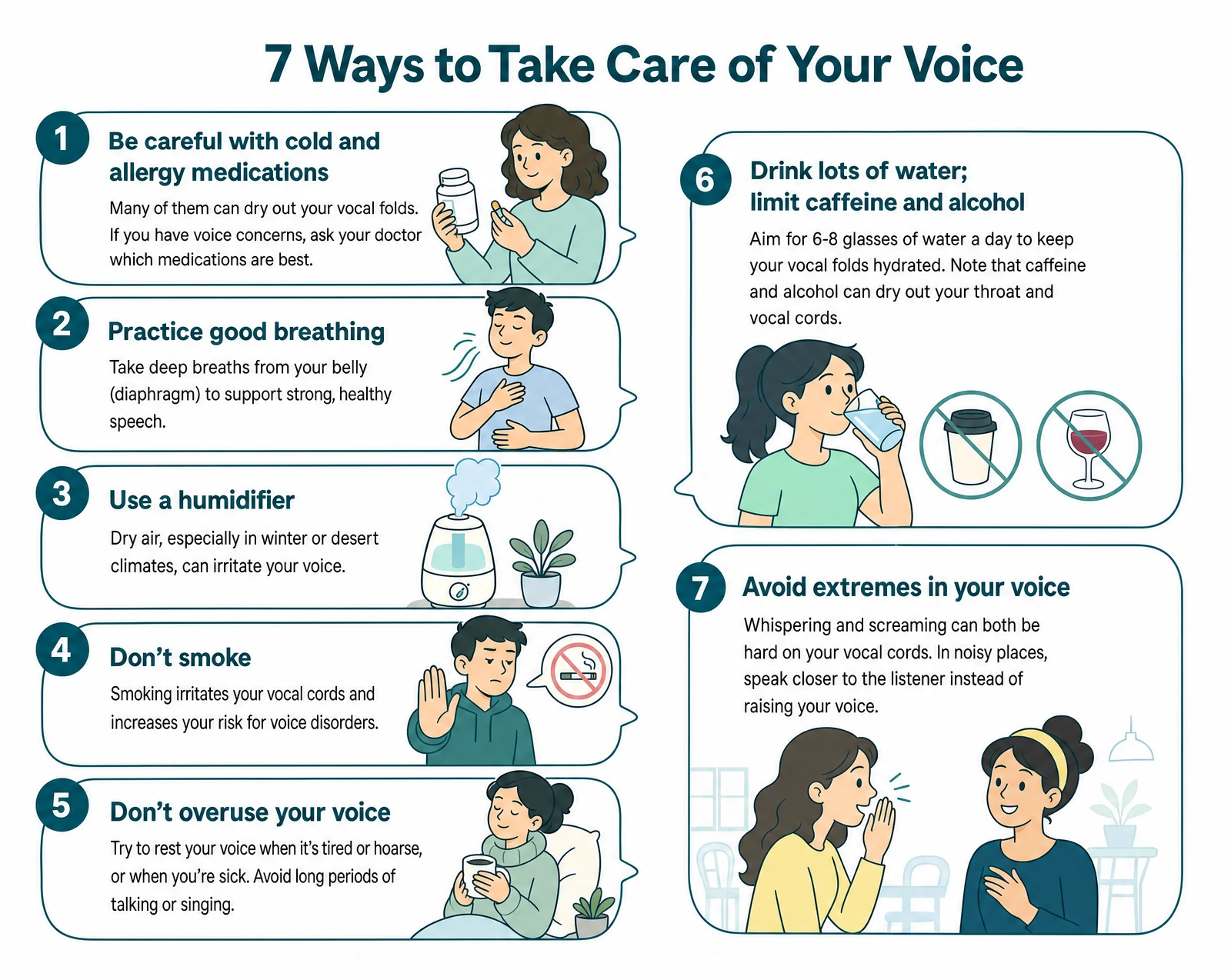
Everyday voice habits can have a meaningful effect, particularly if you use your voice frequently. Healthy habits include:
- Drinking enough water during the day to support healthy vocal fold vibration
- Avoiding frequent throat clearing, which may irritate the vocal folds
- Taking breaks from extended periods of talking whenever possible
- Managing conditions such as acid reflux or allergies that may irritate the voice box
4. Practice voice exercises
Speech therapists use focused voice exercises to strengthen breath support, vocal fold coordination, and vocal efficiency. Common exercises include:
- Lip trills: Blow air through relaxed lips until they vibrate gently, then add your voice. Lip trills coordinate airflow and help reduce tension during speech.
- Gentle humming: Humming supports a relaxed speaking voice and lets you practice forward resonance without pushing from the throat.
- Straw phonation: Hum through a drinking straw. The gentle resistance can help your vocal folds vibrate more efficiently and with less effort.
Although these exercises are safe for many people, consult a voice specialist if you have persistent hoarseness, discomfort, vocal fatigue, or another voice concern.
When to see a speech-language pathologist
Healthy voice habits can promote vocal health. But when vocal fry persists or your voice does not feel healthy, consider scheduling an evaluation with a speech therapist who specializes in voice disorders.
Consider an evaluation if:
- Your voice has sounded hoarse, rough, or strained for longer than two to four weeks
- Speaking causes pain, tightness, or discomfort
- Your voice becomes tired after ordinary conversations
- You frequently lose your voice or experience more voice cracks than usual
- Your voice is interfering with work, school, or everyday life
- Your symptoms persist even after you practice healthy voice habits
During voice therapy, a speech therapist assesses how you use your voice and determines whether your vocal fry is a normal speaking pattern, a sign of inefficient voice use, or related to another voice disorder. Treatment is tailored to the individual and may involve breathing strategies, resonance training, voice modulation exercises, vocal hygiene education, and a home practice plan for developing healthier speaking habits over time.
How speech therapy can improve your voice
Vocal fry is a common feature of human speech and is completely normal for most people. Many speakers naturally move into the fry register during everyday conversations, and occasional use is not harmful. If vocal fry causes fatigue or discomfort or makes communication difficult, however, healthy voice habits and speech therapy can help you develop a stronger, more efficient voice.
At Astrel, our licensed speech-language pathologists offer personalized online voice therapy for adults and children. In virtual sessions, your speech therapist will evaluate your voice, teach evidence-based exercises suited to your goals, and help you improve vocal quality while reducing strain.
If you are dealing with hoarseness, vocal fatigue, or unwanted vocal fry, you do not have to address it alone. Find a speech therapist at Astrel and get started with an evaluation to work toward a healthier, more confident voice.
Frequently asked questions (FAQs)
What causes vocal fry?
Vocal fry occurs when the vocal folds, or vocal cords, relax and vibrate more slowly than during typical speech. It commonly appears when you speak quietly, reach the end of a sentence, first wake up, feel tired, or run low on breath while talking. Some people also use it intentionally as part of their natural speaking style.
What does vocal fry sound like?
Vocal fry sounds low, rough, creaky, or crackly. It is often compared to popping popcorn, a door slowly creaking open, or a gentle rattle at the end of a sentence. As the lowest register of the human voice, it is a normal way for the vocal folds to produce sound.
Can you stop using vocal fry?
Yes. If you want to reduce vocal fry, voice therapy techniques can help you use your voice more efficiently. Helpful approaches include improving breath support, practicing healthy voice modulation, increasing vocal resonance, and maintaining good vocal hygiene . The goal is usually not to eliminate vocal fry, but to use it comfortably and intentionally instead of throughout most of your speech.
Are vocal fry, glottal fry, and creaky voice the same?
These terms are closely connected, but they are not always used in the same way. Glottal fry is the clinical name that speech-language pathologists often use for the same lowest vocal register. Creaky voice is a broader linguistic term that encompasses vocal fry. In some languages, it plays an important communication role rather than representing a voice concern.
Is vocal fry a voice disorder?
No. Vocal fry is not itself considered a voice disorder. For most people, it is a normal vocal register used occasionally during speech. However, if your voice is consistently hoarse, strained, weak, painful, or tired, a speech-language pathologist can evaluate whether another voice disorder is affecting your vocal quality.
Is vocal fry permanent?
No. Many people naturally move in and out of vocal fry depending on their speaking style, energy level, and breath support. If it has become more noticeable over time or is interfering with communication, voice therapy can help you build healthier and more efficient speaking habits.
Can speech therapy help with vocal fry?
Yes. A speech-language pathologist can evaluate how you use your voice and determine whether vocal fry is a normal speaking pattern or is connected to inefficient voice use. Therapy may involve breathing exercises, resonance training, vocal hygiene education, and individualized strategies designed to improve vocal quality, endurance, and comfort.