


Voice therapy exercises may reduce vocal strain, strengthen breath support, and make speaking more comfortable. If you experience hoarseness, a weak or strained voice, or voice loss after talking, at-home techniques such as vocal warm-ups, lip trills, and straw phonation may help. But these exercises are not right for everyone. The best approach depends on the cause of your voice problem, and some conditions need treatment from a speech therapist.
Key takeaways
- Voice therapy exercises may ease vocal strain, improve breath support, and make speaking feel more comfortable.
- Gentle warm-ups and cool-downs, such as lip trills and straw phonation, can support healthy voice use.
- Choose short, consistent practice sessions rather than pushing your voice too hard.
- Stop the exercises if you feel pain or your voice symptoms get worse.
- See a speech therapist if hoarseness or another voice problem continues for more than 2 to 4 weeks.
Free 30-minute evaluation
Looking for a speech therapist?
Talk through what you are noticing and get clear next steps.
Book free evaluation
What are voice therapy exercises?
Voice therapy exercises are techniques designed to help your voice work more efficiently. Speech-language pathologists, also called speech therapists, often use them to reduce strain, improve breath support, and promote healthy vocal cord movement, making speech feel easier.
Nearly 18 million Americans experience voice problems, but many never seek treatment. Voice disorders are especially common among people who rely on their voices throughout the day, including teachers, singers, coaches, and customer service professionals.
The exercises that are right for you depend on the source of your symptoms. For instance, someone with muscle tension may benefit from exercises that promote relaxation. A person recovering from a vocal injury may need techniques that strengthen breath support or help the vocal cords heal. “There isn't a single voice exercise that works for everyone,” says Hamshi Ganjam, a speech-language pathologist at Astrel. “The best exercise is the one that targets the underlying cause of the problem. Two people with hoarseness may sound similar, but they often need very different treatment plans.”
Many effective exercises for home practice fall into a category called semi-occluded vocal tract (SOVT) exercises. Lip trills, humming, and straw phonation are all examples. These techniques gently alter airflow so the vocal cords can vibrate more efficiently.
Daily vocal warm-ups
Note: Each exercise should feel easy and comfortable. Stop if you develop pain or worsening hoarseness, and speak with your doctor or speech-language pathologist.
Athletes warm up before exercise, and your voice can also benefit from preparation before extended use. If you plan to teach, sing, give a presentation, speak during a long meeting, or coach a team, a few minutes of gentle vocal warm-ups can help prepare your voice.
A vocal warm-up is not meant to make your voice louder or stronger. Its purpose is to increase blood flow, coordinate breathing, and ease muscle tension so your voice works more efficiently. Every exercise should feel comfortable and easy.
Lip trills
Lip trills are among the most common voice therapy exercises because they are simple, gentle, and effective. To make a lip trill, relax your lips and blow air through them until they vibrate, producing a sound like a child pretending to drive a toy car.
As a type of SOVT exercise, lip trills create gentle back pressure. This can reduce tension on the vocal cords while improving airflow and coordination between your breath and voice. Lip trills may be useful if you notice vocal strain, tend to push your voice while speaking, or feel tired after talking.
How to practice a lip trill:
1. Let your lips and the muscles around your mouth relax.
2. Breathe in comfortably through your nose.
3. Exhale in a steady stream to make your lips vibrate.
4. When that feels easy, add your voice at a comfortable pitch.
5. Gently glide from a low pitch to a high one, then come back down.
A common mistake is blowing too much air or tightening the lips. If you have trouble starting the trill, lightly support your cheeks with your fingertips until the movement feels easier.
Gentle humming
Humming gently is another simple way to warm up. It promotes forward resonance, which means feeling light vibrations around your lips, nose, or the front of your face rather than feeling as though all the effort comes from your throat. This can help your voice sound and feel more relaxed and efficient.
Begin by humming at a comfortable pitch for several seconds. Pay attention to the gentle buzzing near your mouth or nose. Next, carry that sensation into simple words beginning with /m/, such as “mom,” “more,” or “money.” Once that feels easier, try short phrases or familiar greetings while maintaining the same relaxed voice.
It is fine if you do not notice the “buzzy” sensation immediately. “Finding your resonant voice can take some practice,” Ganjam says. “Try relaxing your jaw and lips, and avoid squeezing or tightening the muscles around your mouth.”
Straw phonation
Straw phonation is another research-supported SOVT exercise commonly used by speech therapists in voice therapy. You make sound through a drinking straw, which helps the vocal cords vibrate with less impact while supporting better breathing and vocal efficiency.
How to practice straw phonation:
1. Put a regular drinking straw between your lips, forming a gentle seal around it.
2. Hum through the straw at a comfortable pitch.
3. After several breaths, slowly glide from a low pitch to a high pitch and back down.
4. Continue for 2 to 5 minutes, keeping your breathing relaxed and steady.
This exercise should feel easy rather than effortful. Do not blow forcefully into the straw or tighten your lips or throat.
Breath support exercises for a stronger voice
Healthy voice production begins with healthy breathing. Rather than pushing harder to make yourself heard, voice therapy uses steady airflow to power your voice. This approach can reduce stress on the vocal cords and make speaking more comfortable.
Diaphragmatic breathing
Diaphragmatic breathing, often called belly breathing, is a common voice therapy exercise. It helps you breathe more deeply and efficiently, providing a steady stream of air as you speak.
How to practice belly breathing:
1. Sit or lie in a comfortable position and relax your shoulders.
2. Rest one hand on your chest and place the other just above your belly button.
3. Inhale slowly through your nose, letting your belly rise more than your chest.
4. Exhale gently through your mouth until your lungs feel comfortably empty.
5. Practice for about 5 minutes once or twice each day.
Many people naturally raise their shoulders or direct each breath only into the chest. Instead, notice your ribs and abdomen expanding as you inhale. Diaphragmatic breathing is a new skill for many people, and it generally becomes easier with practice.
Sustained airflow exercises
After practicing diaphragmatic breathing, you can work on controlling airflow while producing sounds. These exercises are designed to keep your voice steady rather than strained or squeezed.
Take a comfortable breath, then exhale slowly while making a long “sss” or “ffff” sound. Keep the airflow smooth and even for as long as it remains comfortable. With practice, you can try an easy “ooh” sound using the same relaxed stream of air.
Easy onset is another useful technique. Instead of beginning a word with a forceful burst, let a gentle stream of air start just before you turn on your voice. This may ease tension, particularly in words that begin with vowel sounds.
Coordinating breathing with speech
The last step is bringing healthy breathing into everyday conversation.
Instead of fitting a long sentence into a single breath, pause at natural points to refill your lungs. Shorter phrases often feel easier and put less stress on the voice. If you start running out of air or speaking too quickly, slow down and take a breath before continuing.
“With consistent practice, these techniques often become more automatic,” adds Ganjam. “Many people find that good breath support, strategic pauses, a relaxed speaking voice, and a comfortable speaking pace help reduce vocal fatigue throughout the day.”
Vocal cool-down exercises
Cooling down can also benefit your voice after intensive use. If you have spent the day teaching, singing, presenting, coaching, or talking for long stretches, a few minutes of gentle exercise may help your vocal cords recover and ease muscle tension. It is similar to stretching after a workout.
Gentle humming
Quiet humming for a few minutes can help your voice relax. Hum softly at a low, comfortable pitch, keeping your jaw, neck, and shoulders loose. You can also glide slowly from your usual speaking pitch down to a lower note several times.
You are not trying to extend your vocal range. Focus instead on making an easy, relaxed sound with minimal effort.
Easy sighs
Gentle sighing can release tension that accumulates after long periods of voice use.
Take a slow, quiet breath. As you exhale, make a relaxed “ah” or “oh” sound and let your pitch glide down naturally. It should feel effortless, like a sigh at the end of a long day. Repeat for 2 to 5 minutes while relaxing your throat, jaw, and shoulders.
Light straw phonation
Straw phonation can also serve as a cool-down. Put a straw between your lips and hum softly through it, slowly gliding your pitch up and down. Keep the airflow light and do not push your voice.
Some people also like bubble phonation. For this exercise, place the end of the straw in a glass of water while you hum. The soft bubbles provide feedback that supports steady airflow and relaxed voice production.
Related guides







When should you practice voice therapy exercises?
For most people, a few short sessions are more effective than one long practice period. Unless your speech therapist gives you a different schedule, aim for two or three sessions a day, lasting about 5 to 10 minutes each. You might practice briefly in the morning, afternoon, and evening to build consistency without tiring your voice.
As a general rule, warm up before activities that involve extensive talking or singing, then cool down afterward.
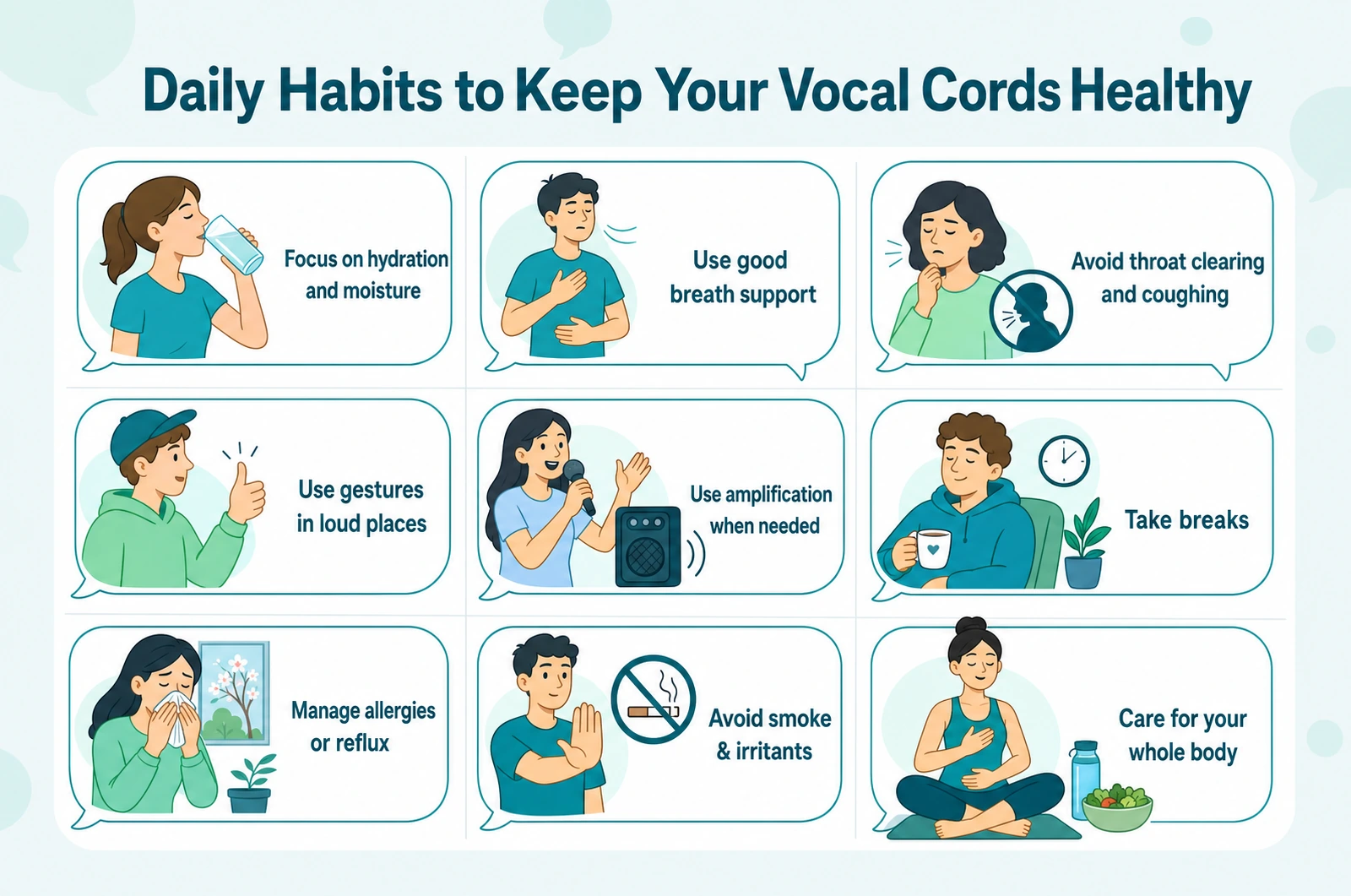
Healthy voice habits, also called vocal hygiene, matter just as much as the exercises. Drink plenty of water, get enough sleep, avoid yelling over loud background noise, and limit frequent throat clearing. When your voice needs rest, speaking less is usually better than whispering because whispering can put additional strain on the vocal cords.
Remember that voice therapy is not a one-size-fits-all treatment. Which exercises you should use, and how often you should practice them, depends on the cause of your voice problem. If you are seeing a speech therapist, follow the personalized home program they provide.
When should you see a speech therapist for a voice problem?
Home voice exercises can be useful, but they are not appropriate for every voice problem. If your symptoms do not improve or repeatedly return, you need to identify the underlying cause.
See a doctor if your hoarseness continues for longer than 2 to 4 weeks. Seek care sooner if you have:
- Complete loss of your voice, known as aphonia
- Pain when speaking or swallowing
- Difficulty breathing
- Swelling in the neck
- Coughing up blood
People with persistent voice problems are often referred to both an ear, nose, and throat (ENT) doctor and a speech-language pathologist. An ENT or laryngologist can inspect the vocal cords for concerns such as swelling, vocal nodules, muscle tension, vocal fold paralysis, or other medical conditions. The evaluation may include videostroboscopy, a procedure that uses a tiny camera and flashing light to assess how your vocal cords move during speech.
Once the cause of your symptoms is identified, a speech therapist can develop a treatment plan tailored to your needs. It may involve voice therapy exercises, breathing techniques, vocal hygiene strategies, and coaching on more efficient voice use. For professional voice users, including teachers, singers, coaches, and public speakers, early treatment may also help prevent future vocal injuries.
The most effective voice exercises are those that address the cause of your problem. If symptoms persist even with home practice, seek professional guidance instead of continuing to try additional exercises by yourself.
Voice therapy with Astrel is tailored to your voice and goals. In online sessions, your speech-language pathologist will evaluate how you use your voice, teach exercises suited to your needs, and offer feedback so you can practice with confidence. You will also learn healthy vocal habits that may prevent future strain and support your long-term vocal health.
Whether you are recovering from a vocal injury, managing persistent hoarseness, or hoping to speak with more comfort and confidence, you do not have to work it out alone. Our licensed speech therapists can help you develop a stronger, healthier voice. Click here to get started.
Frequently asked questions
Can voice therapy exercises be done at home?
Yes. Many voice therapy exercises can be practiced safely at home, including gentle humming, lip trills, diaphragmatic breathing, and straw phonation. However, the right exercises depend on the cause of your voice problem. If symptoms do not improve or keep returning, a speech therapist who specializes in voice can develop a personalized treatment plan.
Do voice therapy exercises work?
Yes. Research supports voice therapy exercises, and speech therapists commonly use them to improve vocal efficiency, ease strain, and encourage healthy voice use. As with physical therapy, consistent practice and exercises matched to your diagnosis offer the best results.
How long does voice improvement take?
Some people experience less vocal strain after only a few practice sessions, while others require several weeks of consistent work. Recovery time depends on the underlying cause of the voice problem, its severity, and how consistently you follow the treatment plan.
Which voice exercises are best for hoarseness?
The right exercises depend on why your voice is hoarse. Some people may benefit from gentle techniques such as humming, lip trills, straw phonation, and diaphragmatic breathing. But persistent hoarseness may result from conditions including muscle tension, vocal nodules, acid reflux, or vocal cord injuries. Identifying the underlying cause is important before you begin an exercise program.
Can voice exercises damage my voice?
Voice exercises should not hurt. Stop and contact your doctor or speech therapist if an exercise increases hoarseness, causes pain, or leads to vocal fatigue. Incorrect exercises, or exercises performed incorrectly, may delay recovery when an underlying voice disorder has not been diagnosed.
How is voice therapy different from vocal warm-ups?
Vocal warm-ups are brief exercises that prepare your voice for speaking or singing. Voice therapy is an individualized treatment program led by a speech therapist. It may combine warm-ups with breathing techniques, vocal hygiene education, and other exercises intended to treat a particular voice disorder.