


When children are learning to communicate, many parents wonder what is typical. How can you tell whether your toddler has a delay or is simply a “late talker”? And what exactly is the difference between speech and language?
This article explains the signs of speech and language delays and offers practical ways to support your child’s communication development at home.
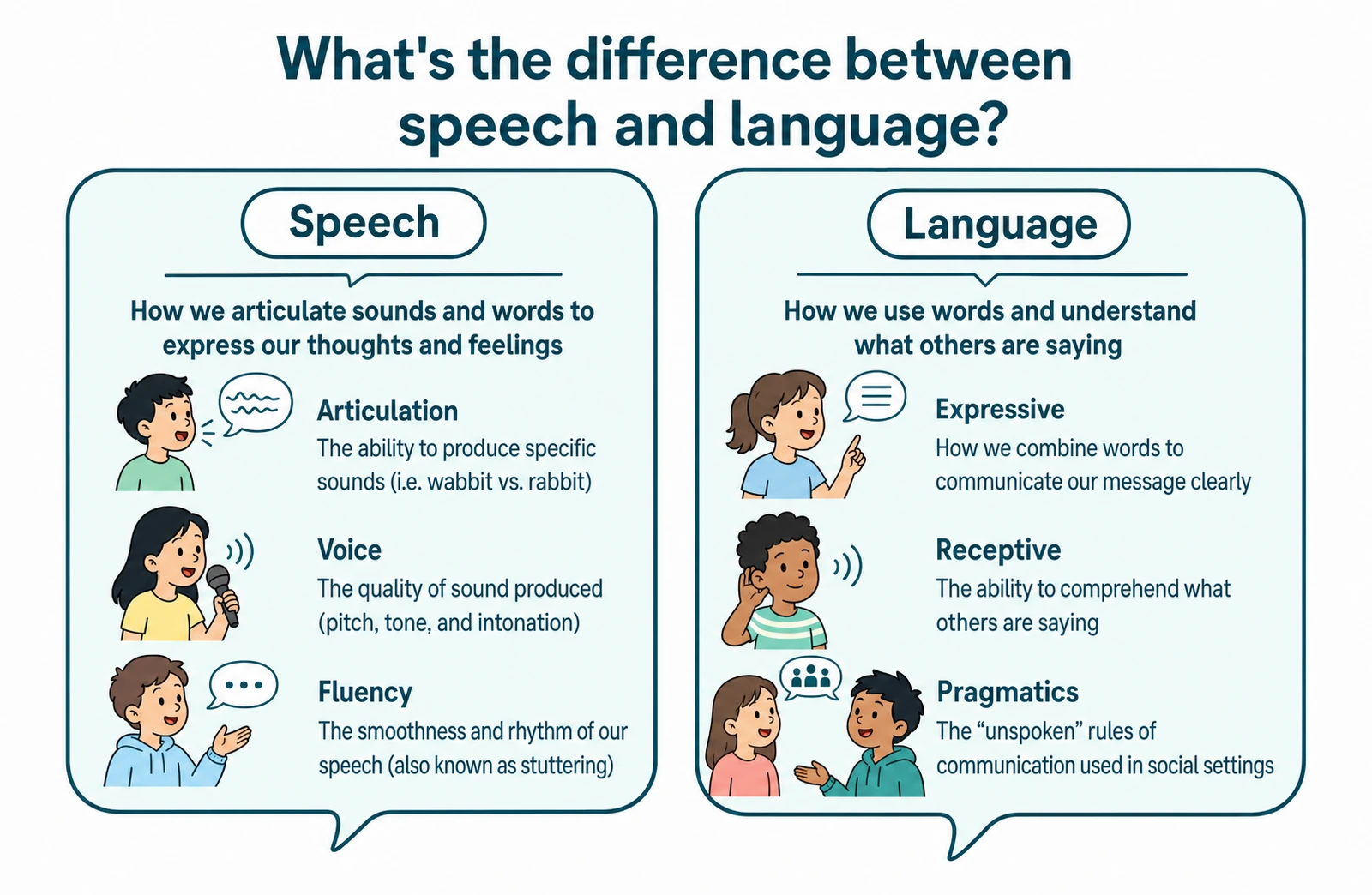
The difference between speech and language
Speech is how we produce sounds and words. It includes:
- How we use the mouth, lips, and tongue to make speech sounds
- Voice, including how we use the vocal folds and breath to produce sound
- Fluency, meaning the rhythm and smoothness of speech
Language is the system of words we use to communicate our thoughts, wants, and needs. It includes:
- Understanding the meanings of words
- Knowing how to combine words into sentences
- Knowing how to talk with other people across different situations
Free 30-minute evaluation
Looking for a speech therapist?
Talk through what you are noticing and get clear next steps.
Book free evaluation
Speech and language milestones
Every child develops on their own timeline. Still, children typically reach certain speech milestones within an expected age range. By 1 year, for example, a child is typically combining sounds to say things such as “mimi” and “upup.” By 3 years old, toddlers should use a broad range of sounds in words, including /b/, /n/, /t/, /w/, /g/, /f/, and /h/.
Speech development also includes how clearly a child speaks. Ideally, anyone should be able to understand at least 50% of what a child says by the time the child is 4 years old.
Children’s language development follows similar expectations, with certain milestones typically reached within an expected age range. Between 12 and 18 months, a child should respond to their name, follow simple directions, and begin saying new words independently. At about 2 years old, toddlers are expected to have at least 5 to 10 words that they use regularly and spontaneously. Two-year-olds also typically begin using simple two-word phrases, such as “I want,” “Give me,” or “More please.”
What is a speech delay?
Speech sounds develop in a typical sequence, and children are expected to say each sound correctly within a certain age range. A speech delay occurs when a toddler does not meet the typical speech milestones. The child develops speech sounds in the expected order, but more slowly than is considered normal.
Several factors can cause a speech delay. These include oral-motor problems, such as difficulty coordinating the tongue, lips, and mouth to pronounce sounds correctly.
What is a language delay?
Language skills also develop in a typical sequence, with children expected to use certain language concepts within particular age ranges. A language delay occurs when a child develops language skills in the correct order, but at a slower, or delayed, rate than expected.
Related guides







How can you distinguish a speech delay from a language delay?
Knowing the signs of speech and language delays can help clarify the difference. A child with a speech delay is often difficult to understand. They use words and phrases to communicate their ideas, but they struggle to form the correct sounds needed for clear speech.
A toddler with a language delay may produce the correct sounds and pronounce some words, yet be unable to form phrases or sentences that make sense. The child may also have trouble following simple directions or understanding what words mean.
What should I do if I think my child has a delay?
Some children have a speech delay or a language delay, while others have both. If you suspect a delay, trust your instincts and contact a speech-language pathologist, also called a speech therapist. A speech therapist is the professional most qualified to evaluate and diagnose your child. The sooner treatment begins, the more quickly your child can make progress toward their milestones.
Speech therapy includes caregiver education and training, helping you learn how to support your child at home. Treatment will be tailored to your child, but you can begin using the following general speech and language strategies today.
11 ways to support your child’s speech and language development
Many studies have shown that parents and caregivers play an essential role in children’s speech and language development. Children learn to communicate through everyday conversations and activities, and you spend more time with your child than anyone else. That puts you in the best position to help improve their speech or language delay.
Try these strategies:
1. Start talking to your child at birth, even if it feels a little silly.
Even newborns benefit from listening to speech.
2. Respond positively to your baby’s coos and babbles.
Interact with your baby as though they are talking to you.
3. Play simple games with your baby.
Peek-a-boo and patty-cake are both great options.
4. Talk with your child often.
Even something as simple as narrating what you’re doingcan help. For example, say, “I’m putting your yogurt in the bowl!”
5. Read books aloud.
If your child loses interest in the story, simply talk about the pictures instead.
6. Sing to your child and let them listen to music.
Learning songs helps your child pick up new words. Songs also build memory and listening skills and help children express ideas with words.
7. Build on what your child says.
For instance, if your child says, “Bluey,” you might respond, “Here is Bluey!”
8. Describe what your child is doing, feeling, and hearing throughout the day.
You might say, “You are hungry” or “You’re playing with your trains.”
9. Give your child your full attention when they talk to you.
After asking a question, allow enough time for your child to answer before you fill the silence.
10. Ask your child plenty of questions.
Give your child opportunities to tell you what they are doing or thinking.
11. Don’t point out or correct your child’s grammar mistakes.
Instead, model good grammar by saying the phrase correctly yourself.
Astrel has also created a video series featuring helpful exercises you can try at home. You can find all the videos here.
If you are concerned about a speech or language delay, don’t hesitate to seek help. Time and again, early intervention has been shown to be key. Start by talking with your pediatrician. If you remain concerned, contact a speech therapist. Speech therapists are specifically trained to diagnose communication issues, and speech and language delays can be treated effectively.