

Expressive language is how we communicate through words, sounds, and gestures. Some children experience delays as these skills develop. Expressive language difficulties can affect a child’s behavior, academic performance, and emotional life. Here’s how to recognize the signs of expressive language disorder and support your child.
“Oh, she said she wants another cookie.” “Yes, he does like giraffes.” “He wants Grandma to read to him tonight.” Parents and caregivers may recognize what it’s like to “decode” a child’s speech for someone else. I found myself doing exactly that with my 7-year-old over dinner with Grandpa the other night. If this sounds familiar, your child may have a limited vocabulary or become frustrated when trying to talk. Those can be signs of an expressive language disorder, but you’ll need more information to know. This guide explains expressive language disorder and when speech therapy may be appropriate.
How to use this guide
This guide covers a lot of ground. Read it from beginning to end for a thorough overview, or go directly to the sections most relevant to your child and situation. Then take these next steps:
1. Skim the age section for a quick overview of what to expect as language develops.
2. Review the milestones to help you decide whether it’s time for an evaluation.
3. Try one or two home strategies while you arrange the next steps.
What is expressive language disorder?
It helps to begin with two terms: receptive language and expressive language. Here is how Hamshi Ganjam, a speech-language pathologist with Astrel, defines them:
Receptive language refers to how well a child understands what they hear. It includes:
- Following directions
- Understanding questions
- Recognizing what words and sentences mean
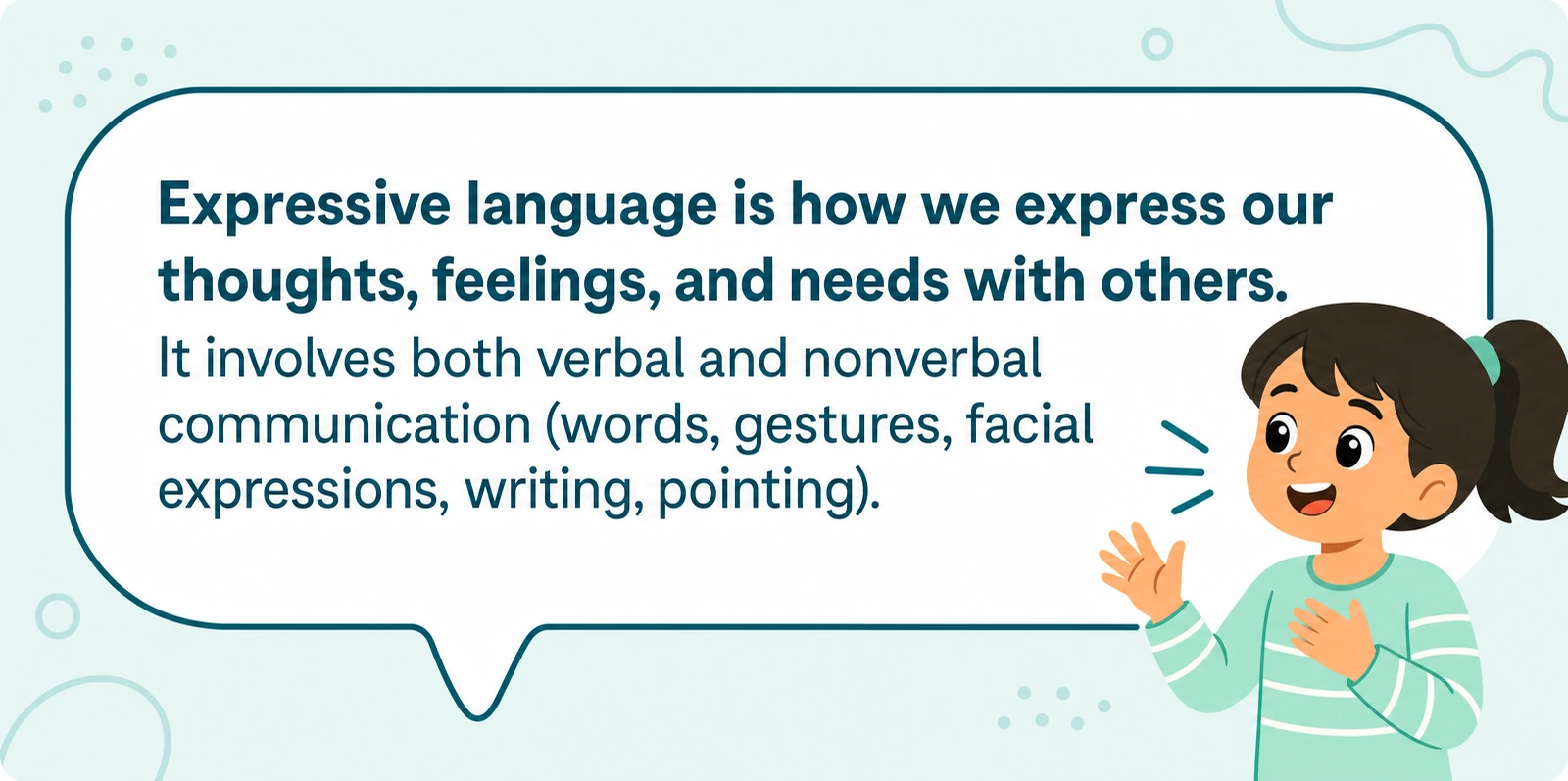
Expressive language refers to how a child communicates their wants, needs, thoughts, and feelings. They may do this through words, phrases, sentences, gestures, and facial expressions.
Expressive language disorder is a type of developmental language disorder. A child may have difficulty getting their message or meaning across to other people. Signs may include:
- Using fewer words than expected for their age
- Using verb tenses incorrectly, such as saying “I runned” instead of “I ran”
- Having trouble recalling words or building sentences
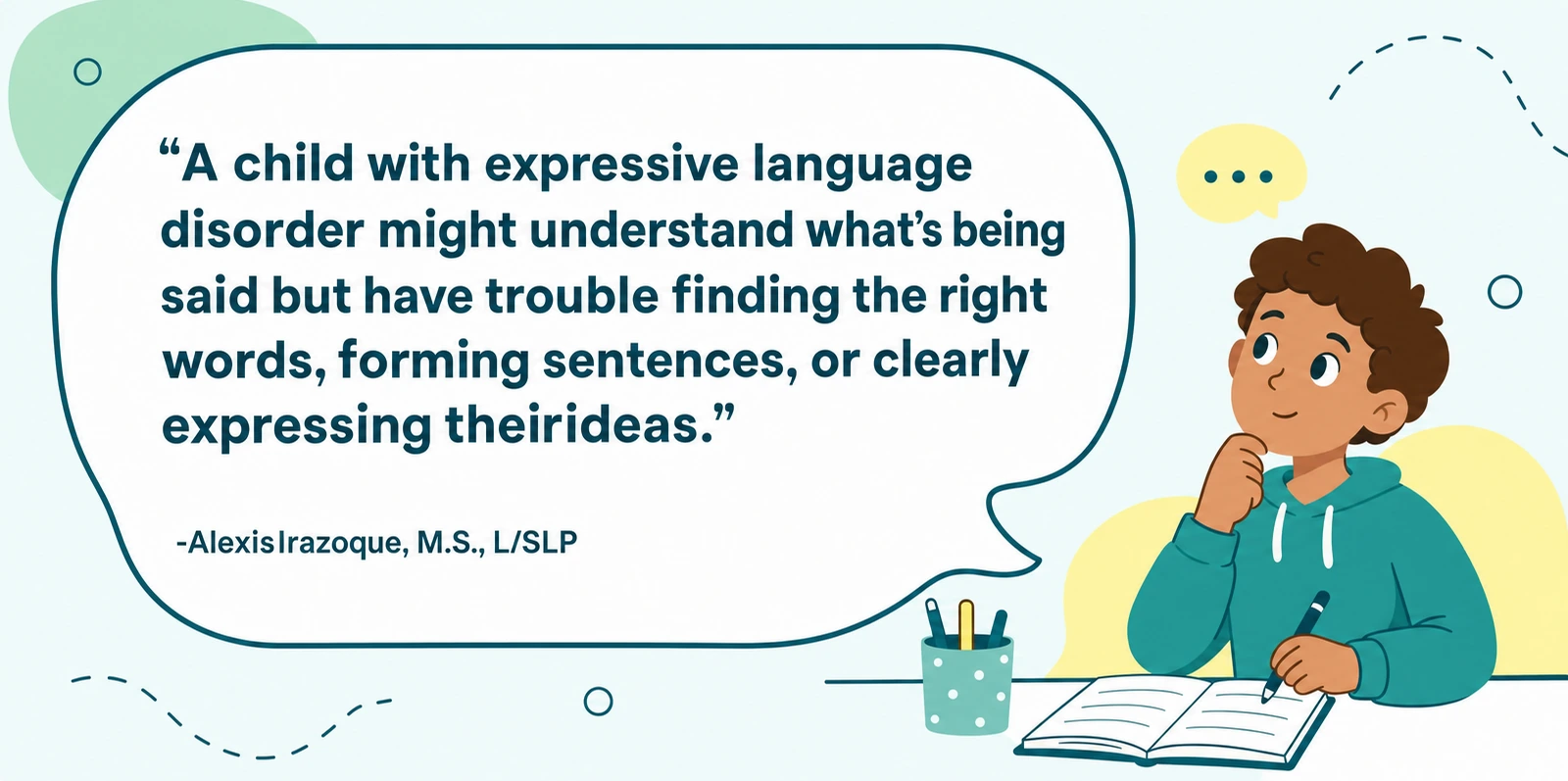
“A child with expressive language disorder might understand what’s being said but have trouble finding the right words, forming sentences, or clearly expressing their ideas,” Ganjam says. Expressive language problems affect 5% to 8% of children.
Expressive language milestones by age
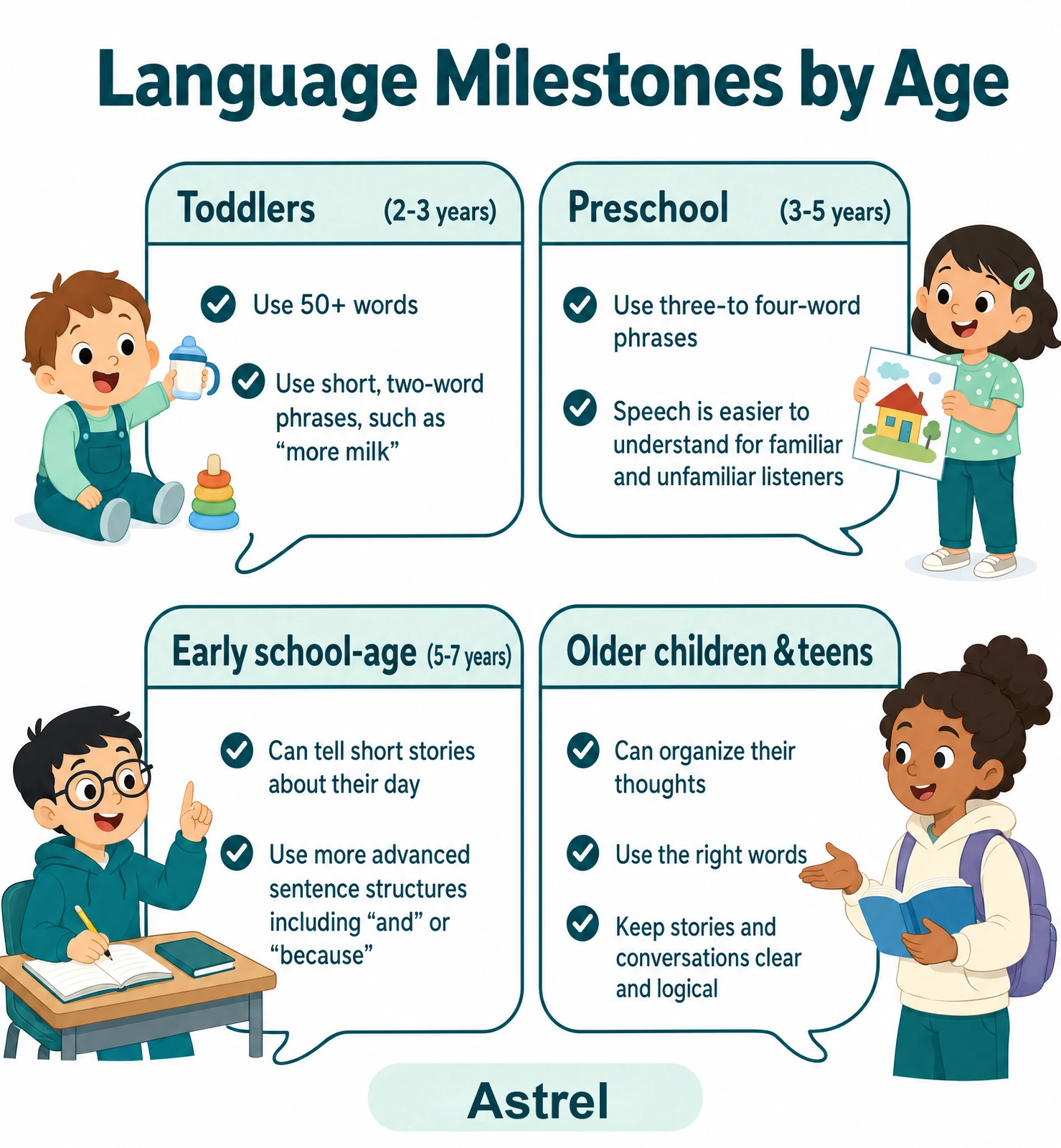
Language changes as children grow, so expectations for a preschooler or grade schooler differ from those for a toddler. We asked Ganjam to share quick, age-based checks for expected expressive language milestones. These checks are not diagnostic, but they can offer a general picture of typical development.
Toddlers (ages 2 to 3)
- Uses more than 50 words
- Combines words into short, two-word phrases, such as “more milk” or “go outside”
Preschoolers (ages 3 to 5)
- Uses phrases containing three to four words
- Is becoming easier for both familiar and unfamiliar listeners to understand
Early school-age children (ages 5 to 7)
- Can tell brief stories about their day
- Uses more advanced sentence structures, connecting ideas with words such as “and” or “because”
Older children and teens
- Can organize their thoughts
- Chooses the right words
- Keeps stories and conversations logical and easy to follow
Language delay vs. language disorder: What’s the difference?
A child can have either a language delay or a language disorder. With an expressive language delay , a child follows the typical developmental path but reaches milestones later than expected for their age. With a disorder, language development does not follow a typical pattern. This usually affects communication and can contribute to academic difficulties, behavior problems at school, and challenges in relationships with other children.
If you’re concerned about your child’s communication or they are not meeting any of the milestones above, contact a speech therapist for an evaluation. Together, you can develop a plan that fits your child’s needs.
Signs of expressive language disorder at different ages
Caregivers are often the first to notice that something may be wrong. Ganjam explains that although there are specific signs to watch for, the list is not exhaustive. Pay attention to your instincts. “If a child of any age has a hard time clearly expressing their thoughts or ideas, that’s a sign that speech therapy could help,” she says.
Toddlers
- Communicates mostly through gestures, grunts, or single words
- Has speech that is difficult to understand
- Appears to be losing speech skills
Preschoolers
- Avoids talking
- Becomes frustrated while trying to communicate
- Uses short, incomplete sentences that are difficult to follow
Early school-age children
- Has difficulty putting sentences together
- Uses words incorrectly
- Struggles to retell simple events in the correct order
Older children and teens
- Jumps from one point to another while telling a story
- Omits important details
- Relies on vague terms such as “thing” or “stuff” instead of more specific words
Conditions that can look similar and factors to rule out
Several issues and conditions can resemble expressive language disorder:
- Hearing loss or repeated ear infections. Difficulty hearing can affect speech and language development. Work with your child’s pediatrician to have their hearing and ear health evaluated.
- Speech sound disorders. A child may have difficulty producing common speech sounds, such as “sh.” This could point to another condition, including an articulation disorder.
- Attention, learning, or autism spectrum differences. These differences can occur alongside expressive language disorder, but they should be evaluated separately.
- Bilingualism. Growing up in a bilingual home does not cause expressive language disorder. However, bilingual children are more likely to be underdiagnosed or overdiagnosed with the condition. Children should be evaluated in both languages because developmental delays will appear across every language they speak.
What causes expressive language difficulties?
Expressive language disorder has many possible causes. It may occur on its own or as part of a broader diagnosis. Risk factors include:
- A family history
- Complications during birth
- Hearing loss
- Genetic disorders
- Brain injury
- Autism
In some cases, professionals cannot identify a cause.
What happens during a speech evaluation
According to Ganjam, here is what to expect when you meet with a speech therapist for an evaluation:
- Caregiver interview: You will discuss your child’s developmental history and how they communicate at home. This is your opportunity to explain your specific concerns.
- Language assessment: The speech therapist will use play-based or structured language assessments to understand your child’s vocabulary, sentence formation, and ability to express ideas. The therapist may use a tool such as the OWLS-II, or Oral and Written Language Scales, Second Edition. During one task, for example, your child may look at a picture and explain what is happening.
- Child observation: Throughout the evaluation, the therapist will observe how your child interacts and communicates.
“The process is designed to be engaging and comfortable for the child. It will give us the information we need to guide us to next steps,” Ganjam says.
After the evaluation, the speech therapist will discuss possible treatment options with you, including speech therapy. They can also review goals and supportive strategies for home and the classroom.
Treatment and support for expressive language disorder
You can support your child’s language development in several ways:
- Speech-language therapy: Find a licensed speech therapist who offers in-person or virtual therapy. Both treatment formats are effective. For more about Astrel's approach, read our guide to treating language disorders.
- Parent coaching: Use simple, natural strategies to model language for your child at home. You’ll find examples below.
- Classroom support: Make sure your child’s teachers understand their language development. Talk with them about practical ways to provide support at school.
- AAC: The abbreviation stands for augmentative and alternative communication. AAC may involve low-tech tools, such as picture cards, or devices such as tablets.
A common myth is that children, especially boys, will simply grow out of this kind of language problem, says Byron Ross, Ph.D., CCC-SLP, Instructional Professor in the Department of Communication Sciences and Disorders at the University of Houston. “But early intervention is the key to addressing any language issue,” he says. An earlier diagnosis allows treatment to begin sooner, supporting better progress and development.
Home practice: Simple routines that help
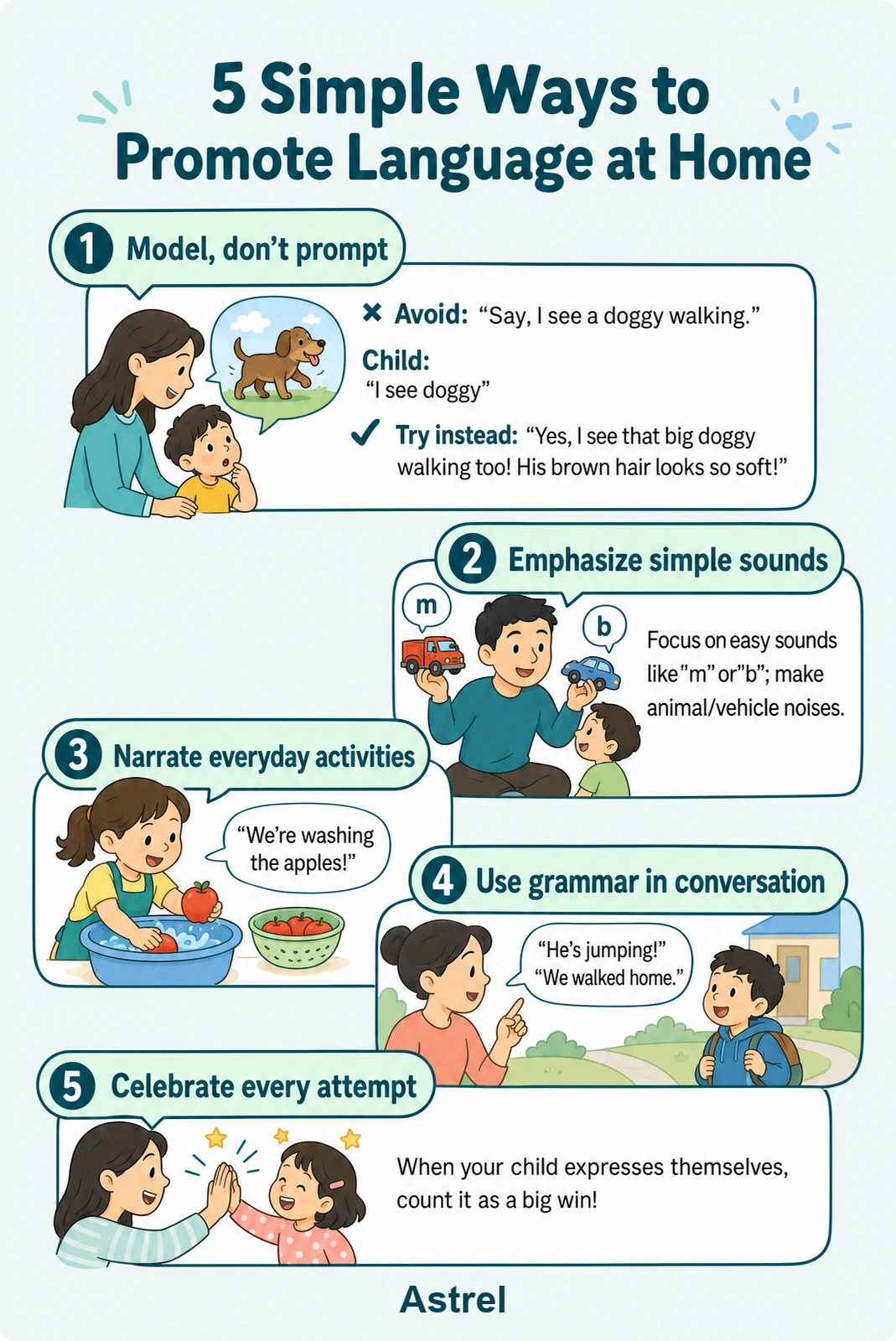
One way to support your child is through language modeling, which means showing them how to use language. Ross explains that this differs from asking a child to say something. For example, if your child uses only two or three words to make their point, you may be tempted to ask them to repeat the idea as a complete sentence.
Instead of asking your child to repeat after you, model the language naturally. “Children learn the language they hear, so modeling good language is important,” Ross says. Here is one example:
If your child says “I see doggy.”
Avoid saying “Say, ‘I see a doggy walking.’”
Instead, you can say “Yes, I see that big doggy walking too! His brown hair looks so soft!”
Expressive language practice can be playful and fun. Ganjam encourages caregivers to try the following:
- Narrate ordinary activities: “We’re washing the apples!”
- Emphasize simple sounds, such as “m” or “b,” along with animal and vehicle sounds.
- Model grammar during conversation, such as “He’s jumping!” or “We walked home.”
Treat every effort to express themselves as a meaningful success. “Celebrate every attempt to communicate,” Ganjam says.
Related guides







Language support at home and in the classroom
Ask your child’s speech therapist for ideas tailored to home and school. These suggestions can help you begin:
At home, invite your child to describe a picture from their day. During dinner, try a conversation game such as “Tell me 3 things about,” “Rose/Thorn,” or “Would you rather?” Choose an option that is appropriate for your child’s age and development.
At school, ask your child’s teacher which areas are most challenging. Work together to identify the best supports. The teacher might offer word banks or graphic organizers, give your child additional time to think before answering, or model language rather than correcting your child in front of the class. Your speech therapist can also prepare a list of ideas or techniques for the teacher.
Creating an inclusive communication environment
All forms of communication deserve respect, not only verbal speech. If your child is nonverbal, a speech therapist may recommend AAC or alternative communication devices. Ross emphasizes that these approaches do not prevent children from talking. Using a device does not give children a reason to avoid learning to speak.
“The research actually suggests the opposite. A child actually becomes more verbal when using an AAC device,” he explains. That is because these devices also model language.
Partnering with a speech therapist
You, your child, and the speech therapist can work as a team. “I love when caregivers want to be actively involved. It truly makes such a difference,” Ganjam says. She recommends taking these steps:
Share observations and updates. Bring teachers’ notes, brief video clips, and other useful examples to therapy sessions.
Set goals together. Perhaps you want your child to ask for what they need or tell complete stories. Let the speech therapist know which skills would be most useful and meaningful for your child’s growth.
Practice at home. Ask the speech therapist for activities that fit naturally into your daily routines. “Kids learn best when they’re communicating with the people they love most,” Ganjam says.
Ask questions. Discuss your child’s progress, which strategies to use, and what else you can do at home.
Stay patient and positive. Progress can take time. Celebrate each new word or phrase, and praise your child whenever they try to communicate.
Frequently asked questions
What is an example of expressive language disorder?
Expressive language is how we communicate through words, sounds, and gestures. A child with expressive language disorder has difficulty communicating and may struggle to share their needs, thoughts, and feelings.
What is an example of a language processing disorder?
Language processing disorder is a learning disability that makes it difficult to process information. A person may have trouble understanding language, using it, or both, which can lead to communication problems.
Can expressive language disorder be corrected?
Yes. Speech therapy is an effective treatment for expressive language disorder. It can help a child expand their vocabulary, build more complex sentences, and learn to communicate ideas.
Is expressive language disorder the same as autism?
No. Expressive language disorder is not autism. Autism is a risk factor that can make a child more likely to have a language disorder. Speech therapy treats expressive language disorder, and it may be one of the therapies recommended for a child with autism.
How can I help a child with language processing disorder?
Start by arranging an evaluation with a licensed speech therapist. Speech therapy can help your child strengthen language and communication skills. You can also support their development at home by reading together, modeling language regularly, and following the speech therapist’s recommendations.
Key takeaways
- Expressive language disorder involves difficulty communicating. A child may struggle to use words, form sentences, or express ideas clearly.
- The cause is often unknown. Risk factors include hearing loss, autism spectrum disorder, and family history.
- Speech therapy is an effective treatment for expressive language delay or disorder, and sessions can take place in person or virtually.
- Early intervention and language modeling by parents at home are the best ways to support a child.
Free 30-minute evaluation
Looking for a speech therapist?
Talk through what you are noticing and get clear next steps.
Book free evaluation