


Some children have difficulties that affect how they eat and drink. A childhood feeding disorder can affect a child’s nutrition, health, and safety. It can also make mealtimes stressful for the child and their family. Feeding therapy can help children with sensory food aversion, swallowing problems, and other feeding disorders.
Many parents wonder what to do when their toddler refuses to eat anything, and when a child’s lack of interest in food becomes a concern. In this guide, our feeding therapists answer common questions about feeding and swallowing disorders in children. You’ll learn which signs and symptoms to watch for, how to tell whether your child may need feeding therapy, and how to support a “picky eater” at home.
What is a pediatric feeding disorder?
Early childhood brings many exciting feeding milestones, from learning to suck, swallow, and breathe as infantsto learning to chew foods with different textures as toddlers. Because this is a time of rapid growth and brain development, it’s important to pay attention to any difficulties your child has with eating or drinking.
Pediatric feeding disorders (PFDs), also called childhood feeding disorders or pediatric dysphagia, can be defined as “impaired oral intake that is not age-appropriate, and is associated with medical, nutritional, feeding skill, and/or psychosocial dysfunction.” Pediatric feeding disorders often occur in children who are neurodivergent, autistic, or bound by routine. These children may feel comfortable only with familiar or routine experiences, which can limit the range of foods they eat.
Pediatric feeding disorders can also occur in children with:
- Developmental disabilities
- Oral-motor difficulties, such as childhood apraxia of speech)
- Muscle tone issues
- Cerebral palsy
- Sensory differences
- Challenges related to a head injury
Free 30-minute evaluation
Looking for a speech therapist?
Talk through what you are noticing and get clear next steps.
Book free evaluation
Signs and symptoms of a childhood feeding disorder
How can you tell whether your child needs feeding therapy? Toddlers and children with feeding disorders may show the following signs or symptoms:
- Eating less food than expected for their age
- Eating fewer varieties of food than expected for their age
- Showing disruptive or inappropriate behaviors during mealtimes
- Having difficulty feeding themselves by the expected age
- Having difficulty independently and appropriately using utensils or devices, such as a cup or spoon, during meals
- Slow physical growth and/or slow weight gain
To learn what to expect at different ages, review our feeding milestones for babies up to 12 months old and toddlers ages 1 to 3 years old.
Some children with feeding problems are at risk of choking or aspiration, which happens when food or liquid enters the airway. This is a sign that feeding therapy is necessary.
Watch for these symptoms of aspiration:
- Coughing while eating or drinking
- Eyes becoming red while eating or drinking
- Teary eyes while eating or drinking
- A gurgly or wet-sounding voice during or after eating or drinking
- Gagging
- Choking while eating or drinking
Children who show any of these symptoms, whether during infancy or later in childhood, may have a feeding or swallowing disorder. They should be evaluated by a speech therapist who specializes in feeding disorders.
What is a sensory feeding disorder?
Some feeding disorders are related to sensory issues. One type of childhood feeding disorder is a sensory feeding disorder, also known as sensory food aversion. A child with this disorder has trouble eating because they are sensitive to how foods smell, look, feel, taste, and/or sound.
For example, some children react negatively to mixed textures, such as soup containing vegetables. Others may dislike crunchy foods such as crackers. These sensory sensitivities can create major feeding challenges and often restrict the foods a child will eat. This may affect the child’s nutritional intake and growth.
Sensory aversion is more than simply being a “picky eater.” Picky eating may be developmentally appropriate between ages 2 and 4. It becomes a concern when exposure to new or non-preferred foods triggers a “fight or flight” response. A child might run away, hide, panic, or shut down. If your child responds this way, they may have a sensory feeding issue that can be treated with sensory feeding therapy.
Signs of a sensory feeding disorder
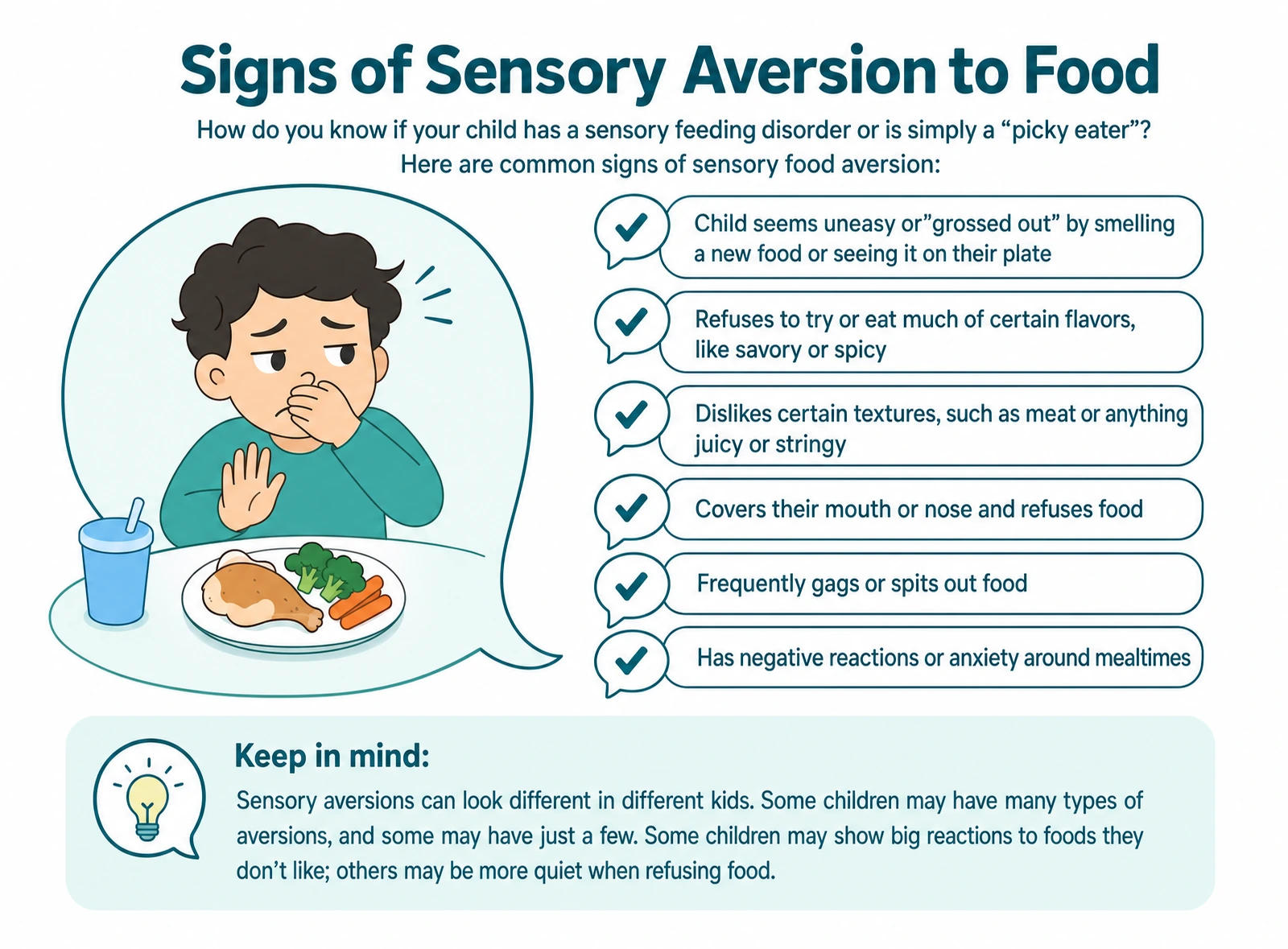
How can you distinguish sensory food aversion from picky eating? Children with a sensory feeding disorder may show these signs and behaviors:
- Seeming disgusted by the sight of a new food on their plate
- Feeling uneasy because of the smell of a new food
- Refusing to try or eat much of certain flavors, such as savory or spicy foods
- Disliking certain textures, such as meat or foods that are juicy or stringy, including fruits and vegetables
- Gagging frequently
- Covering their mouth or nose and refusing food
- Spitting out food
- Showing negative reactions or anxiety around eating and mealtimes
Sensory aversions do not look the same in every child. Some children have many types of aversions, while others have only a few. One child may react strongly to foods they dislike, while another may refuse them more quietly.
Children need to be able to eat both a wide variety of foods and an adequate amount of food. Watch your child closely and note what you observe. If your child has a sensory aversion, you’ll likely begin to recognize the pattern.
What is childhood feeding therapy?
Pediatric feeding therapy supports children who have difficulty with the physical process of eating or swallowing. Its goal is to improve a child’s ability to safely eat as many foods and liquids as possible. Therapy can help your child get the nutrition they need while making mealtimes easier and more enjoyable.
Childhood feeding therapy is provided by a speech-language pathologist, also called a speech or feeding therapist, who specializes in this area. The therapist helps the child safely eat the least restrictive diet possible, meaning as many foods and liquids as possible. Feeding therapy can make a meaningful difference in your child’s experience with food. To learn more about Astrel’s approach to feeding therapy for children, read our treatment guide.
Therapy for feeding skills and safety
If your child has dysphagia and feeding safety is a concern, safety will be a top priority in therapy. Feeding safety centers on protecting the airway. Because the esophagus and airway are very close together, food that enters the airway instead of the esophagus can lead to choking or aspiration.
Some children have muscle weakness, oral-motor weakness, or poor coordination of the mouth. These difficulties can increase the risk of feeding safety problems and related complications.
For a child with dysphagia, therapy will focus on identifying foods and liquids they can safely eat and drink. Some children cannot safely eat anything by mouth and may need alternative forms of nutrition, such as a g-tube.
Feeding therapy may include oral-motor exercises designed to improve a child’s strength and coordination, which can also support safer eating. For example, a child with poor jaw strength may need to build that strength to chew adequately.
Therapy for sensory food aversions
When children do not eat enough food or enough types of food, therapy will focus on increasing both the amount and variety they eat. These children may have sensory issues or behavioral responses that restrict their intake.
The speech therapist will help the child reduce sensory aversions, or negative responses to food. Strategies may include:
- Playing with non-preferred foods
- Using food chaining, which involves trying new foods that are similar to foods the child already likes
- Allowing child-led interactions with food
For example, playing with food allows a child to become comfortable interacting with it before eating it. The speech therapist may guide the child through a series of steps that gradually lead to taking a bite, such as smelling, touching, kissing, and then licking the food. By observing the child’s reactions, the therapist can determine when they are ready to try eating it.
The speech therapist may also work on helping the child eat a larger amount of food. One approach is to offer a structured meal and prompt the child to take bites while playing a game or eating a highly preferred food.
For more details and examples of what happens during sensory feeding therapy, read this article.
How can I tell if my child needs feeding therapy?
Your child may need feeding therapy if:
- They show signs of aspiration, choke during meals, or physically struggle while eating.
- They appear stressed at mealtimes or have strong, negative reactions to food.
- They do not eat enough food or a wide enough variety of foods.
- They consistently refuse many foods.
If your child shows any of these signs, speak with their pediatrician or a speech therapist. This is especially important if your child is losing weight or you are concerned about malnutrition. Trust your instincts. If something does not seem right, contact a professional.
Related guides







What happens in online feeding therapy?
Some types of feeding therapy can take place online, but others cannot. Your child’s pediatrician and speech therapist should make this decision. The speech therapist may need to be physically present to observe the child’s oral-motor and swallowing abilities.
Children who don’t have known airway safety concerns are more likely to be seen through teletherapy. Online feeding therapy requires planning and communication between the speech therapist and the parent or caregiver. The therapist will ask you to bring certain foods to the session, then guide you and your child through different exercises with each food.
Whatever the therapy goals, and whether sessions happen online or in person, the parent or caregiver should be involved.
Whatever goals therapy addresses, and whether it takes place online or in person, it is extremely important for the parent or caregiver to participate. This involvement helps you learn how to support your child during meals at home.
Astrel matches families with a licensed speech therapist who is trained to evaluate and treat childhood feeding disorders. All therapy takes place online through face-to-face video conferencing on Zoom. This format makes it easier for parents and caregivers to attend sessions with their child, and parent coaching is a key part of our treatment approach.
Support between sessions: The Astrel portal
Feeding therapy continues beyond the end of each session. At Astrel, you’ll have access to our client portal, which is designed to make practicing feeding strategies easier and more effective. It includes:
- Learning Paths that explain and reinforce feeding strategies
- Demonstration videos showing real feeding techniques in action
- Home practice activities to use during everyday meals
- Text messaging support for asking questions, receiving reminders, or getting tips from your therapist between sessions
Using the portal tools and practicing regularly can help your child progress faster and become more independent in their feeding abilities.
Tips for helping a toddler or child with picky eating
If your toddler refuses to eat or your child seems to be a “picky eater,” these strategies can support them and encourage them to try new foods:
- Create a food-positive environment. Use calm, positive, and supportive language to reduce the pressure to try new foods. Instead of saying, “Try it, you’ll like it,” you might say, “This is a food we’re learning about.”
- Serve small portions of new or non-preferred foods. Smaller portions can help prevent a potential fight-or-flight response.
- Encourage your child to explore foods in new ways. Describe the food in simple, child-friendly terms. What does it look like? How does it smell? What does it feel like?
- Involve your child. Invite them to help make the grocery list, then bring them along to shop.
Read this article for more ways to help your picky eater.
Get started with Astrel today
If your child needs help with eating or drinking, contact Astrel today. We’ll listen to your concerns and guide you through the next steps. If online feeding therapy is appropriate, we’ll match your family with a licensed speech therapist who can complete an evaluation and create a treatment plan. Get in touch with us here!