


Stuttering can be a typical part of language development in childhood. But if it continues for more than 3 to 6 months, or your child avoids speaking or seems less confident, speech therapy may be needed.
Key takeaways
- Between 5% and 10% of children stutter, often between ages 2 and 6 as their language skills develop.
- About 75% of these children will outgrow their stutter. The remaining 25% may need speech therapy to help prevent stuttering from continuing into adulthood.
- Consider a speech therapy evaluation if you hear repetitions, prolongations, or blocks in your child’s speech, if they avoid certain words, or if they make unusual body movements while speaking.
- The evaluation will likely include an oral-motor assessment, articulation testing, speech samples, and questions about your child’s medical and developmental history.
Free 30-minute evaluation
Looking for a speech therapist?
Talk through what you are noticing and get clear next steps.
Book free evaluation
How children’s speech develops
Many children stutter at some point during childhood. In fact, between 5% and 10% of all children will stutter for anywhere from a few weeks to several years. This often occurs between 2 and 6 years old, while children are developing their language skills.
When children first begin talking, many kinds of speech errors are common. They may mispronounce certain sounds or words, and young toddlers may be hard to understand, especially for people who do not know them well. This is normal. A young child’s speech is rarely 100% accurate, and it takes time to develop and sound more mature.
Occasional stuttering can also happen as children begin using longer phrases and sentences. Children often stutter during periods of significant vocabulary growth. This is likely related to the more complex motor planning their tongue and lips need to coordinate longer sentences.
About 75% of these children will naturally overcome their stutter over time. The remaining 25% may need speech therapy to help prevent stuttering from continuing into adulthood.
What can stuttering sound like?
You may hear these types of stuttering in your child’s speech:
- Repetitions: A repetition is a type of disfluency, or interruption in speech, in which a word, syllable, or sound is repeated more than three times. For example: “I w-w-w-w-w-w-want a snack.”
- Prolongations: A prolongation occurs when a sound is stretched or held for an unusually long time. For example: “I fffffffffffffffffound my shoe.”
Signs that stuttering may not be a typical part of development
It can be difficult to tell whether your child’s stutter will persist or is a temporary part of developing language skills.
If the stutter continues for more than 3 to 6 months, it may have become a clinical issue. At that point, it may be time to contact a speech therapist.
The following signs may also indicate that your child has abnormal fluency, meaning their speech is not flowing smoothly, and could benefit from a speech evaluation:
- You hear repetitions, prolongations, or blocks, which are pauses in speech, during your child’s everyday conversations
- Your child avoids talking or seems to lack confidence
- Your child avoids certain words to prevent stuttering
- Your child expresses concern about their speech
- You notice unusual body movements such as eye blinking, jerky jaw movements, or foot stomping while your child speaks
- Your child becomes out of breath while speaking
If you notice any of these signs, contact a speech therapist early, before the stutter has time to progress.
If the evaluation shows that your child’s speech is typical, that is reassuring and can put your mind at ease. But if their fluency is not typical, early intervention is recommended because speech therapy can prevent stuttering from worsening and persisting. The sooner your child learns to manage their stutter, the better.
What happens during a stuttering evaluation?
The speech therapist will likely begin by asking you to complete a case history form or answer questions about your child’s medical and developmental history. Mention any family history of stuttering because a child is more likely to stutter if a parent or sibling does.
Next, the speech therapist will perform an oral-motor evaluation to assess the strength and function of your child’s oral muscles. This helps rule out physical or motor issues that could affect speech.
Your child will also likely be screened for articulation and language abilities. If the speech therapist decides it is appropriate, they may conduct a formal evaluation in these clinical areas. Most of the testing, however, will likely focus on speech fluency. The therapist will use several techniques to assess different aspects of the stutter. If your child can read, they may be asked to read a short story aloud so the therapist can assess reading fluency. The therapist will then talk with your child or ask them to tell a short story to assess speaking fluency. For a child who is not yet reading, the therapist will likely collect a couple of different speaking fluency samples.
After these tests, the speech therapist will count both the stuttered syllables and the total syllables spoken in each sample. These figures allow the therapist to calculate the percentage of syllables stuttered. When this calculation is part of a normative assessment, the numeric data can help show how the child’s speech fluency compares with that of other children the same age.
Although numeric data matters, the speech therapist will also consider your child’s speech as a whole. Speech therapists continually assess a child’s speech throughout the evaluation.
Finally, the speech therapist will check for any secondary behaviors. Secondary behaviors are physical actions associated with stuttering. They may include eye blinking, unusual jaw movements, foot stomping, or clenched fists. Children learn these behaviors over time as they try to avoid stuttering. Tell the therapist if you notice any of them at home.
To learn more about the evaluation process and Astrel’s approach to treatment, read our stuttering treatment guide.
Related guides






How to support a child who stutters
If you think your child is stuttering, you can take a few simple steps to support them at home.
- Give your child plenty of time when you talk together. Do not rush them.
- Do not react negatively when you hear them stutter.
- Do not interrupt your child.
- Tell your child how much you enjoy talking with them, and offer plenty of praise and encouragement.
Find a speech therapist who specializes in stuttering
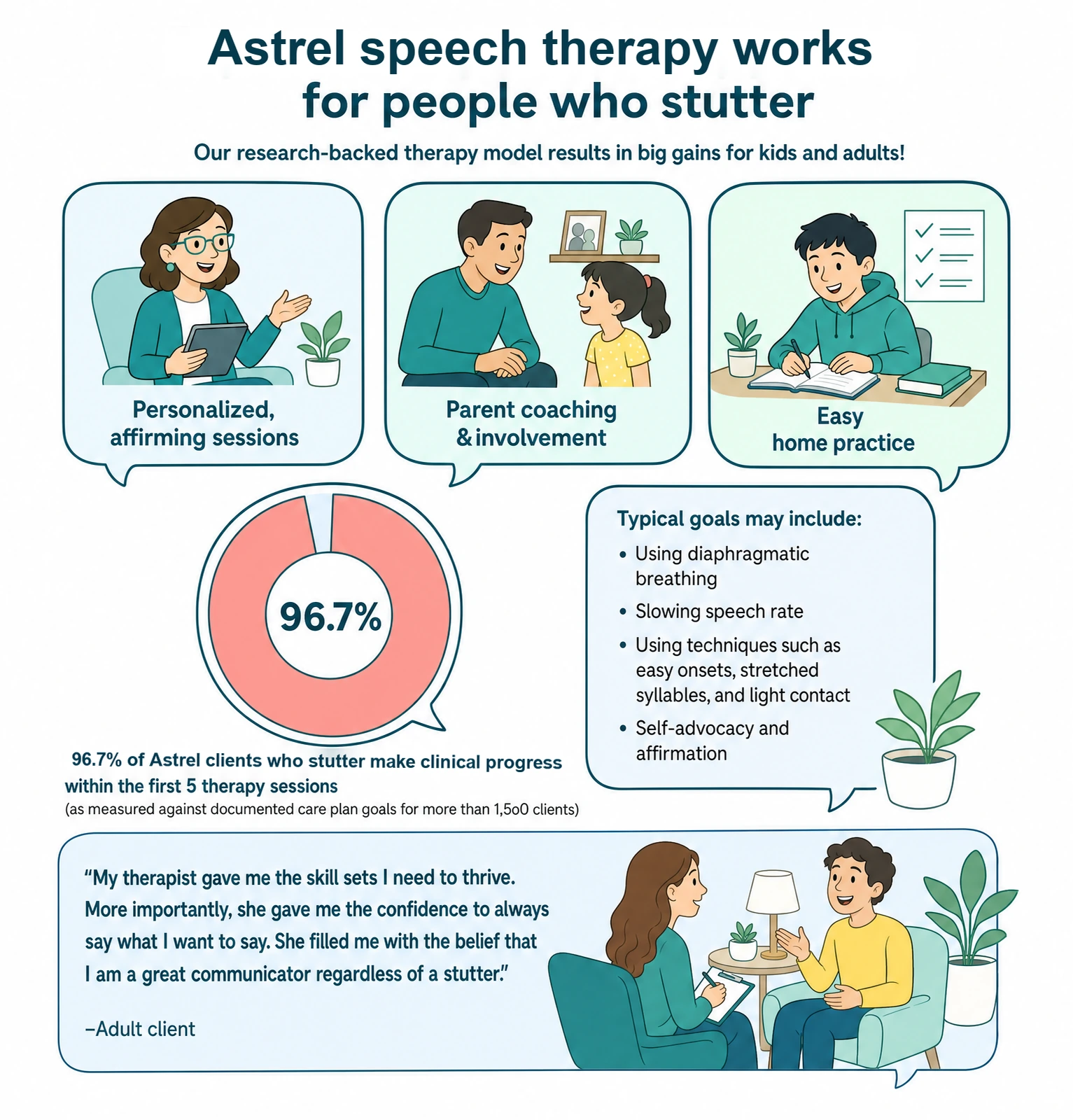
At Astrel, we have helped hundreds of children who stutter learn to speak more smoothly and confidently. During online speech therapy at Astrel, your child will learn directly from their speech therapist. You will also receive coaching on how to support your child at home between sessions, because children learn best from the people they spend the most time with and love the most. That means you.
You will also have access to our innovative online learning portal, which includes videos, tips, and activities designed to make speech therapy practice at home easier. Remember, more practice means more progress.
Ready to begin? Find a speech therapist for your child.
Frequently asked questions
Is it normal for children to stutter?
Stuttering can be a typical part of speech development. Between 5% and 10% of children ages 2 to 6 will stutter. About 75% will naturally overcome their stutter, while the other 25% may need speech therapy to help prevent stuttering from continuing into adulthood.
Is stuttering genetic?
Research suggests there is likely a genetic connection to stuttering. A person may be more likely to stutter if other members of their family stutter.
How can I tell if my child needs speech therapy for stuttering?
If your child has difficulty speaking smoothly, their stutter is worsening, or stuttering affects their daily life, contact a speech therapist for an evaluation.
Can stuttering be cured?
There is no cure for stuttering. The goal of stuttering therapy is to help children and adults manage their stutter, speak with greater ease, and feel confident when communicating. Certain techniques can help people speak more smoothly, which may reduce their stutter. Even if it does not decrease, speech therapy can help people feel empowered to speak freely in many different situations.