


Stuttering often emerges during the preschool years, as children learn new words, build longer sentences, and coordinate more complex mouth movements for speech. In 4-year-olds, stuttering may be a typical disfluency that resolves on its own, but in some children it persists.
Key takeaways
- Stuttering in toddlers and preschoolers is often part of typical development, particularly between ages 2 and 5, when language skills are expanding quickly.
- Researchers do not fully understand why children stutter. It is associated with differences in brain function, genetics, and rapid language development, not with parenting or anything a child “does.”
- For most young children, stuttering is temporary. Some continue to stutter, however, and may benefit from early support through speech therapy.
- Physical tension, frustration, avoidance, or stuttering that continues for more than 6 to 12 months may indicate that a speech-language evaluation is needed.
- Simple steps at home, such as slowing your own speech, easing communication pressure, and allowing your child time to talk, can make conversations easier and more positive.
Free 30-minute evaluation
Looking for a speech therapist?
Talk through what you are noticing and get clear next steps.
Book free evaluation
Is stuttering normal in 4-year-olds?
Many toddlers and preschoolers go through periods of speech disfluency. Disfluencies are moments when speech is not completely “smooth.” A child might repeat words or phrases, pause while speaking, or lose their train of thought. These are often typical developmental disfluencies that improve without treatment.
However, true developmental stuttering also often begins during the preschool years. Stuttering is a neurological condition that affects speech timing and flow. It may cause a child to repeat sounds, prolong them, or become “stuck” on a word.
This article explains what developmental stuttering can look like and which warning signs to watch for. It also covers simple ways to support your child at home and signs that a speech evaluation may help. If you are unsure whether your child’s speech is typical, an evaluation can offer answers and peace of mind.
At what age does stuttering usually begin?
Most children who stutter first show signs between ages 2 and 5. In fact, approximately 95% of children who stutter begin before age 4. The average age of onset is about 33 months, just under 3 years old. This is known as developmental stuttering.
Stuttering may develop gradually and become more pronounced, or it may appear suddenly. “Some children go through periods when stuttering improves, disappears, and then returns again,” explains Astrel speech-language pathologist Adhvika Shetty.
Researchers estimate that 5% to 8% of children experience stuttering or significant speech disfluencies at some point during childhood. Many children grow out of stuttering. For others, it may become more pronounced with age or continue throughout life.
Why stuttering often begins during the preschool years
The preschool years bring new demands on a child’s communication skills. At this stage, children are:
- Learning hundreds of new words
- Building longer, more complex sentences
- Trying to communicate bigger ideas and emotions
- Thinking faster than they can talk
- Developing the speech motor skills required for smooth speech
During this period of rapid development, a child’s speech may not always keep pace with their thoughts and growing language skills.
Why a 3-year-old might suddenly begin stuttering
It can be startling when a child who previously spoke smoothly seems to begin stuttering overnight. However, sudden onset is common with stuttering.
As children acquire new words and start communicating more complex ideas, the demands on their speech increase. Stuttering sometimes becomes noticeable during these periods of rapid growth.
“Parents may see more stuttering when a child is excited, tired, or eager to share something important. These situations don't cause stuttering, but they can make it easier to notice,” Shetty adds.
What developmental stuttering can look like
Developmental stuttering is the most common type of stuttering among children. A child who stutters may:
- Repeat sounds (“C-c-c-cat”)
- Repeat syllables (“Bu-bu-bubble”)
- Repeat words (“Can, can, can I have a snack?”)
- Prolong sounds (“Ssssssometimes”)
- Become stuck on a word, with no sound coming out
- Frequently use filler words such as “um” or “like”
- Pause frequently while speaking
- Blink their eyes, tense their face, or show other signs of physical effort while speaking
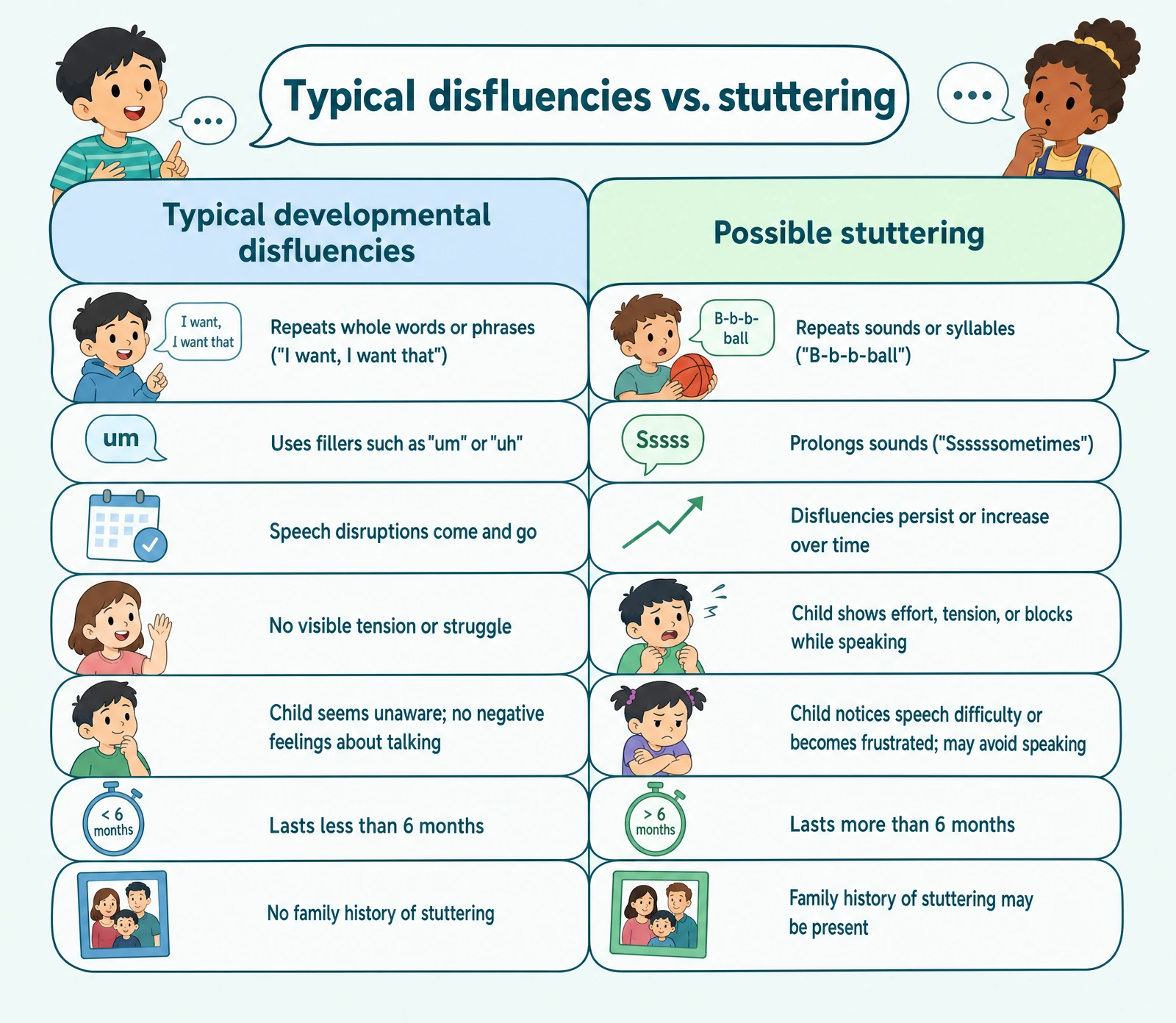
Many preschoolers have typical speech disfluencies. However, if your child repeats sounds, appears to struggle while talking, becomes frustrated with their speech, or has stuttered for more than 6 months, consider scheduling a speech-language evaluation.
Why do children stutter?
Researchers do not believe there is one single cause of stuttering. Instead, developmental stuttering appears to arise from a combination of genetic, neurological, and developmental factors.
Several factors may contribute to developmental stuttering:
Genetics and family history
Family history is among the strongest predictors of stuttering. Children with a parent, sibling, or another close relative who stutters are more likely to stutter themselves.
Speech-related differences in the brain
Research links stuttering to differences in the brain systems that control speech timing, planning, and motor coordination. These differences can make smooth speech more difficult.
Demands of language development
Periods of rapid language growth may make stuttering more noticeable in some children.
Temperament and communication style
Children with sensitive temperaments may respond more strongly to communication difficulties. Temperament does not cause stuttering, but it can shape how a child reacts to moments of disfluency.
“It’s also important to know that stuttering is not something a child chooses to do, and it's not caused by poor parenting,” Shetty emphasizes. Stress or major life changes can sometimes make stuttering more noticeable, but they do not cause it.
When should you be concerned about stuttering?
Not every child who stutters needs immediate speech therapy. Many toddlers and preschoolers experience a temporary period of disfluency that resolves on its own. Still, consider speaking with your child’s pediatrician or a speech therapist if your child:
- Has stuttered for more than 6 to 12 months
- Is stuttering more frequently or severely over time
- Shows frustration, embarrassment, or anxiety about speaking
- Shows physical tension while talking, such as eye blinking or jaw movements
- Becomes stuck on sounds or words
- Avoids speaking in certain situations or avoids particular words
- Has a family history of stuttering
- Began stuttering after age 4, and their speech difficulties are getting worse
- Has other speech or language concerns
If you are uncertain, trust your instincts. Many families find that an evaluation offers useful reassurance, guidance, and support.
Related guides






How to support a child who stutters at home
If your child stutters, you can take several simple steps to support their communication at home. The aim is not to eliminate stuttering overnight. Instead, create a relaxed, positive speaking environment where your child feels heard and confident. Shetty recommends the following strategies:
Model calm, unhurried speech. Modeling means showing your child what to do. Speak a little more slowly, pause between sentences, and leave plenty of time for conversations. Instead of instructing your child to “slow down,” demonstrate the speaking style you want them to hear.
Let your child finish. When your child speaks, listen patiently and maintain eye contact. Avoid interrupting, completing their sentences, or guessing what they want to say. Pay attention to what your child is communicating, rather than how they are saying it. This can help them feel heard and valued.
Reduce communication pressure. A string of rapid-fire questions can overwhelm young children. Instead of asking several questions one after another, turn some of them into comments. For example:
Instead of: “What did you do at school today?”
Try: “It sounds like you had a fun day at school.”
You can also set aside time each day for one-on-one conversation, giving your child your full attention without distractions.
Above all, remain patient and supportive. Your child needs to know that what they have to say matters, even when their speech is not perfect.
When to consult a speech therapist about stuttering
If you are concerned about your child’s speech, you do not need to wait until you are certain something is wrong. A speech-language evaluation can help determine whether your child’s disfluencies are part of typical development or whether speech therapy may be appropriate.
Early intervention can be highly effective for many young children who stutter. Speech therapy can help children communicate with greater confidence, reduce tension around speaking, and show families how to support communication at home.
Even if therapy is not recommended, an evaluation can give families peace of mind.
What happens during a stuttering evaluation?
A speech-language pathologist, also called a speech therapist, will collect information about your child’s speech, language, and developmental history. The evaluation may include:
- An interview with a parent
- Questions about any family history of stuttering
- A speech and language screening
- Analysis of speech samples
- A review of risk factors for persistent stuttering
- Recommendations specific to your child
The purpose is to understand your child’s overall communication skills, not simply to count instances of stuttering.
How Astrel supports children who stutter
At Astrel, our licensed speech-language pathologists offer personalized, evidence-based support for children who stutter. Convenient online speech therapy allows families to receive expert care from home.
Your child’s therapist works directly with your child while also coaching you on strategies for supporting communication during everyday routines. This collaborative approach helps children develop confidence and practice skills in the situations where they matter most.
We also view reducing stigma and encouraging acceptance as important parts of treatment. Children who stutter deserve to feel confident and empowered when they communicate.
If you are concerned about your child’s speech or would simply like professional reassurance, scheduling an evaluation can be a helpful first step.
Frequently asked questions
When does stuttering usually begin?
Stuttering most often starts in early childhood, typically between ages 2 and 5. Because language develops rapidly during this period, many cases of developmental stuttering first emerge in the preschool years. Stuttering may develop gradually or appear to begin suddenly.
Is stuttering in toddlers always a sign of a problem?
No. Stuttering in toddlers is often temporary and connected with typical language development. Many toddlers go through periods when they repeat words or pause as they organize their thoughts.
What is preschool stuttering?
Preschool stuttering refers to disfluencies in children ages 2 to 5. These may include repetitions of sounds, syllables, or words. Stuttering can vary depending on whether a child is excited or tired, or trying to explain something complex.
How does developmental stuttering differ from typical disfluency?
Developmental stuttering includes patterns such as sound repetitions, prolongations, or blocks. It may also involve visible tension or frustration. Typical disfluency is generally less frequent, comes and goes, and does not involve struggle or awareness.
Why do children stutter?
Researchers do not believe there is one single cause of stuttering. Stuttering often reflects a combination of genetics, brain differences in speech processing, and rapid language development. Parenting, bilingualism, and intelligence do not affect it.
Can stuttering in a 3-year-old go away on its own?
Yes. Many cases of stuttering in 3-year-olds improve without treatment, especially when disfluencies are mild and there are no warning signs such as frustration or physical struggle.
Should I wait if my child is stuttering?
If you continue to have concerns, it is best to schedule an evaluation. Some speech differences resolve without treatment, but a speech therapist can determine whether your child’s speech is typical or may need support.