


Lisps are among the most common speech impediments. An estimated 23% of people who receive speech therapy are treated for a lisp. But what is a lisp, exactly, and how can you tell if you have one?
What is a lisp?
People often use the word “lisp” to describe several kinds of speech impediments, but a lisp is a specific type of speech error. It is difficulty pronouncing the /s/ or /z/ sounds because the tongue is positioned in an incorrect motor pattern.
When someone has a lisp, their tongue position blocks the airflow needed to make the /s/ and /z/ sounds. That disrupted airflow creates the familiar sound of a lisp.
Only the /s/ and /z/ speech sounds are associated with lisps. Difficulty pronouncing another sound, such as /r/ or /l/, is not a lisp. It is an articulation error.
Free 30-minute evaluation
Looking for a speech therapist?
Talk through what you are noticing and get clear next steps.
Book free evaluation
What does a lisp sound like?
There are four types of lisps. Here is how each one occurs and what it can sound like.
1. Interdental, or frontal, lisp
An interdental lisp occurs when the tongue moves forward between the teeth. When the person tries to pronounce /s/ or /z/, they make a “th” sound instead.
2. Lateral lisp
A lateral lisp occurs when the sides of the tongue are raised, causing air to escape around them. This type of lisp is often described as sounding “slushy.”
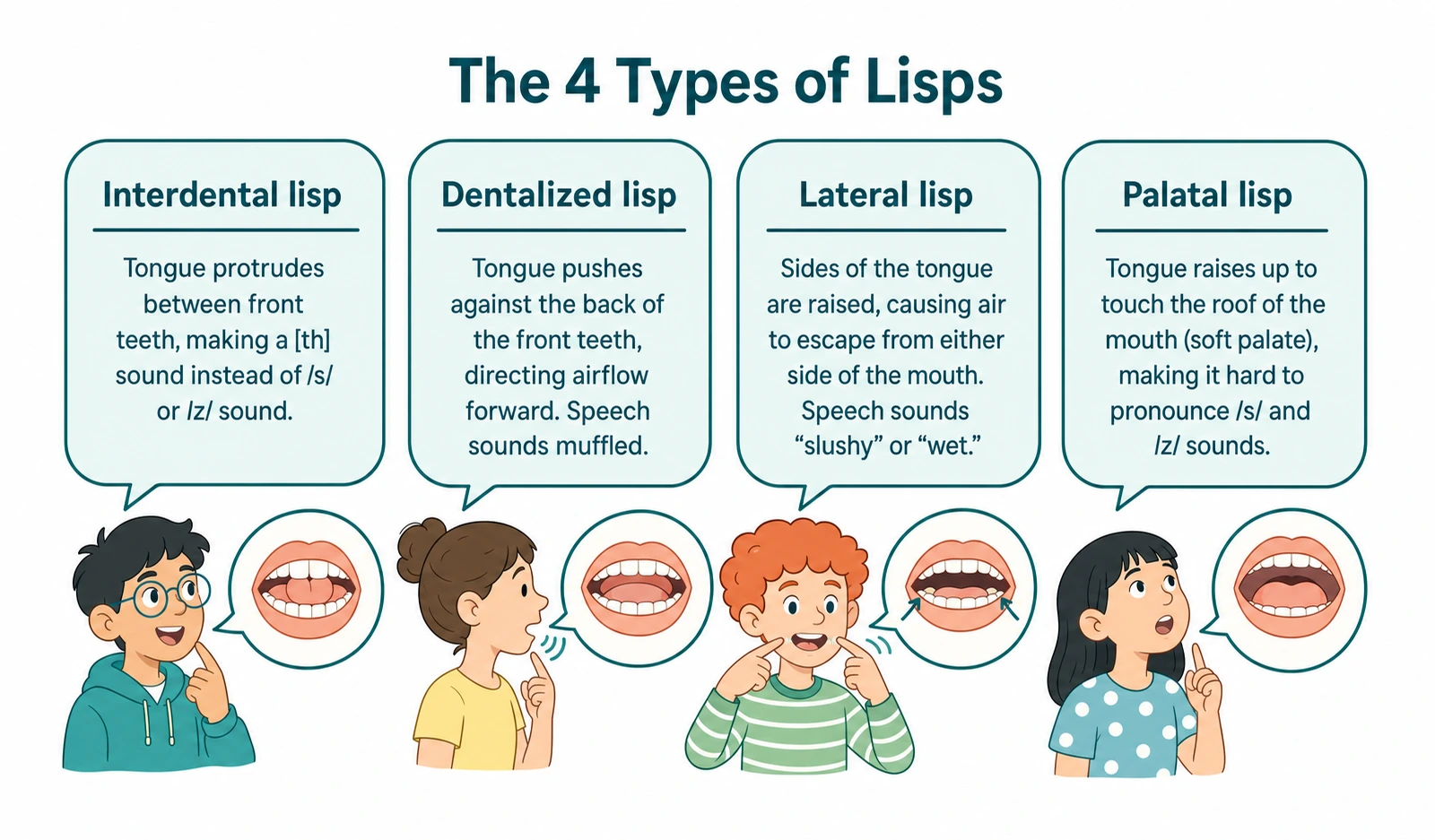
3. Dentalized lisp
A dentalized lisp resembles an interdental lisp because the tongue moves forward. The difference is that the tongue does not push between the teeth. Instead, it presses against them.
4. Palatal lisp
A palatal lisp occurs when the tongue presses against the soft palate, or the roof of the mouth. It is less common than the other types of lisps, but it can still make the /s/ and /z/ sounds difficult to produce.
Who can have a lisp?
Children and adults can both have lisps. However, an interdental lisp may be a normal part of childhood development.
An interdental lisp may be a normal part of childhood development.
A 2020 clinical review examined the ages at which children typically begin producing each speech sound correctly. The studies included in the review found that children can typically pronounce /s/ and /z/ correctly by age 4 years, 11 months. Until then, an interdental lisp could technically be considered a normal part of development.
How can you tell if your child has a lisp?
If your child has difficulty producing /s/, /z/, or both sounds, they may have one of the four types of lisps. If you are not sure which sound is difficult, give your child words containing /s/ and /z/ and ask them to repeat each one. Listen carefully to how they pronounce the words. If it helps, write their pronunciations on paper so you can review them later.
You may need to speak with a speech therapist to understand exactly what is happening with your child’s speech. A speech evaluation can provide answers and a plan for improving your child’s communication.
Related guides







Can a lisp go away on its own?
A lisp can go away on its own. However, if a child’s lisp continues past age 5, speech therapy may be needed to correct it.
If a child’s lisp continues past age 5, speech therapy may be needed.
Adults who did not receive speech therapy or learn to produce /s/ and /z/ correctly may continue to have a lisp into adulthood. Because they have spoken this way throughout their lives, the speech pattern is much more established as a habit. Even so, adults can work on correcting a lisp if they choose. Speech therapy can help adults as well as children. An adult who is motivated to learn strategies for correcting a lisp may benefit from speech therapy.
How can speech therapy help improve a lisp?
A speech-language pathologist, also called a speech therapist, can help children and adults who have a lisp. During a detailed speech evaluation, the therapist can identify the type of lisp and develop a program that targets tongue placement.
Speech therapy for a lisp trains the tongue muscles to move into the position needed to produce clear /s/ and /z/ sounds. Depending on the person’s needs, treatment may also address other speech sounds, or phonemes.
The speech therapist will provide exercises to complete during sessions and at home throughout the week. Home practice is essential for improving a lisp. Because a lisp involves an incorrect motor pattern, the new, correct pattern must be practiced repeatedly before it becomes established.
For some people, a lisp affects confidence and quality of life. Speech therapy can make a meaningful difference. If you or someone you care about is concerned about speech, contact a speech therapist for an evaluation.