


Speech errors are a normal part of development as young children learn to talk. Lisps are among the most noticeable speech disorders during this stage. A child with a lisp often has trouble pronouncing certain consonants, particularly the /s/ and /z/ sounds.
The question parents ask most often is, “Will my child grow out of a lisp?” In many cases, a lisp is a temporary part of language development and resolves on its own. But while a lisp may sound cute in a toddler, it can become concerning if it continues. Speaking with a lisp can affect a child’s confidence and self-esteem throughout the school years and beyond.
Fortunately, a lisp can be corrected at any age. This guide answers common questions about lisps, describes what they sound like, and explains how they are evaluated, diagnosed, and treated.
What is a lisp?
Many people recognize the sound of a lisp. In its most common form, a person makes a “th” sound when trying to produce an “s” or “z” sound.
A lisp occurs when the tongue is positioned incorrectly inside the mouth during speech. A person who lisps typically touches or presses the tongue against the teeth, or pushes it between them.
Lisps often become noticeable after age 2, when children begin developing their language skills. It is always a good idea to consult a speech-language pathologist if you think your child has a lisp, but an evaluation is especially important as your child approaches age 5.
Free 30-minute evaluation
Looking for a speech therapist?
Talk through what you are noticing and get clear next steps.
Book free evaluation
What are the four types of lisps?
There are four distinct types of lisps, each with specific characteristics and patterns of tongue placement. The differences may seem subtle, but an accurate diagnosis is important for treatment.
The four types of lisps are:
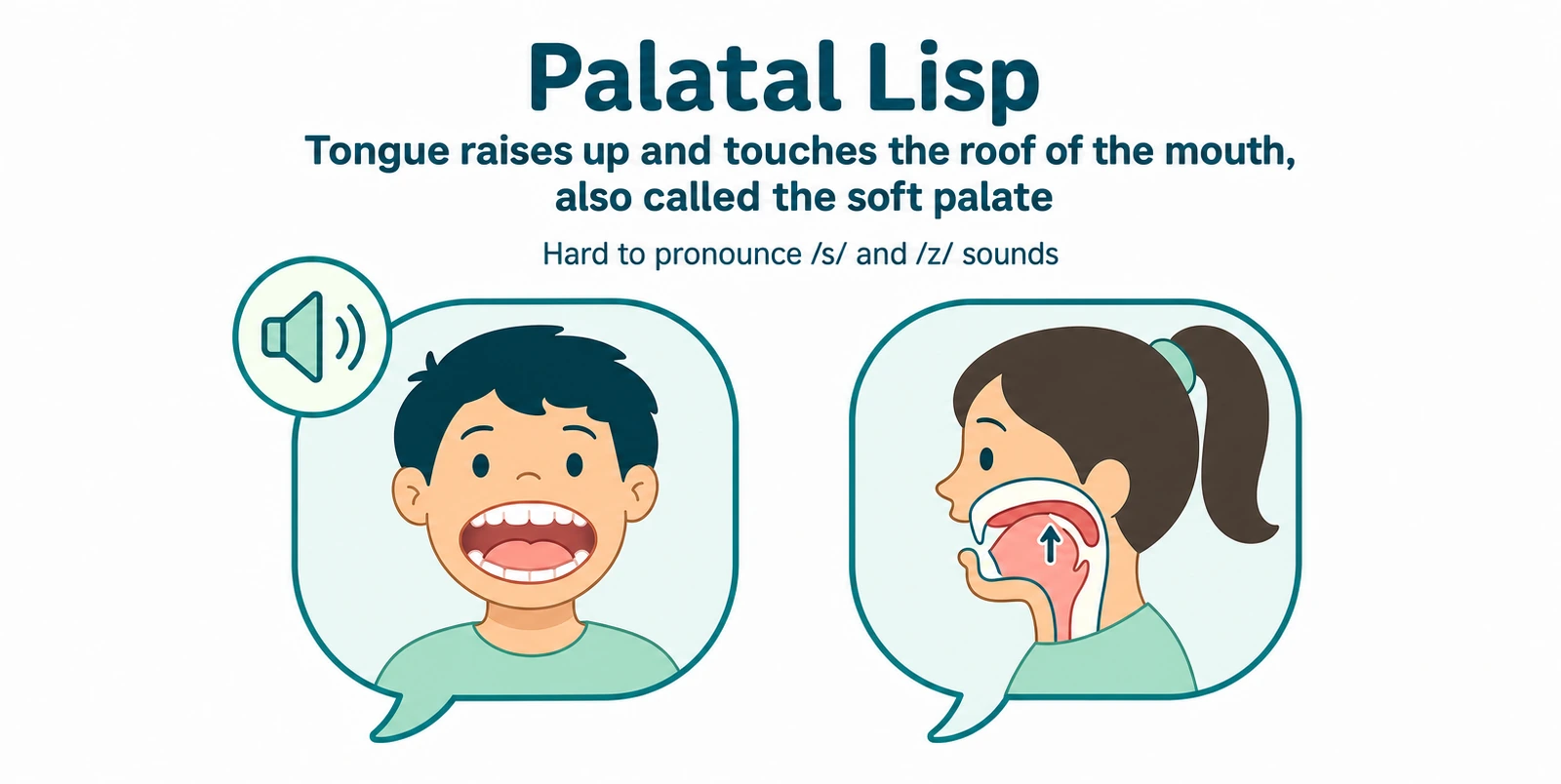
1. Palatal lisp
A palatal lisp involves the soft palate, also known as the roof of the mouth. When the tongue rolls back and touches the roof of the mouth during speech, the person often has difficulty producing /s/ and /z/ sounds.
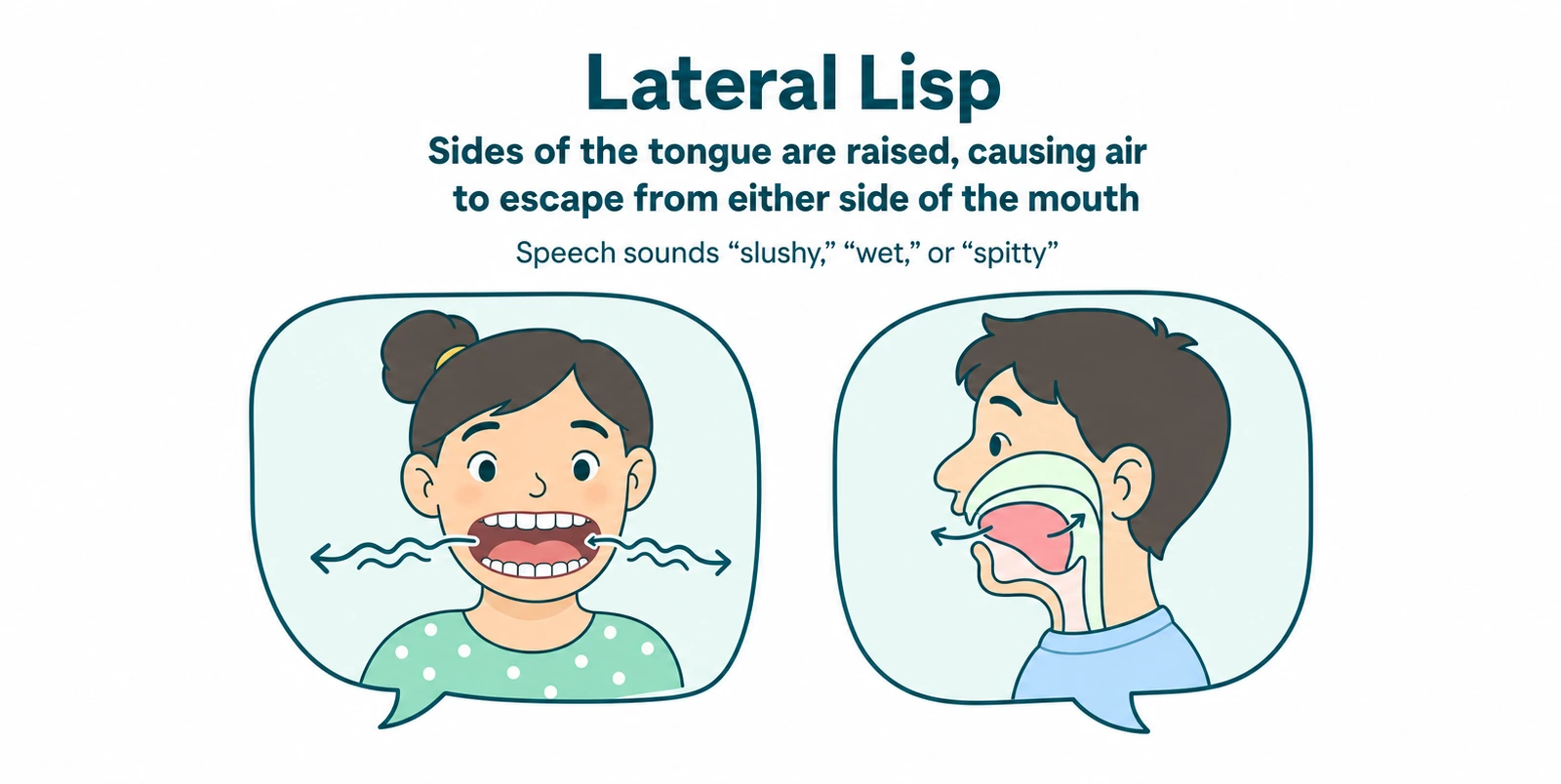
2. Lateral lisp
A lateral lisp occurs when the tongue stays in a nearly normal position, but airflow escapes from one or both sides of the mouth. It is sometimes called a “slushy lisp” because words may sound “wet” or “spitty.” The sound comes from a mixture of air and saliva.
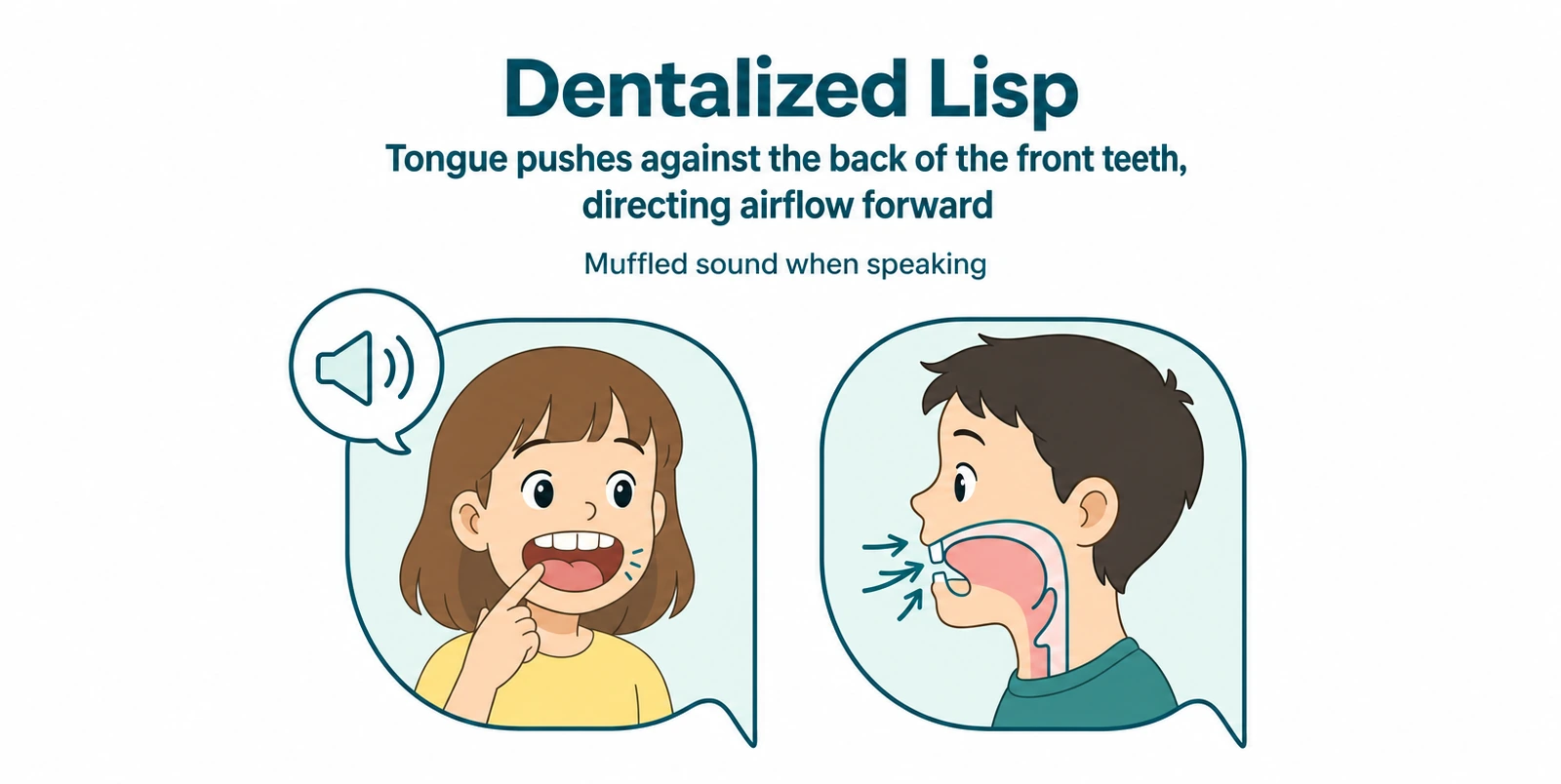
3. Dentalized lisp
With a dentalized lisp, the tongue presses against the front teeth and directs airflow forward. This commonly creates a “muffled” sound.
4. Interdental lisp
Interdental lisps are often called frontal lisps. They occur when the tongue moves forward or protrudes between the front teeth.
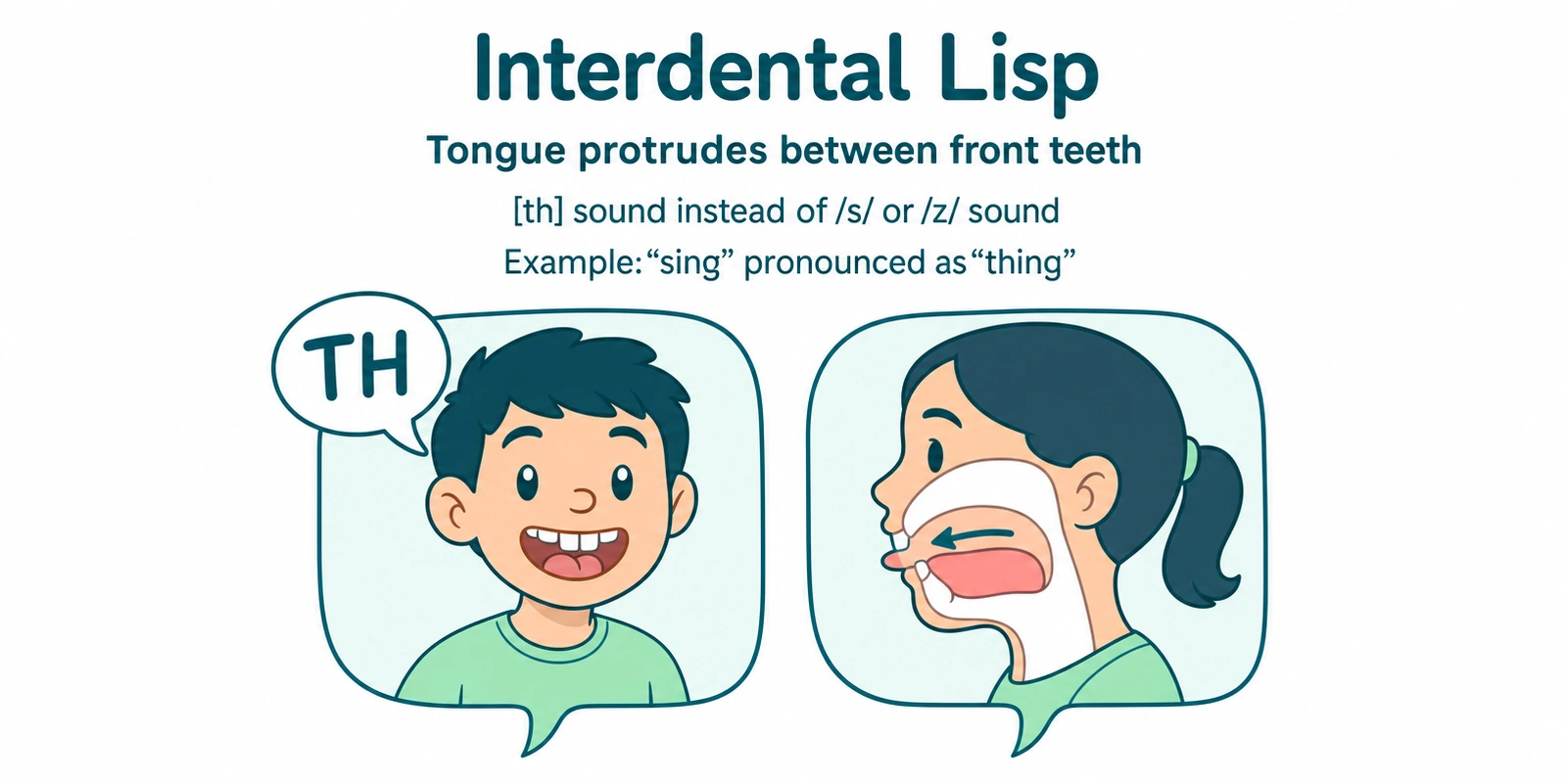
Dentalized and interdental lisps are both common during a child’s language development. Many children have one of these types of lisps until around age 4½.
Lateral and palatal lisps, however, do not occur as part of a child’s natural development. A child with either type should be evaluated by a speech therapist as soon as possible.
What causes a lisp?
A lisp results from incorrect tongue placement inside the mouth. This placement can obstruct airflow during speech and distort the way a person pronounces words and syllables.
Several factors can cause a lisp, including:
- Learning to pronounce sounds and syllables incorrectly
- Problems with jaw alignment
- A tongue tie, which occurs when the tongue is attached to the bottom of the mouth in a way that limits its movement
- A tongue thrust, in which the tongue protrudes between the teeth
What is the difference between a tongue thrust and a lisp?
Although a lisp can be a result of a tongue thrust, the two are not the same. The distinction can be difficult to recognize and should be determined by a speech therapist.
A tongue thrust is an orofacial myofunctional disorder (OMD). It occurs when the tongue moves noticeably forward as a person speaks or swallows. The tongue may rest too far forward inside the mouth or push between the teeth during speech and swallowing.
Like a lisp, a tongue thrust can lead to articulation errors that affect how a person produces sounds.
How can a lisp affect someone’s life?
Lisping often does not severely affect a person’s ability to be understood. Even so, a lisp can influence social and emotional well-being.
Some caregivers worry that peers may tease their child. Children with a lisp may also feel anxious or uncomfortable when talking with other people, which can affect their confidence, self-esteem, and ability to socialize.
These effects can be more difficult for adults with a lisp. They may feel frustrated or embarrassed when speaking at work, or they may avoid certain social situations altogether.
A lisp affects each person differently, and not everyone wants to change the way they speak. Still, parents and adults can take steps to reduce the impact of a lisp.
How are lisps identified and diagnosed?
In many cases, a child’s pediatrician, school nurse, or teacher will refer the family to a speech therapist. Speech therapists are communication experts and the professionals best qualified to assess, evaluate, and treat people with lisps.
Lisps vary in type and severity. If you suspect that your child has one, it is a good idea to be proactive and request an evaluation from a speech therapist.
During a lisp evaluation at Astrel, your speech therapist may:
- Review your medical history or your child’s medical history
- Examine the anatomy of the mouth and assess tongue placement
- Check for concerns such as a tongue tie or tongue thrust
- Observe your or your child’s speech fluency, vocal quality, and social communication skills
- Determine whether the person has a lisp or another type of speech sound disorder
- Offer a professional opinion about when intervention should begin. For example, the speech therapist may recommend delaying treatment and monitoring your child to see whether the lisp disappears naturally over time
How are lisps treated?
Habits can become harder to change over time. For that reason, the earlier speech therapy starts, the more quickly a lisp can be corrected and overall communication can improve.
After identifying the type of lisp, the speech therapist will create a treatment plan tailored to the person’s needs. The plan will often help the person:
- Become more aware of where the tongue is positioned during speech
- Hear and recognize the difference between correct and incorrect pronunciations of sounds and syllables
- Produce target sounds correctly
- Correctly pronounce increasingly complex language, including consonant and vowel combinations, structured and spontaneous sentences, and more
- Practice using the correct pronunciations in everyday situations outside therapy sessions
Speech therapists at Astrel use a range of cues and techniques to address a lisp because different approaches work for different people.
Therapy will likely focus on placement practice, which teaches how different parts of the mouth work together to produce speech sounds. Some children respond well to a verbal cue, such as a reminder to “use your ‘snake’ sound.” A gestural cue may also help, such as dragging one finger down the arm to represent a long, hissing sound.
As the person learns to produce the target sounds, the speech therapist will gradually provide less help. This builds independence in speech sound production, which is the overall goal of speech therapy.
Through the Astrel portal, you’ll receive weekly practice activities tailored to your needs. The more consistently you practice at home, the faster you’ll make progress.
As you become more independent, your speech therapist will increase the complexity of the tasks. At the start of therapy, for example, you might practice the /s/ sound by itself rather than in words. Over time, you will likely progress to using /s/ in sentences and conversation. Your Astrel speech therapist will also teach self-monitoring and self-correction techniques to help you use your new skills in everyday conversations.
Every Astrel client also has access to our client portal, which includes educational Learning Paths covering strategies taught during therapy sessions. The portal offers examples, tips, demonstration videos, quizzes, and more. You will also receive weekly home practice activities tailored to your needs. The more you practice speech therapy techniques at home between sessions, the faster you’ll make progress.
How does online speech therapy for a lisp work?
Astrel matches children, families, and adults with a certified speech therapist who is trained in their area of need. All therapy takes place online through face-to-face video conferencing.
The client’s age and stage of development shape how the speech therapist works with them during sessions:
Ages 0 to 3: Caregivers attend sessions and work directly with their child’s speech therapist to learn cues and strategies for home practice. This helps them practice confidently with their child between sessions and support continued progress.
Ages 3 to 6: Caregivers join video sessions with their child so both can learn useful skills from the speech therapist. Reinforcing those lessons outside the session helps the child continue building skills.
Ages 7 and older: Most children attend video sessions independently, while parents receive updates and tips during each session.
Adults: Adults usually attend sessions on their own, but they are welcome to include loved ones or family members.
Related guides







Can adults correct a lisp?
First, it is never too late to “fix” a lisp.
Many adults have a lisp that was not properly treated when they were younger. They may feel frustrated, embarrassed, or self-conscious, and they may want to correct the lisp so they can speak with more confidence.
It is equally important to recognize that not every adult wants to change their lisp, and that is perfectly OK. Some adults have accepted the way they speak. Their lisp has become part of their unique image and persona.
Not every adult wants to fix their lisp, and that is perfectly OK.
Assessment and treatment are largely similar for adults and children, beginning with professional help from a speech therapist. One added challenge for adults is finding someone to practice with outside therapy. This could be a spouse, family member, or friend. What matters is choosing someone you trust to provide honest feedback and encouragement as you continue working to improve your lisp.
If you are considering speech therapy for yourself, contact Astrel. We can answer your questions and help you determine the next steps. Connect with us here.
How long does it take to correct a lisp?
Every person is different, so the frequency and intensity of speech therapy will vary based on individual needs. Some children show significant improvement within a month or two. Others may need speech therapy for a year or longer. In most cases, the recommended schedule for lisp treatment is two speech therapy sessions per week.
The length of treatment can depend on factors such as:
- The person’s age
- The type of lisp
- The person’s awareness of mispronunciations and ability to correct them independently
- How well the person follows directions
- How consistently the person practices at home
At-home exercises that may help correct a lisp
As with any speech or language concern, practicing with a speech therapist only once or twice a week is not enough. Changing established habits requires regular reinforcement. Practicing between sessions, or helping your child practice, can lead to faster progress.
Your speech therapist will recommend home practice based on your specific needs. The following tips and techniques may also help with correcting a lisp.
Model correct speech for your child: Children absorb speech habits by watching and interacting with the people they love, especially family members. That is why it is important to model correct speech when talking with your child.
Speak slowly and clearly, using correct pronunciation. Maintain eye contact with your child, even if you need to kneel to reach their level. This gives them a clear view of how your mouth moves and forms sounds.
Practice with a mirror: Sit with your child in front of a mirror and practice producing the “s” and “z” sounds together. Watch how your teeth and mouth move, then encourage your child to copy the correct movements. This can help anyone, particularly visual learners. Adults with a lisp can also benefit from practicing with a mirror.
Use the butterfly technique: This common speech therapy technique is easy to practice at home. Prolong the letter “i” when saying words such as “chin” or “win.” Notice how the sides of your tongue lift slightly, like a butterfly’s wings. The tongue should be in the same position when producing the /s/ and /z/ sounds. The exercise is designed to keep the tip of the tongue from protruding past the teeth.
Drink through a straw: Using a straw when drinking can be especially helpful for people with dentalized or interdental lisps. A straw naturally encourages the tongue to pull back into the mouth, which can help build oral-motor strength. To avoid using disposable plastic, consider buying a washable, reusable metal straw.
Help your child stop sucking their thumb: Although thumb-sucking is a natural instinct, it can cause a lisp or make one worse. Thumb-sucking may shift the teeth and create space for the tongue to protrude forward. Try offering a comforting substitute your child enjoys, such as a favorite toy or blanket.
Get started with Astrel
If you are considering speech therapy for your own lisp or your child’s, contact Astrel today. We can answer your questions and help you decide what to do next. Start our simple sign-up here.