


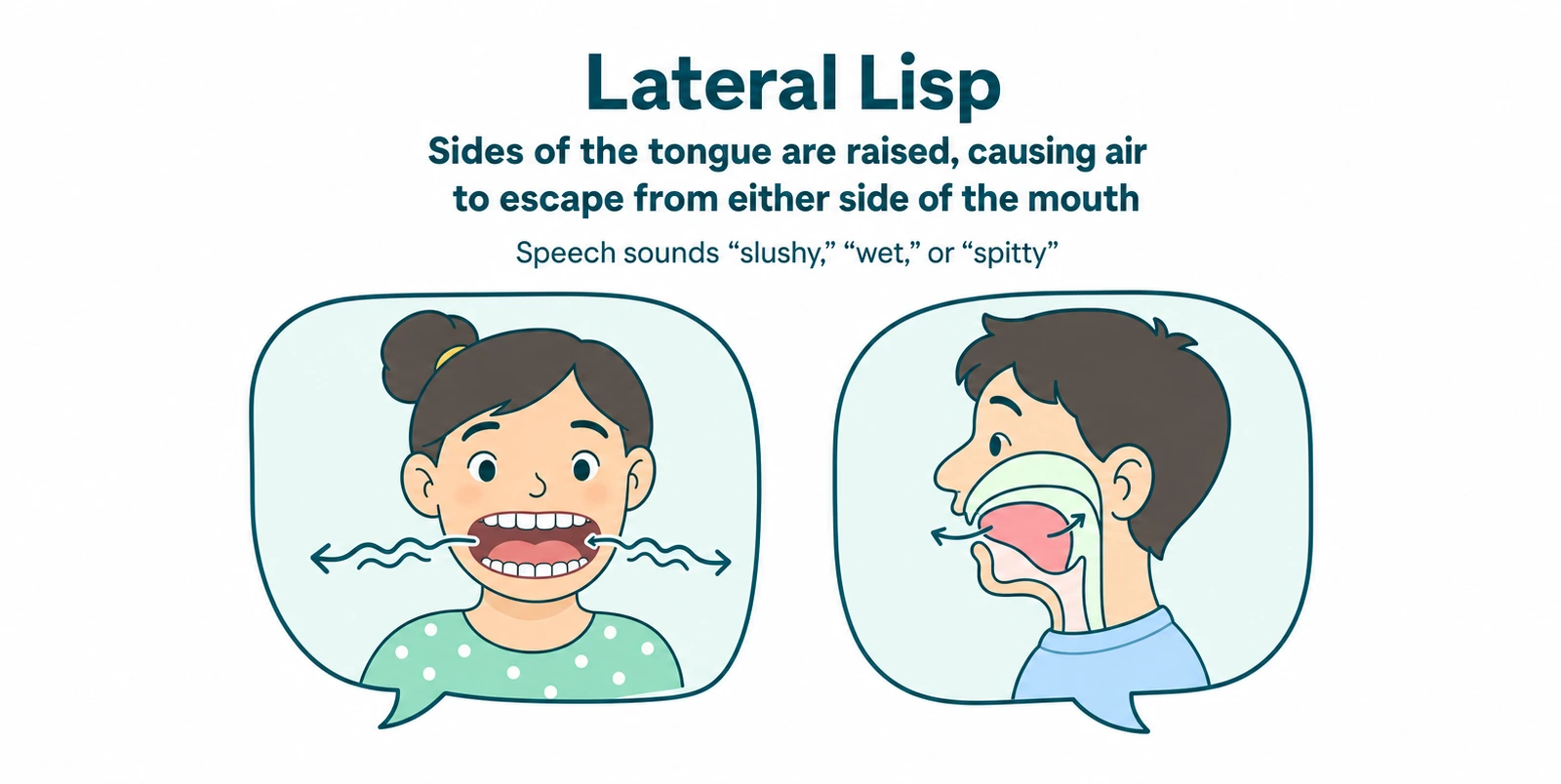
A lateral lisp happens when the sides of the tongue do not lift during production of the /s/ or /z/ sound. Air then escapes around the sides of the tongue, making speech sound “slushy” or “wet.” Speech therapy can train the tongue muscles to move into the position needed for a clear /s/ sound.
Key takeaways
- A lateral lisp sounds “slushy” because the tongue is positioned incorrectly, allowing air to flow over its sides instead of forward.
- A lateral lisp is not part of typical development, and a person will not usually outgrow it.
- Speech sound differences that reduce intelligibility may also affect a person’s confidence, self-esteem, and willingness to socialize.
- A speech therapist can identify the type of lisp and develop a treatment plan to correct it.
- Speech therapists use several exercises to correct a lateral lisp, including the exploding /t/ technique and the straw technique.
Free 30-minute evaluation
Looking for a speech therapist?
Talk through what you are noticing and get clear next steps.
Book free evaluation
What causes a lisp?
A lisp is a common speech condition in children and adults. An estimated 23% of people who receive speech therapy are there because of a lisp. Lisps result from an incorrect motor pattern for tongue position and movement. In practical terms, a person with a lisp positions the tongue in a way that blocks the airflow needed to produce /s/ and /z/. This altered airflow creates the familiar lisping sound.
The reason for this incorrect tongue position is not always clear. Several factors can contribute to a lisp, including:
- Learning to produce /s/ and /z/ incorrectly during childhood
- Jaw misalignment or other problems with jaw alignment
- A tongue tie, which restricts movement because the tongue is attached to the bottom of the mouth and may lead to a lateral lisp
- A tongue thrust, in which the tongue protrudes forward and may also affect feeding and swallowing
Lisps usually develop during childhood. Without treatment, they can continue through the teenage years and into adulthood. A lisp may make someone’s speech sound less mature or harder to understand, but it can be corrected with guidance and practice.
The difference between the /s/ and /z/ sounds
Before going further, it helps to understand how /s/ and /z/ are produced correctly. This article uses /s/ most often in its examples because /s/ and /z/ require the same tongue placement. The only difference is voicing: the vocal cords do not vibrate during /s/, but they are active and vibrating during /z/.
Try it yourself. Put your hand on your throat and say /z/. You should feel a vibration as your vocal cords come together. Keep your hand in place and say /s/. You should not feel a vibration because the vocal cords are not being used.
In other words, the same production rules apply to /s/ and /z/. The only difference is whether the voice, or vocal cords, is used.
The four types of lisps
There are four different types of lisps. Identifying the type matters because it guides the treatment approach used in speech therapy. Here is how each type works and what it sounds like:
1. Lateral lisp
A lateral lisp occurs when the sides of the tongue do not lift, allowing air to escape around them. The resulting sound is often described as “slushy” or “mushy.”
2. Interdental (frontal) lisp
An interdental lisp occurs when the tongue pushes forward between the teeth. As a result, the person produces a “th” sound while trying to say /s/ or /z/.
3. Dentalized lisp
A dentalized lisp is similar to an interdental lisp because the tongue moves forward. The difference is that the tongue presses against the teeth rather than pushing between them.
4. Palatal lisp
A palatal lisp occurs when the tongue presses against the soft palate, or roof of the mouth. Although it is less common than the other types, it can still make /s/ and /z/ difficult to produce.
What does a lateral lisp sound like?
Once you know what to listen for, a lateral lisp is easy to recognize. The tongue remains in a relatively correct position, but its sides do not lift high enough. This allows air to escape from either side of the mouth. The extra airflow gives speech a distinctly “slushy,” “wet,” or “spitty” quality. In fact, a lateral lisp is sometimes called a “slushy lisp.”
To hear an example of a lateral lisp, watch this video of Sid the Sloth from the movie “Ice Age.” His /s/ sound shows a classic lateral lisp. However, a lateral lisp can affect several sounds, including /s/, /z/, /sh/, /ch/, /zh/, and /dj/. You hear these sounds in words such as “sun,” “zoo,” “shoe,” “chew,” “casual,” and “juice.”
How can I tell if my child has a lisp?
Children develop articulation skills at different rates. Some pronounce /s/ clearly at a young age, while others have difficulty with it for longer. Children may master /s/ at any point between ages 3 and 8.
If an 8-year-old still has difficulty producing the /s/ sound, it is considered a clinical developmental delay. However, waiting until age 8 to begin working on the sound is not recommended. For most children, the ideal time to start is around age 5 or 6. Here are the reasons:
- Speech habits become more deeply established over time, and an uncorrected lisp can continue into adulthood. The sooner an incorrect production changes, the better. It is easier to “undo” speech errors earlier rather than later.
- Most children begin school around age 5. At that point, they become more aware of how their speech compares with their peers’ speech, which may leave them feeling self-conscious.
- Other people need to be able to understand your child’s speech. The goal is for children to communicate clearly and confidently. If people repeatedly ask, “What did you say?” the experience can affect a child emotionally and make them less likely to speak.
Related guides







Can you outgrow a lisp?
Dentalized and interdental lisps are relatively common and typical among children in the early stages of language development. Many children have them until about age 4½, and these lisps may resolve on their own.
A lateral lisp, however, is not part of typical development. Children with a lateral lisp generally will not outgrow it and will need speech therapy. For this reason, it is a good idea to consult a speech-language pathologist. They can identify the type of lisp affecting you or your child and provide a clinical recommendation for the best way to correct it.
How speech therapy can help correct a lateral lisp
A speech-language pathologist, also called a speech therapist, can help children and adults with a lateral lisp. During a detailed speech evaluation, the therapist identifies the type of lisp and creates an individualized program that targets tongue placement. Lisp therapy trains the tongue muscles to move into the position needed for a clear /s/ sound. When necessary, treatment may also address the other speech sounds described above.
Weekly speech therapy is generally recommended for people working on /s/ production.
As part of an individualized plan, the speech therapist decides where the person should begin practicing /s/. This step is essential. When someone is learning a new sound, starting at the appropriate level can have a major effect on progress.
Starting at the right level is a major factor in making progress when practicing a new sound.
For example, someone who cannot produce /s/ correctly by itself should not practice it in sentences yet. Therapy would begin with the isolated /s/ sound. Practice would then progress to /s/ in syllables, followed by words and more advanced levels. The person meets a series of milestones while working toward their goals.
Speech therapists also work on a sound according to its position within a word. Here are examples of /s/ in three word positions:
- Initial word position = sun
- Medial word position = messy
- Final word position = bus
This process may seem tedious, but a person cannot be expected to practice /s/ a few times and immediately use it correctly in everyday conversation. Following a structured progression pays off over time.
Speech therapists have the training, education, and licenses required to help people improve speech production. If you or someone you care about is concerned about a lisp, contact a speech therapist for an evaluation. Earlier intervention is always recommended, but adults can benefit from speech therapy too. A lisp can be corrected at any age.
Tips and exercises for correcting a lateral lisp
If you think you or your child may have a lateral lisp, you can try several tips and techniques . A speech therapist can determine which exercises are best for your particular situation, but the following approaches are commonly used.
Discrimination
Before a child works on producing /s/, they need to recognize the difference between a correct and incorrect /s/. Discrimination practice is simple. It requires only you, your child, and a few minutes.
Model the /s/ sound for your child, producing it correctly on some attempts and incorrectly on others. After each example, ask whether the sound was right or wrong. With practice, your child should learn to distinguish a correct /s/ from an incorrect one.
You can practice with /s/ by itself or place it in a word such as sock, messy, or bus. You can even slip an incorrectly produced word into a sentence and ask your child to spot it: “Do you want tomato thoup for lunch?”
Keep track of how often your child correctly distinguishes between accurate and inaccurate productions. Once they can do so with 100% accuracy, you are ready for the next step.
Giving the /s/ sound a new name
This technique can be fun for children because they get to name the /s/ sound. You might call it a mad cat: “Sssss!” Or use a slithering snake: “Sssss! Sssss!”
For a child working to correct a lisp, the incorrect /s/ pattern is probably well established. When they hear “Say your /s/ sound,” their tongue and mouth automatically try to move in the familiar way. That is why the same /s/ error keeps happening.
Using a different name, such as “the mad cat,” essentially tricks the child’s mind into bypassing the usual motor pattern for /s/ and building a new, correct one.
This technique bypasses the child’s usual motor pattern for /s/ and helps establish a new, correct pattern.
Experiment with different names for /s/ to find what works for your child. If you choose “slithering snake,” for example, say, “Let me hear a slithering snake sound.”
Listen closely to what your child produces. The sound may not be an exact /s/, but it will likely be closer than it would be if you simply asked them to say /s/.
Tongue placement for the /s/ sound
There are two tongue positions that can be used to produce the /s/ sound.
The first and most common position is tongue tip up. The tongue tip should barely touch the bumpy area behind the upper front teeth. The sides of the tongue should lift high enough to touch the inner surfaces of the upper back molars. This creates a tight seal that prevents extra air from slipping over the tongue’s sides and producing the “slushy” sound of a lateral lisp. Instead, the air moves only through the front of the mouth.
To practice this placement, ask your child to watch your mouth while you produce /s/. Remind them where the tongue belongs. Once it is in the correct position, have them blow air through the front of the mouth. The action is almost like whispering and stretching out a /t/ sound: “ssssssssss.” A correct /s/ has smooth airflow without slushiness or interruption.
Most people produce /s/ with the tongue tip pointing up. Some people, however, make a clearer /s/ with the tongue tip pointing down.
Although most people use a tongue-tip-up position, others produce a better /s/ with the tongue tip pointing down. With this placement, the tongue tip barely touches the back of the lower front teeth.
If your child uses the tongue-down position for /s/, ask them to say “ah.” The tongue placement for “ah” is the placement needed for a tongue-down /s/. The only difference is that your child should close their teeth while keeping the tongue in the same place.
Whichever position your child uses, once the tongue is placed correctly, they should blow air and direct it through the front of the mouth. The result should be smooth and clear: “sssss.” A mirror may help your child watch their mouth and check that the tongue does not stick out.
The exploding /t/ technique, also called the “tapping T”
This technique helps place the tongue correctly so air moves through the front of the mouth instead of around the sides. Start by saying /t/ four times in a row, holding the final sound. It should sound something like t-t-t-tssssss. The /t/ will naturally turn into an /s/ sound.
Next, try using just one exploding /t/: t-sssss. Finally, try producing /s/ while keeping the tongue in that same position. Because the tongue is now placed correctly, the sound should be accurate. Listen for a smooth /s/ without any “slushiness.”
The straw technique
Hold a straw in front of your teeth. Produce /s/ and try to send the air through the straw rather than around the sides of your tongue. The sound changes noticeably depending on where you direct the airflow.
You can also put the straw into a cup of water. When the air travels forward correctly and passes through the straw, you should see bubbles in the water. This gives the speaker immediate feedback while they practice producing /s/ or /z/.
A lisp affects each person differently. If you want to reduce its impact and improve speech production, it is important to take action. The first step is to contact a speech therapist for an evaluation.
Frequently asked questions
What is a slushy lisp?
A lateral lisp is often described as sounding slushy, mushy, or wet. The sides of the tongue do not lift during /s/, so air escapes around them. This gives speech a “wet” or “spitty” quality.
Does a lisp affect only the /s/ sound?
A lisp typically affects /s/ and /z/ because both sounds depend on precise tongue placement and airflow. If the tongue-positioning pattern is more severe, other sounds may also be affected. A speech therapist can evaluate the full impact.
Can a lateral lisp be corrected?
A speech therapist can help children and adults correct a lateral lisp. Following a detailed speech evaluation, the therapist develops a specific program targeting tongue placement. Speech therapy for a lateral lisp trains the tongue muscles to move into the position required for a clear /s/ sound.
Is a lateral lisp ever developmentally typical?
There are several types of lisps. Dentalized and interdental lisps are relatively common and typical in young children. They may resolve on their own, often around age 4. A lateral lisp, however, is not part of typical development. Children with a lateral lisp are unlikely to outgrow it and will need speech therapy.